Search Header Logo
OAS Biology LS3

OAS Biology LS3

Assessment

Presentation

Biology

9th - 12th Grade

Practice Problem

Medium

NGSS
HS-LS3-1, HS-LS3-2, HS-LS1-1

+7

Standards-aligned

Created by

Mickey Duncan

Used 5+ times

FREE Resource

6 Slides • 36 Questions

1

Multiple Choice

Question image
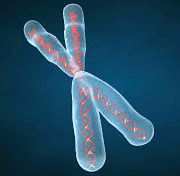
The yellow part of this picture is DNA. What do you think the turquoise part around it is?
1

chromosome

2

gene

3

DNA

4

ACTG

2

Multiple Choice

DNA is inside your cells. What part of the cell is the DNA inside of?
1
cell membrane
2
cytoplasm
3
nucleus

3

Multiple Choice

Question image
What is a gene?
1
A bundle (like a hot dog bun) that the DNA is packed into
2
something inside the nucleus
3
a piece of DNA
4
all of your DNA

4

Multiple Choice

Which sentence is FALSE?
1
All organisms have 23 pairs of DNA.
2
Chromosomes are made of genes.
3
DNA is made out of 4 chemicals: adenine, cytosine, thymine, guanine
4
DNA is the recipe for life.

5

Multiple Choice

Which sentence is FALSE?
1
Humans have 23 pairs of DNA.
2
Humans have 46 total chromosomes.
3
Genes are made of chromosomes.
4
Every human's DNA is at least 99% similar.

6

Multiple Choice

Question image
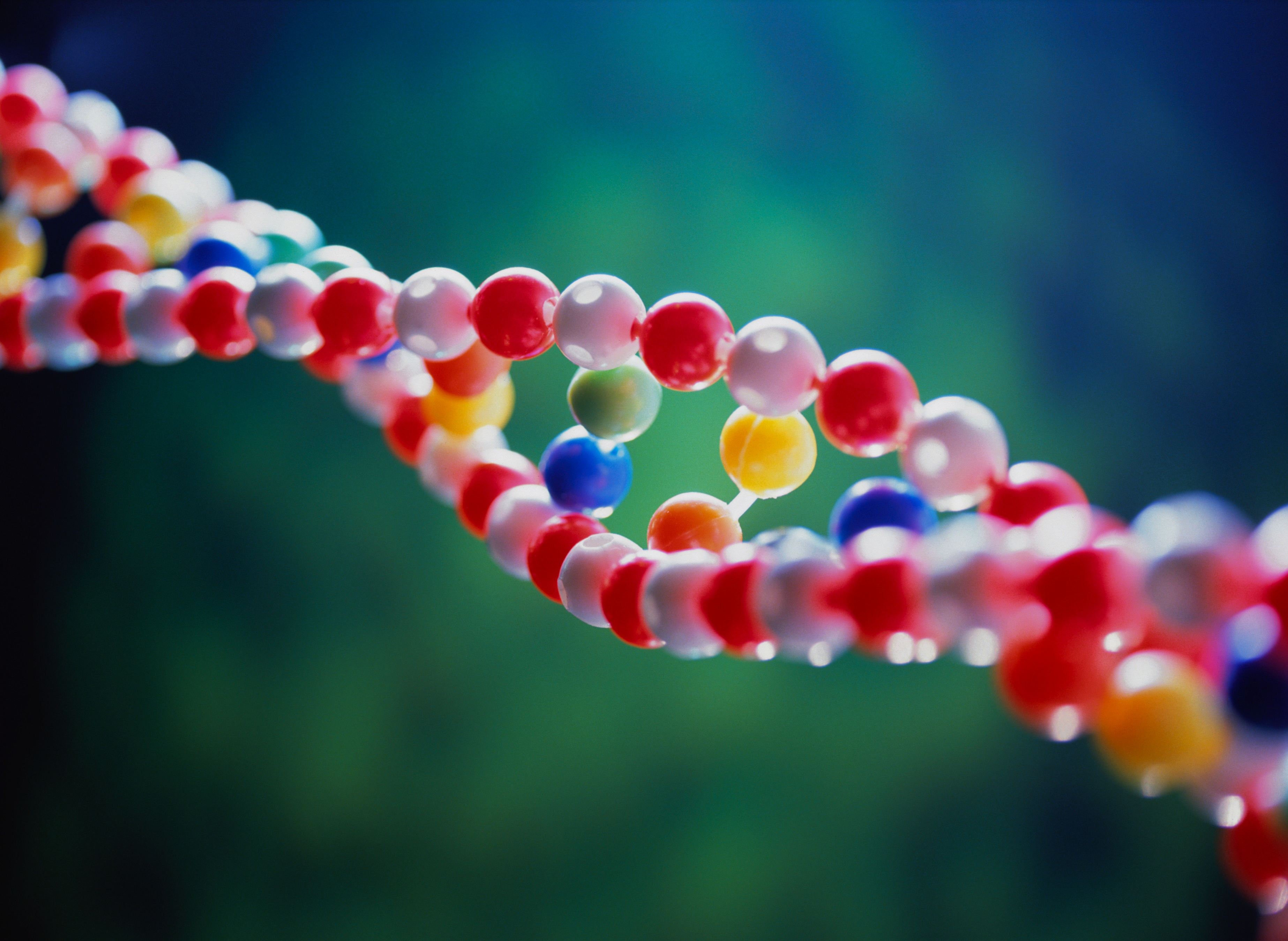
The twisted ladder shape of DNA is referred to as a ....
1
Twizzler candy
2
twisted ladder
3
double helix
4
yo mama

7

Multiple Choice

Little pieces of DNA that code for our traits are called

1

cells

2

chromosomes

3

genes

8

Multiple Choice

Question image
Genetic traits are passed from ________ to ________.
1
parent; offspring
2
chromosomes; traits
3
DNA; genes
4
offspring; parents

9

Multiple Choice

Question image

Why is DNA important?

1

It is very small and very complicated.

2

It is in everything.

3

It serves as the blueprint for traits of all living things.

4

We eat it every day for energy.

10

Multiple Choice

Question image

A chromosome is made of coiled up ___________.

1

cells

2

nuclei

3

DNA

11

Multiple Choice

Little pieces of DNA that code for our traits are called

1

cells

2

chromosomes

3

genes

12

Multiple Choice

Question image
1

chromosome

2

DNA

3

genes

4

heredity

13

Multiple Choice

Question image

Segments of DNA are called _______________________

1

Genes

2

Alleles

3

Traits

4

Chromosomes

14

Multiple Choice

Question image

The passing of traits from parents to offspring is known as....

1

hierarchy

2

heredity

3

traits

4

genetics

15

Multiple Choice

Question image
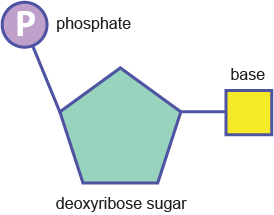
Nucleotides are made up of a sugar, phosphate, and..?
1
nitrogenous base
2
nucleic acid
3
cholesterol
4
fatty acid

16

Multiple Choice

Question image

The 2 exact copies of DNA in a chromosome are called ________.

1

chromatids

2

genes

3

mutations

4

pathogens

17

Multiple Choice

Question image

The number of human chromosomes is

1

23

2

46

3

92

4

64

18

Multiple Choice

What is the result of mitosis?
1
1 cell
2
2 genetically identical cells
3
2 genetically different cells
4
4 genetically identical cells

19

Multiple Choice

Question image
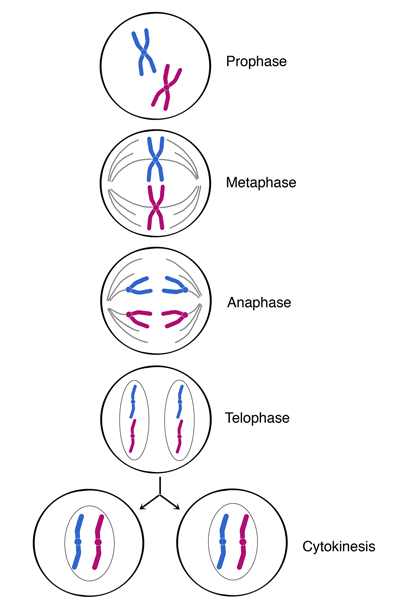
This picture shows which process? 
1
mitosis
2
meiosis
3
the cell cycle

20

Multiple Choice

Question image
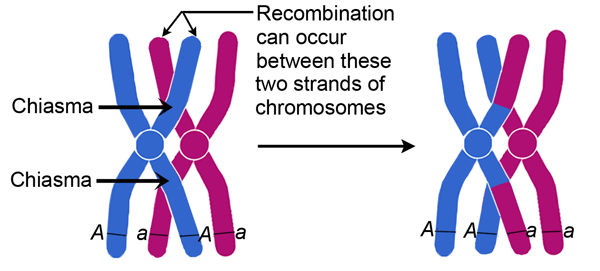
This image shows chromosomes during Prophase 1. Which of the following correctly describes the process shown?
1
segregation of sister chromatids
2
condensation and segregation of alleles
3
mutationin which the DNA content of the gene is altered
4
crossing - over in which alleles are exchanged

21

Multiple Select

Question image

Which statements are TRUE (more than one answer is correct!)

1

Different species have different chromosome numbers

2

The cells of larger organisms have more DNA than the cells of smaller organisms

3

Within a species, individuals will have the same chromosome number but have different genes

4

Offspring can inherit chromosomes from relatives other than the parent (s)

22

Multiple Choice

Different forms of genes

1

Allele

2

Genotype

3

Phenotype

4

Trait

23

media

24

Duplication

Part of the chromosome is "copied & pasted" back into itself.

media

25

Inversion

Part of the chromosome is flipped so that the genes are reversed in order.

media

26

Deletion

Part of the chromosome is removed and lost.

media

27

Translocation

Section of two non-homologous chromosomes are switched.


This is not like crossing over because the pieces are not equivalent!

media

28

Crossing Over

Crossing over is not considered to be a mutation.


During crossing over, homologous chromosomes exchange equivalent sections of their genes.


This process naturally occurs in Prophase I.

media

29

Multiple Choice

Question image

What type of mutation is this?

1

Duplication

2

Inversion

3

Deletion

4

Translocation

5

none

30

Multiple Choice

Question image

What type of mutation is this?

1

Duplication

2

Inversion

3

Deletion

4

Translocation

5

none

31

Match

Match the following

Allele

Homozygous

Recessive

Heterozygous

Homozygous

Dominant

Genotype

variation of a gene

hh

Hh

HH

allele combination

32

Multiple Choice

Question image

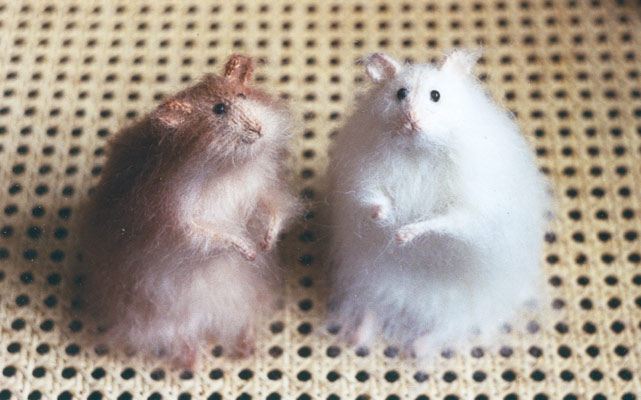
Long hair is a dominant trait. Choose the BEST statement.

1

This guinea pig received two dominant traits. (HH)

2

This guinea pig cannot have a recessive allele. (h)

3

This guinea pig could be homozygous dominant (HH) or heterozygous (Hh)

4

This guinea pig is homozygous recessive (hh)

33

Multiple Choice

Genome maps provide the DNA sequences of chromosomes. Some scientists have compared the genome maps of a hedgehog and a sloth. What do these genome maps allow the scientists to determine?

1

The color patterns of the offspring of each species

2

How much the size ranges of the two species differ

3

The methods of protein synthesis that each species uses

4

How closely related the two species are to each other

34

Multiple Choice

Question image

The opossum, which is native to North America, and the kangaroo, which is native to Australia, are marsupials.

The fact that both these mammals incubate their immature offspring in a pouch provides evidence that they —

1

belong to the same species

2

must range great distances to eat

3

have very similar skeletal structures

4

are descended from a common ancestor

35

Multiple Choice

Question image
Black fur is dominant (B) over white fur (b).  Find the probability of heterozygous offspring using the following genotype of these parents.
Bb + bb
1
0%
2
25%
3
50%
4
100%

36

Multiple Choice

In plants, tall (T) is dominant to short (t). Perform the following cross: Tt x Tt. What is the probability of producing a short plant?

1

0%

2

25%

3

50%

4

75%

37

Multiple Choice

You create a punnett square to determine the probability of hair color being passed to offspring. Brown hair is dominant. Blond hair is recessive. Both parents have brown hair. Both parents are heterozygous. What is the probability that the offspring will also have brown hair?

1

100%

2

75%

3

50%

4

25%

38

Multiple Choice

Question image

The different forms of a gene.

1

Genes

2

Allele

3

Phenotype

4

Pedigree

39

Multiple Choice

Question image

A number that describes how likely it is that an event will occur.

1

Probability

2

Punnett square

3

Pedigree

4

Genotype

40

Multiple Choice

Question image
What allele combination should go in the missing box?
1
AA
2
Aa
3
aa
4
none of these

41

Multiple Choice

Question image

What is the probability of having BB?

1

0%

2

25%

3

50%

4

75%

5

100%

42

Multiple Choice

Question image

What does a Punnett Square do?

1

tell you exactly what your offspring will look like

2

predict genotypes and phenotypes in offspring

3

It has no purpose

Question image
The yellow part of this picture is DNA. What do you think the turquoise part around it is?
1

chromosome

2

gene

3

DNA

4

ACTG

Show answer

Auto Play

Slide 1 / 42

MULTIPLE CHOICE