Search Header Logo
TCi lesson 6 (and 5)

TCi lesson 6 (and 5)

Assessment

Presentation

Science

6th - 8th Grade

Easy

NGSS
MS-LS4-2, MS-LS4-4, MS-LS3-1

+5

Standards-aligned

Created by

Ken Balcom

Used 4+ times

FREE Resource

10 Slides • 20 Questions

1

media
media
media

Lesson 6 Evolutionary Relationships (Lesson 5 section 5)

2

Multiple Choice

Change over time
1

Natural Selection

2

Selective Breeding

3

Homeostasis

4

Evolution

3

Multiple Choice

Where the better adapted organisms survive to pass traits along to offspring.
1

Evolution

2

Natural Selection

3

Extinction

4

Artifical Selection

4

media
media
media
media

5. Mutations and Natural Selection

Natural Selection acts on decides the value of a
mutation, there are 3 possibilities

-Beneficial - helps the organism and becomes
more common

-Example:

mutation to digest lactose

-Neutral - has no effect and randomly becomes
more or less common in a population

-Example: attached versus free earlobes

-Harmful - become less common over time

-Example: albinism - having no skin
pigment

5

Multiple Choice

Question image

An environment becomes colder. Some of the rabbits which live there have a mutation that causes their fur to be longer and thicker allowing them to stay warmer. This is an example of a

1

positive mutation

2

negative mutation

3

neutral mutation

6

Multiple Choice

Question image

A species of frog lives in the rainforest. One of the frogs is born with a mutation which causes it's skin to be completely white. This is an example of a

1

positive mutation

2

negative mutation

3

neutral mutation

7

Multiple Choice

Question image

Between 6,000 and 10,000 years ago a mutation led to blue eyes in humans. This is an example of a

1

positive mutation

2

negative mutation

3

neutral mutation

8

media
media
media

1. Species Are Related

Darwin's theory and the tree of life point to life
having a common

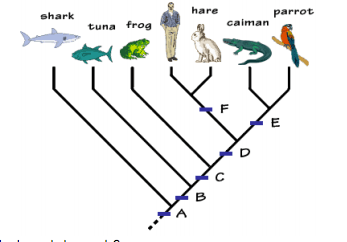
Sciences uses branching tree diagram to show
relationships, the more branches organism
share the more closely related they are…see
diagrams

DARWIN'S FIRST
VERSION FROM HIS
NOTES

9

Multiple Select

Question image

Which species are extinct? (Check all that apply)

1

Asian elephant

2

Mammoth

3

Mastadon

4

Stellar's sea cow

5

Dugong

10

Multiple Choice

Question image

On the cladogram, which organism is the closest relative of the parrot?

1

Frog

2

Hare

3

Caiman

4

Parrot

11

Multiple Choice

Question image

Are humans related to tuna?

1

yes

2

no

12

media
media
media
media

2. Evidence of Common Ancestry From Anatomy

Copy diagrams these 2 (don't need to copy skulls):

13

Multiple Choice

Question image

The similarities of bone structure in the diagram provide evidence of what?

1

The organisms probably use there forelimbs for the same thing.

2

The organisms evolved from a common ancestor.

3

The organisms have the same DNA.

4

All vertebrate species have identical forelimbs.

14

media
media
media
media
media

3. Evidence of Common Ancestry From Fossils

The fossil record show the relationships between past
and present organism through time by showing how they
change

organism that have traits of past and future organism are called transitional

The fossil is still being added too

15

Multiple Choice

Which of the following pieces of evolution evidence deals with aged and identified fossils?
1

fossil record

2

comparative embryology

3

comparative biochemistry

4

comparative anatomy

16

Multiple Select

What is a transitional fossil? Select 2.

1

a modern plant or animal species

2

a fossil that shows the steps of evolution

3

a fossil with characteristics of a modern and extinct species

4

a fossil that is an imprint of remains in rock

17

media
media
media
media

4. Evidence of Common Ancestry From Embryos

Embryos contain evidence of our evolutionary
relationships… all vertebrates have a specific pattern
of development from their ancestor that include the
development of gill slits, tails and limb buds…even
when they go away during development

This points to a common ancestry

18

Multiple Choice

Question image

What type of evidence is shown with the diagram above?

1

Molecular

2

Anatomical

3

Embryological

4

Fossil

19

Multiple Choice

Question image
The diagram illustrates an embryonic stage of two organisms.

Which of the following can be determined by observing the embryos shown in the diagram
1

The organisms share a common ancestry.

2

The organisms belong to the same genus.

3

The organisms are native to the same geographic areas.

4

The organisms will grow into anatomically similar adults.

20

media
media
media

5. Similar Traits Through Adaptation

Convergent Evolution - unrelated species end up with the
same, or very similar, traits because they are adapted to
similar environments or lifestyles

Organisms “converge” on certain traits because they lead
to success in similar environments…example large
aquatic predators…Sharks, Dolphins,
Ichthyosaurus…(eventually penguins)

21

Multiple Choice

When unrelated species evolve similar characteristics because they live in similar

environments

1

Divergent Evolution

2

Speciation

3

Convergent Evolution

4

Punctuated equilibrium

22

Multiple Choice

Whales, sharks, and penguins all have streamlined bodies and fins/flippers for moving in water even though they belong in different classes of animals (mammals, fish, and birds)

1

Convergent

2

Divergent

3

Coevolution

23

media
media
media

Add to notes Additional Concept

24

Multiple Choice

Question image

What

type

of structure?

1

Homologous

2

Analogous

3

Embryological

4

Vestigial

25

media
media
media
media

Add to notes Additional Concept

Snake leg bones

26

Multiple Choice

Question image

Vestigial structures

1

structures that perform a similar function but are not similar in origin

2

remnants of once-important structures that have slowly lost all or most of their function

3

features found in different organisms that share structural similarities but may have very different functions

4

preserved remains of an organism

27

media
media

Review of Selection Types

28

Multiple Choice

When comparing the DNA of two different organisms, the more differences in the DNA base pairs the more-

1

Closely related they are.

2

Distantly related they are.

3

It doesn't prove anything.

4

They look alike.

29

Match

Match the following

Analogous Structure

Homologous Structure

Embryology

Molecular (DNA) Evidence

Vestigial Structures

Same function different structure

Same structure different function

Comparing embryological development of different species

Comparing DNA and amino acid sequences of different species

Structures in the body of an organism that no longer work.

30

Match

Match the following

Diversity

Natural Selection

Adaptation

Species

Development

media
media
media

Lesson 6 Evolutionary Relationships (Lesson 5 section 5)

Show answer

Auto Play

Slide 1 / 30

SLIDE