Math 8 Review
Presentation
•
Mathematics
•
8th Grade
•
Medium
+22
Standards-aligned

Heather Kinkade
Used 13+ times
FREE Resource
70 Slides • 52 Questions
1
Math 8 Review
2
How to use this Quizziz Lesson
Each Unit will have a slide or slides that reviews key ideas.
Use the slide, your notebook, and others to help you complete the questions.
Then there will be questions about this unit on the paper.
After you finish all questions, THEN enter your answers on quizizz.
YOU MUST SHOW WORK OR IT WILL NOT BE ACCEPTED.
3
Unit 1: Congruency
The BIG IDEA: Sliding, flipping, or turning a shape doesn’t change the side
lengths or angles sizes of the shape. This is called CONGRUENCE.
Unit 1 introduced Translations, Reflections, and Rotations.
Click through the next few slides to see what each one looks like.
4
Translations make congruent figures
Triangle ABC
Moved
7 units right
Triangle A’B’C’
“A Prime, B Prime, C
Prime”
Pre-Image
Translation
After
Before
Image
5
Reflections make congruent figures
Triangle ABC
Flipped Across the
y-axis
Triangle A’B’C’
“A Prime, B Prime, C
Prime”
Pre-Image
Reflection
After
Before
Image
6
WHat is a rotation?
7
RotationS make congruent figures
Triangle ABC
90 degree rotation
Counter- Clockwise
Triangle A’B’C’
“A Prime, B Prime, C
Prime”
Pre-Image
Rotation
After
Before
Image
8
We also learned that 8 angles were formed using two
parallel lines and a transversal.
9
Some of the Angles were CONGRUENT.
Corresponding Angles (Different Lines, Same
Position) are CONGRUENT using a translation
Watch each animation and notice which angles
are the same.
10
Angle Pairs Created By Parallel Lines and Transversals
Alternate Interior Angles are CONGRUENT using a ROTATION.
Watch the animation to see which angles are the same
11
Congruent means same measure. So if on yellow angle is 120 degrees, all of them are 120 degrees.
12
Some of the angles were supplementary (add up to 180)
13
STOP
Complete the questions on your paper.
You can go back and look at the slides for help but once you go past this slide you
won’t be able to go back.
14
Multiple Choice
Are the figures congruent? Explain.
Congruent by rotation.
Congruent by dilation.
Not congruent, sizes are different.
Congruent by reflection.
15
Multiple Choice
What it the measurement for angle 12?
140o
180o
40o
160o
16
Multiple Choice
What it the measurement for angle 1?
140o
180o
40o
160o
17
Multiple Choice
What is the measure of ∠2?
58o
Vertical angles
122o supplementary
58o
Alternate Interior
122o
Alternate exterior
18
Multiple Choice
Rectangle ABCD is rotated by 90 degrees counterclockwise about the origin and then translated 3 units left and 2 units down to form rectangle A′B′C′D′ . What is length of segment A′B′ in the resulting figure?
10
3
5
6
19
Multiple Choice
True of False? Triangle ABC is reflected across the x-axis, followed by a reflection across the y-axis.
True
False
20
Multiple Choice
True or False? Triangle ABC is reflected across the y-axis, followed by a translation 6 units down.
True
False
21
Multiple Choice
How does m∠1 compare to m∠6 ?
Greater Than / Less Than / Equal
m∠1<m∠6
m∠1>m∠6
m∠1=m∠6
22
Unit 2: Similarity and Slope
The BIG IDEA: For Unit 2 is that multiplying a side by a scale factor changes the
sides lengths by NOT the angles. This creates SIMILAR FIGURES. Similar
triangles are what we can use to determine the SLOPE (steepness) of a line.
Unit 2 introduced Dilations, Similar Figures, and Slope.
Click through the next few slides to see what each one looks like.
23
Vocabulary
Shape A
Dilation of a scale
factor of 3
Shape A’
Pre-Image
Dilation
After
Before
Image
24
Center of Dilation
25
Scale Factor
SF greater than 1
SF = 1
Original shape
SF LESS THAN 1
The ratio of the new shape’s size to the old shape’s size.
Represented by the letter k.
26
Scale Factor
SF greater than 1
SF = 1
Original shape
SF LESS THAN 1
The ratio of the new shape’s size to the old shape’s size.
Represented by the letter k.
ENlargement
Reduction
K = ( 4 / 2) = 2
K = ( 2 / 2) = 1
No change
K = (1 / 2) = 0.5 or ½
27
Dilations Create SIMILAR figures.
Similar figures have the same angles..
Triangle NLM and RPQ are SIMILAR (NLM~RPQ)
28
Similar Figures have sides that are proportional
(form equal ratios)
29
You can create similar figures by multiplying by a scale
factor.
Scale Factor is 1.5 (A to B)
or
Scale Factor is ⅔ (B to A)
30
31
32
Here are different slopes. Watch the gif!
33
34
STOP
Complete the questions on your paper.
You can go back and look at the slides for help but once you go past this slide you
won’t be able to go back.
35
Multiple Choice
Find the slope.
2100
250
150
125
36
Multiple Choice
Write the correct interpretation of the slope: Tim is travelling ______ mile() in _____ hour(s).
Tim travels 50 miles in 1 hour.
Tim travels 1 mile in 50 hours.
37
Multiple Choice
It's a reduction; the scale factor is 2.
It's an enlargement; the scale factor is 2.
It's an enlargement; the scale factor is 1/2.
It's a reduction; the scale factor is 1/2.
38
Multiple Choice
Polygon ABCDE will be dilated by a scale factor of 2. Will the images be congruent or similar?
Congruent
Similar
39
Multiple Choice
If two figures are similar, the corresponding angles are...
Congruent
Supplementary
Proportional
Different
40
Multiple Choice
The two triangles are similar. Solve for X.
2 ft
3 ft
4 ft
6 ft
41
Unit 3: Proportional & Linear Relationships
The BIG IDEA: Slope creates a relationship between x and y. If x gets ONLY
multiplied by the slope to become y then it is a proportional relationship. If it
gets multiplied by the slope and then something is added or subtracted, then it is a
LINEAR RELATIONSHIP.
Unit 2 introduced Tables, Graphs, Equations and Slope-Intercept Form,
Click through the next few slides to see what each one looks like.
42
43
44
45
46
47
48
49
STOP
Complete the UNIT 3 questions on your paper.
You can go back and look at the slides for help but once you go past this slide you
won’t be able to go back.
50
Multiple Choice
Find the missing values.
20 ; 4
15 ; 5
4 ; 20
20
51
Multiple Choice
21
y=2x
y=21x
y=105x
52
Multiple Choice
y = $4.99x +$6.50
y = $6.50x - $4.99
y = $6.50x + 4.99
y = $4.99x - $6.50
53
Multiple Choice
y=3/2x+3
y=2/3-3
y=2/3x-3
y=2/3x+3
54
Multiple Choice
A. The cost per child is $2.50 more at Mr. Bob's than Pizza Safari.
B. The cost per child is $5 more at Mr. Bob's than Pizza Safari.
C. The cost per child is $10 more at Mr. Bob's than Pizza Safari.
D. The cost per child is $15 more at Mr. Bob's than Pizza Safari.
55
Multiple Choice
1, 3, 5
4, 5
2, 4, 5, 6
1, 3
56
Unit 4: Linear Equations & Systems of Equations
The BIG IDEA: Linear equations help us model real world situations where we
have an unknown value. This is called SOLVING EQUATIONS. When there is
more than one unknown we need two equations for the situation, this is called a
SYSTEM OF EQUATIONS.
Unit 4 introduced solving equations with variables on both sides, solution types,
systems of equations, solving by graphing and solving by substitution.
Click through the next few slides to see what each one looks like.
57
Solving Equations with Variables on Both Sides
Subtract 3x from both
sides so that all the x
values are on the left.
58
59
60
61
62
63
When you have two
Y = equations
64
When you only have one
y= or x= equation:
65
Setting up a system of equations
66
67
STOP
Complete the UNIT 4 questions on your paper.
You can go back and look at the slides for help but once you go past this slide you
won’t be able to go back.
68
Multiple Choice
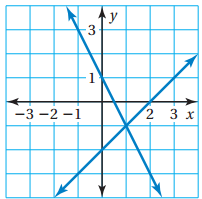
Is this one solution (4,7), no solution, infinite solutions?
The solution is x=0.
The solution is the ordered pair (4,7).
There is no solution since 4=7 is a false statement.
There are infinitely many solutions since 4=7 is a false statement.
69
Multiple Choice
Solve for x: 3(x-4) = -3
3
-3
5
-5
70
Multiple Choice
Solve for t : 2(2t - 3) = 6(t + 2)
t = 9
t = 4
t = -9
t = -3
71
Multiple Choice
Solve for c: 2c - 12 = 9c + 2
14
2
-2
72
Multiple Choice
Solve for x: -38 + 6x = 52 + 3x
20
30
40
10
73
Multiple Choice
y = 2x + 1
y = 4x - 1
(1,3)
(-1,-3)
(-1,3)
(3,1)
74
Multiple Choice
How many solutions?
One Solution
No solution
Infinitely Many Solutions
75
Multiple Choice
1
-2
(1, 2)
(1, -1)
76
Multiple Choice
6
9
17
18
77
Multiple Choice
Find the total number of adult tickets and the total number of child tickets she buys.
10 adult ; 4 child
4 adult ; 5 child
6 adult ; 8 child
8 adult ; 6 child
78
Unit 5: Functions & Volume
The BIG IDEA: A rule that takes an input (x) and creates a single output (y) is
called a FUNCTION. Functions can be represented as tables, graphs, equations,
and stories. Functions can also be used in geometry called FORMULAS.
Unit 5 introduced functions and the volume formula for cylinders, cones, and
spheres.
Click through the next few slides to see what each one looks like.
79
80
81
82
STOP
Complete the UNIT 5 questions on your paper.
You can go back and look at the slides for help but once you go past this slide you
won’t be able to go back.
83
Multiple Choice
Parker's distance from home is increasing between minute 1 and minute 4. True or False?
True
False
84
Multiple Choice
Parker's distance from home is increasing between minute 12 and minute 14. True or False?
True
False
85
Multiple Choice
Parker's distance from home is constant between minute 6 and minute 7. True or False?
True
False
86
Multiple Choice
9
28.27
141.37
706.86
87
Multiple Choice
Has inputs and outputs
Every input has only ONE output
Inputs have different outputs every time
x-values and y-values
88
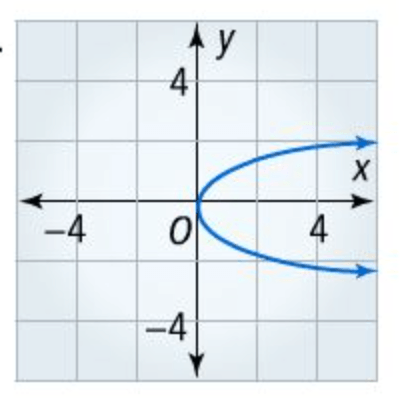
Multiple Choice
Function or not a function?
Function
Not a Function
89
Multiple Choice
Yes, there is a repeated x-value.
No, there aren't any repeated y-values.
Yes, there are repeated y-values.
No, there is a repeated x-value.
90
Multiple Choice
Find the volume in terms of pi.
10π cu. inches
25π cu. inches
50π cu. inches
7π cu. inches
91
Multiple Choice
What is the volume of the sphere, expressed in terms of pi?
V=34πr3
81π in3
729π in3
972π in3
36π in3
92
Multiple Choice
What is the volume of the cone expressed in terms of pi?
V=31πr2h
144π in3
24π in3
48π in3
36π in3
93
Unit 7: Exponents
The BIG IDEA: An Exponent is an expression for repeated multiplication.
Exponents help us write very large or small numbers using Scientific Notation.
Unit 7 introduced exponents, expanded form, exponent rules, scientific notation
and standard notation.
Click through the next few slides to see what each one looks like.
94
95
96
97
98
99
100
101
102
STOP
Complete the UNIT 7 questions on your paper.
You can go back and look at the slides for help but once you go past this slide you
won’t be able to go back.
103
Multiple Choice
8
14
33
3.667
104
Multiple Choice
Martha made a mistake. In what step did Martha make a mistake and what is the correct expression for that step?
105
Multiple Choice
True or false.
True
False
106
Multiple Choice
True or false.
True
False
107
Fill in the Blanks
Type answer...
108
Multiple Choice
How would you write 0.0005 in scientific notation?
50 x 10-5
5 x 10⁻⁴
5 x 10³
.5 x 103
109
Unit 8: Square Roots & Pythagorean Theorem
The BIG IDEA: An Square root helps ups find the side of a square with a specific area. It is the
opposite of squaring a number. These can be perfect squares numbers that give us RATIONAL
NUMBER answers or non-perfect square numbers that give us IRRATIONAL NUMBERS. The
PYTHAGOREAN THEOREM uses square roots to find the sides of a right triangle.
Unit 8 introduced square roots, perfect squares, non perfect squares, perfect cubes square roots,
cube roots, rational numbers, irrational numbers, and Pythagorean Theorem.
Click through the next few slides to see what each one looks like.
110
111
112
113
114
115
116
STOP
Complete the UNIT 8 questions on your paper.
You can go back and look at the slides for help but once you go past this slide you
won’t be able to go back.
117
Multiple Choice
True or False
True
False
Yes
Maybe
118
Multiple Choice
True or False
True
False
Yes
Possibly
119
Multiple Choice
Rational or Irrational
Rational
Irrational
120
Multiple Choice
46
50
52
53
121
Multiple Choice
Find the length of the missing side.
17 cm
22 cm
15 cm
13 cm
122
Multiple Choice
9ft
11ft
6ft
14ft
Math 8 Review
Show answer
Auto Play
Slide 1 / 122
SLIDE

Similar Resources on Wayground
115 questions
AP T1 G7
Presentation
•
7th Grade
115 questions
7E - Tamkeen Science - Term 1
Presentation
•
7th Grade
121 questions
PhySci Final Review 3: Thermal and Electrical
Presentation
•
9th Grade
121 questions
F4 Mathematics Statistics Lesson
Presentation
•
9th - 10th Grade
117 questions
F5 Life's Great Mysteries L9
Presentation
•
9th - 10th Grade
116 questions
CATEGORY 3 CIVICS EOC REVIEW
Presentation
•
7th - 8th Grade
119 questions
The Causes of the Civil War
Presentation
•
8th Grade
115 questions
Order of Operations Expressions and Equations
Presentation
•
6th - 8th Grade
Popular Resources on Wayground
20 questions
STAAR Review Quiz #3
Quiz
•
8th Grade
20 questions
Equivalent Fractions
Quiz
•
3rd Grade
6 questions
Marshmallow Farm Quiz
Quiz
•
2nd - 5th Grade
20 questions
Main Idea and Details
Quiz
•
5th Grade
20 questions
Context Clues
Quiz
•
6th Grade
20 questions
Inferences
Quiz
•
4th Grade
19 questions
Classifying Quadrilaterals
Quiz
•
3rd Grade
12 questions
What makes Nebraska's government unique?
Quiz
•
4th - 5th Grade
Discover more resources for Mathematics
15 questions
Pythagorean Theorem Word Problems Quizizz
Quiz
•
8th Grade
20 questions
Graphing Inequalities on a Number Line
Quiz
•
6th - 9th Grade
20 questions
Scatter Plots and Line of Best Fit
Quiz
•
8th Grade
10 questions
Pythagorean Theorem and its Converse
Quiz
•
7th - 9th Grade
20 questions
Pythagorean Theorem Review
Quiz
•
8th Grade
11 questions
8.12D Simple & Compound Interest
Quiz
•
8th Grade
72 questions
8th Grade SS Q3 Study Guide
Quiz
•
8th Grade
20 questions
Function or Not a Function
Quiz
•
8th - 9th Grade