Search Header Logo
Land and Sea Breeze, Air Masses, Weather Fronts, and Monsoons

Land and Sea Breeze, Air Masses, Weather Fronts, and Monsoons

Assessment

Presentation

Science

6th - 8th Grade

Medium

NGSS
MS-ESS2-5, MS-ESS2-4, MS-ESS2-6

Standards-aligned

Created by

Doctor Doctor

Used 3+ times

FREE Resource

22 Slides • 52 Questions

1

4Q Day 3 Asynchronous Lesson

media

Let us review what we learned in our onsite class today. Please take notes and ask questions!

2

Objectives for the day:

In this lesson, you will...

1. Explain what air masses and weather fronts are.

  1. Explain why sea breeze occurs during the day and land breeze at night.

  2. Identify the factors affecting the weather and the weather instruments used.

3

4

Multiple Choice

The strength of a sea breeze depends on
1

the heat of the day

2

the difference between the temperature of the sea and the land

3

the wind speed

4

the amount of precipitation that day

5

Multiple Choice

How does the air move in a land breeze?
1

From east to west

2

From west to east

3

From the land to the ocean

4

From the ocean to the land

6

Multiple Choice

When warm air rises, ______ pressure forms at the surface of the land or sea.
1

high

2

some

3

low

4

none

7

Multiple Choice

How does the air move in a sea breeze?
1

wind moves from north to south

2

wind moves from ocean to the land

3

wind moves from the land to the ocean

4

wind moves from south to north

8

Multiple Choice

In a sea breeze, the air is warmer above the _____.
1

land

2

ocean

3

sky

4

beach

9

Multiple Choice

Why do land breezes occur at night?
1

Land cools off slower than water, so the air above water is cooler.

2

Water cools off faster than land, so the air above land is warmer.

3

Land heats up slower than water, so the air stays cooler during the day.

4

Water cools off slower than land, so the air above water is warmer.

10

media

Kindly rest your eyes for 3 to 5 minutes.

11

12

monsoons

media

13

Monsoons are winds that change direction​ as seasonal changes. Wind blows in one direction for about six months, then blows the other way for the next six months.

Monsoons are caused by the difference between the annual temperature trends over land and sea.​

Monsoons

14

Monsoons

​Southwest Monsoon, brings hotter and more humid weather. This also occasionally intensify the typhoons as it brings more moisture leading to more rain. It is driven by the prevailing wind that is coming from west or southwest.

​Habagat

media

15

16

Monsoons

media

​Northeast Monsoon, brings cooler and drier air from the North East during the period when it is winter in the Northern Hemisphere. It is characterized by widespread cloudiness with rains and rain showers.

​Amihan

17

18

Multiple Choice

Question image
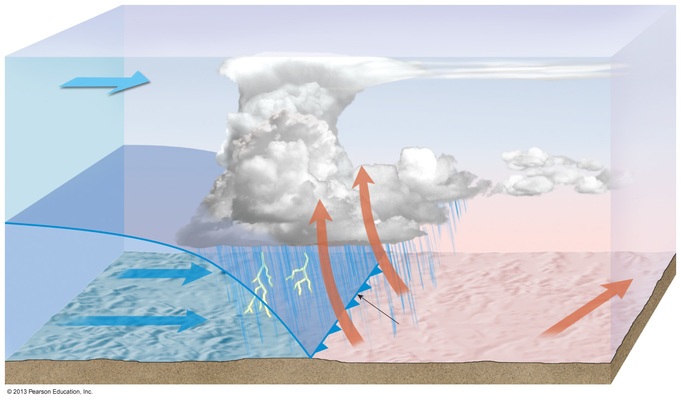
What type of storm front is this? 
1

warm front

2

cold front

3

stationary front

4

occluded front

19

Multiple Choice

Question image
What does symbol # 3 mean?
1

stationary front

2

occluded front

3

warm front

4

cold front

20

Multiple Choice

A front is
1

where warm air is cooling at earth's surface

2

a line where hot and cold air are separating

3

a line where two different air masses meet

4

where cold air is rising and forming rain clouds

21

Multiple Choice

Which most likely produces clear, cool weather?
1

zero air pressure

2

stable air pressure

3

a low pressure system

4

a high pressure system

22

Multiple Choice

_____________ air is more dense and tends to sink
1

cold

2

warm

3

moist

4

dry

23

Multiple Choice

Question image
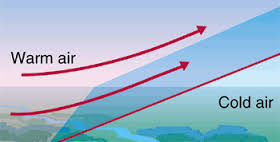
Which type of front is pictured?
1

Cold front

2

Warm front

3

Occluded front

4

Stationary front

24

Multiple Choice

Question image
What symbol is this?
1

warm front

2

cold front

3

stationary front

4

occluded front

25

Multiple Choice

Question image
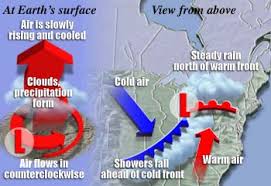
Which system results in rainy or stormy weather?
1

high pressure

2

low pressure

3

hurricane

4

weather system

26

Multiple Choice

Which front is there little movement?

1

warm front

2

cold front

3

occluded front

4

stationary front

27

Multiple Choice

Question image

Which front is in this picture?

1

Warm front

2

Cold front

3

stationary front

4

occluded front

28

Multiple Choice

Question image

What is the name this front?

1

warm front

2

cold front

3

stationary front

4

occluded front

29

Multiple Choice

An air mass has similar

1

temperature and moisture

2

cold and wind

3

rain and temperature

4

warm and dry

30

Multiple Choice

When air masses meet, what is formed?

1

A snow storm.

2

A rain storm

3

A front.

4

A back.

31

media
media

Eat like a panda!

Chill and relax

Be healthy and swift like these gazelles.

Move

For 10 to 15 minutes...

32

33

Air masses

Types of air masses

media

34

Air Masses

A volume of air defined by its temperature and water vapor content.

media

35

What are Air Masses:


  • Large Bodies of air

  • Form when the air over a LARGE REGIONS sits in one place for many days

  • The air gradually takes on the CHARACTERISTICS of the land or water below it

36

How do Air Masses Affect Our Weather?

  • They move with the GLOBAL WINDS patterns

  • As an air mass moves, it brings its CHARACTERISTICS with it 

  • CHANGES weather

37

Multiple Choice

What are air masses?

1

A volume of air defined by its temperature and water vapor content.

2

A volume of air defined by its temperature and pressure.

3

A volume of air defined by its temperature and density.

4

A volume of air defined by its density and air pressure.

38

Air Masses:

  • Air masses are formed by the HEATING and COOLING of land and water. 

  • Air masses are large bodies of air that have the same TEMPERATURE and MOISTURE level throughout.

  • There are FOUR (4) types of air masses:

    - CONTINENTAL POLAR (cP)

    - CONTINENTAL TROPICAL (cT)

    - MARITIME POLAR (mP)

    - MARITIME TROPICAL (mT)

  • The INTERACTION between air masses can impact WEATHER, CONVECTION CURRENTS and WIND.


39

Multiple Choice

Air masses are formed by the ________ and ________ of land and water.

1

Heating and cooling

2

Increasing volume and temperature

3

cooling and increasing pressure

4

Heating and increasing the density

40

Multiple Choice

The INTERACTION between air masses can impact,

1

WEATHER,

2

CONVECTION CURRENTS

3

WINDS.

4

All of the above

41

How do we describe moisture?

  • The FIRST word of an air mass tells us WHERE the mass was formed (over WATER or LAND)

  • Continental

    - Air masses formed over LAND

    - Moisture=DRY

  • Maritime

    - Air masses formed over WATER

    - Moisture=WET

42

Multiple Choice

Continental Air mass is formed over

1

land

2

water

43

Multiple Choice

Maritime Air mass is formed over

1

land

2

water

44

How do we describe temperature?

  • The SECOND word of an air mass tells us if the air mass was formed close to the EQUATOR or POLE

  • Tropical

    -Air masses formed near the EQUATOR

    -Temperature=WARM AIR

  • Polar

    -Air masses formed closer to the POLES

    -Temperature=COLD AIR

45

Multiple Choice

Which statement best describes the general movement of air masses?

1

They move from areas of high altitude to areas of low altitude.

2

B.They move from areas of high pressure to areas of low pressure.

3

They move from areas of high humidity to areas of low humidity

4

They move from areas of low temperature to areas of high temperature.

46

Multiple Choice

Which result most likely occurs when cold and warm air masses collide?

1

A.The cold air mass pushes under the warm air mass.

2

The warm air mass pushes under the cold air mass.

3

The cold air mass and the warm air mass remain stationary.

4

The cold air mass and the warm air mass mix to create a new air system.

47

Multiple Choice

Which statement best describes the movement of winds?

1

Winds blow from low-pressure to high-pressure regions.

2

Winds blow from high-pressure to low-pressure regions.

3

Winds blow from north to south.

4

Winds blow from east to west.

48

Multiple Choice

Continental-Tropical Air Mass

1

Dry, warm air

2

Dry, cold air

3

Wet, warm air

4

Wet, cold air

49

Multiple Choice

Maritime-Polar air mass

1

Dry, warm air

2

Dry, cold air

3

Wet, warm air

4

Wet, cold air

50

Multiple Choice

Continental-Polar Air mass

1

Dry, warm air

2

Wet, warm air

3

Dry, cold air

4

Wet, cold air

51

Multiple Choice

Maritime-Tropical Air Mass

1

Dry. warm air

2

Wet, warm air

3

Dry, cold air

4

Wet, cold air

52

53

Multiple Choice

You observe a falling barometer reading. What does it tell about the weather?

1

low pressure

2

high pressure

3

fine weather

4

stormy weather

54

Multiple Choice

Which describes an air mass?

1

height above sea level

2

distance from the equator

3

surface feature of a region

4

large body of uniform temperature and humidity

55

Multiple Choice

Any form of water that falls from clouds is called________.

1

dew

2

evaporation

3

condensation

4

precipitation

56

Multiple Choice

Scientists who study weather and try to predict it are called ________

1

astronomers

2

climatologists

3

meteorologists

4

weatherologists

57

Multiple Choice

Warm air rises causing less pressure on Earth

1

High Pressure

2

Low Pressure

3

Wind

4

Jet Stream

58

Multiple Choice

Question image
What does this device show?
1

a change in temperature

2

a change in humidity

3

wind speed

4

the amount of rainfall

59

Multiple Choice

Question image
From which direction is the wind blowing in this picture?
1

north

2

east

3

south

4

west

60

Multiple Choice

Question image

From which direction is the wind COMING FROM in this picture?

1

north

2

east

3

south

4

west

61

Multiple Choice

What type of instrument measures the humidity in the air?
1

hygrometer

2

barometer

3

anemometer

4

rain gauge

62

Multiple Choice

Question image
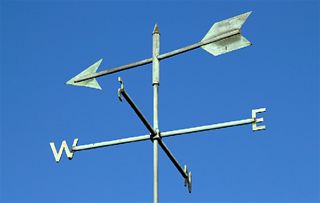
This weather instrument is a...
1

anemometer

2

barometer

3

wind vane

4

thermometer

63

Multiple Choice

Question image
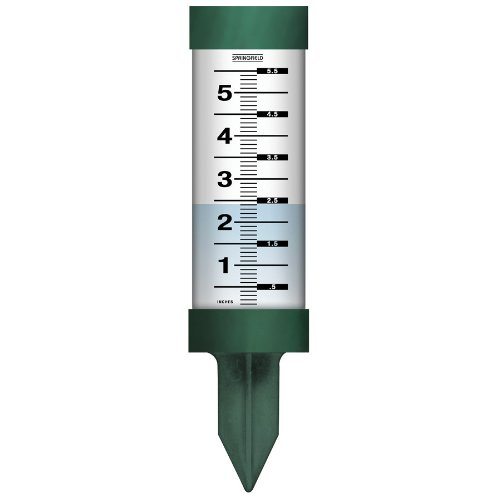
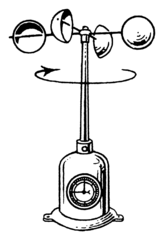
This weather instrument is a...
1

rain gauge

2

U.F.O.

3

satellite

4

anemometer

64

Multiple Choice

Question image
This weather instrument is a...
1

anemometer

2

Christmas ornament

3

wind vane

4

barometer

65

Multiple Choice

Question image
This weather instrument is an...
1

wind vane

2

anemometer

3

barometer

4

thermometer

66

Multiple Choice

What does the wind vane point towards.
1

Where the wind is coming from

2

Where the wind is blowing to

3

the sun

4

the moon 

67

Multiple Choice

The weather forecast tomorrow says there will be a 15 mph northeast wind and a high temperature of 52 degrees. What three instruments will a meteorologist use to make this prediction?
1

anemometer, wind vane, thermometer

2

barometer, hygrometer, wind vane

3

thermometer, satellite image, hygrometer

4

wind vane, satellite image, barometer

68

Multiple Choice

A rain gauge measures what?
1

Air pressure

2

Wind speed wind speed

3

Amount of rain fall

4

Wind direction

69

Multiple Choice

What instrument measures the humidity?
1

anemometer

2

rain gauge 

3

barometer

4

hygrometer 

70

Multiple Choice

What instrument measures temperature?
1

rain gauge 

2

hydrometer

3

thermometer 

4

wind vane

71

Multiple Choice

What instrument measures air pressure?
1

barometer

2

hydrometer 

3

rain gauge

4

anemometer 

72

Multiple Choice

What instrument measures wind speed?
1

thermometer 

2

wind vane

3

barometer

4

anemometer 

73

Multiple Choice

Which instrument measures the temperature of the air?
1

Thermometer

2

Rain Gauge

3

Anemometer

4

Hygrometer

74

Take time to pray and relax.

Well done!

media

4Q Day 3 Asynchronous Lesson

media

Let us review what we learned in our onsite class today. Please take notes and ask questions!

Show answer

Auto Play

Slide 1 / 74

SLIDE