

MS Music Unit 3 Continued

Presentation
•
Arts
•
6th - 8th Grade
•
Practice Problem
•
Easy

Laura Johnson
Used 1+ times
FREE Resource
13 Slides • 6 Questions
1
Unit 3 - MS Music

Mrs. Johnson
Lesson Review
2

In Unit 3 -
Activity
Discussion Question #1
Quiz
What should you have done?
3
Start with your ears
In our busy world, how do we learn to really focus on the music all around us? Should we listen for the beat, the melody, or the harmony? What is most important? Well, the answer of course is—all of them! In this unit, we will learn how to sharpen our listening skills in order to hear the details of music. Doing so will help us to begin thinking about music in a new way.
4
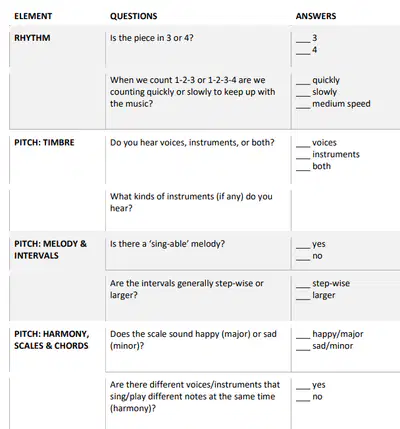
Listening checklist
The first items on our musical checklist will be – you guessed it – our musical elements: rhythm, pitch, melody, harmony, scales, intervals and chords! To this list of musical elements, we will add just a few more things, called expressive elements, for our completed listening checklist: dynamics, articulation, tempo, and form. For each item on our list, we will learn to answer some specific questions.This can be printed off or saved - shown in Lesson 2, Unit 3. Did you look at this?
5
6
What we hear
Timbre - characteristic sound of a particular voice or instrument
Melody & Harmony - melody - Most songs have a tune that keeps coming back again and again. The intervals that we hear in a melody can be large or small. The harmony is the accompanying part that can either be higher or lower.

7
Multiple Choice
Melody is....
the tune that keeps coming back again and again
the part that accompanies the main tune
8
Form: A formula for Music
We know how important it is for us to be able to change our dynamics, articulation, and tempo to make the music more interesting. The pattern of musical changes in a piece is called the form. We will listen for changes in all of our checklist elements to determine if we are in a new section of the form. But don’t worry, there are several “formulas” for form that we can look out for while we are listening. Most music will fall into one of these form “formulas”:
AB, or binary – music with two different sections
ABA, or ternary – music with three sections
ABACADA, or rondo – music with a recurring section
Sonata-allegro (classical form) – formal structure of a sonata or concerto
9
Multiple Choice
Timbre means:
characteristic sound of a particular voice or instrument
cutting wood in the forest
how fast or slow the music is
What we write notes on
10
Tempo
The speed of the music
Allegro - very fast
Adagio - very slow
Moderato - medium in speed
Accelerando - speed up
Ritardando - slow down
Why Italian words?
Italian composers were the first to adopt music notation and the first to add expression to their scores. Was accepted in Italy and later adapted throughout the rest of Europe.
11
Multiple Choice
Allegro in music terms means:
Very slow
Very fast
moderate
super fast
12
Multiple Choice
Adagio in music terms means
skipping
very slow
super fast
13
Multiple Choice
Crescendo means to increase in volume - true or false
True
False
14
Discussion question
Why is Italian the language of musical terminology?
15
Lesson 5 - Transcribing what we hear.
aural skills, or skills that help us listen to music and analyze what we hear
Let's look at the lesson......
16
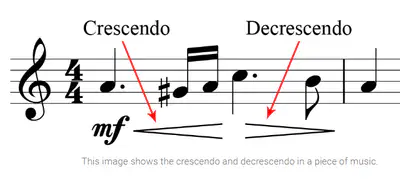
Dynamics
Dynamics - has to do with volume - Intensity! Dynamics just means the volume of the music, and if it
changes or not.
Forte -loud - indicated with a f
Piano-soft - indicated with a p
Crescendo/Decrescendo -get louder/get softer
17
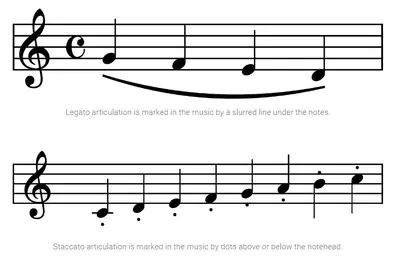
Legato - smooth, connected
Staccato - short, crisp
Articulation
18
Multiple Choice
What language are most music terms in?
Spanish
Italian
French
English
19
Unit 3 Activity
Listen to the song, and identify the times that the section changes. You will notice that a section changes when the “sound” changes from loud to soft, heavy to light, major to minor, or just has a different feeling. Indicate where the sections change by writing down the time stamp; for example: 1:30 means one minute and thirty seconds into the song. Notate at least three different sections. Once you have written down all of the section changes you hear, make a guess at the form of the piece. You may choose between AB, ABA, or rondo. There are several answers that are correct, so use your ears to the best of your ability and make your best guess
Unit 3 - MS Music
Mrs. Johnson
Lesson Review
Show answer
Auto Play
Slide 1 / 19
SLIDE
Similar Resources on Wayground

15 questions
Natural Selection
Presentation
•
6th - 8th Grade
11 questions
The Renaissance
Presentation
•
6th - 8th Grade
16 questions
Basic Acting Tips
Presentation
•
7th - 8th Grade
18 questions
Elements of Art Review
Presentation
•
6th - 8th Grade
14 questions
SEL Self Management
Presentation
•
6th - 8th Grade
13 questions
Vocabulary Builders
Presentation
•
6th - 8th Grade
15 questions
Context Clues
Presentation
•
6th - 8th Grade
13 questions
SEL
Presentation
•
6th - 8th Grade
Popular Resources on Wayground
11 questions
Hallway & Bathroom Expectations

Quiz
•
6th - 8th Grade
10 questions
HCS SCI 03 Summer School Assessment 2
Quiz
•
3rd Grade
11 questions
Home Scope
Quiz
•
7th - 8th Grade
12 questions
2026 TAP Technology in the Classroom
Presentation
•
Professional Development
15 questions
HCS SCI 05 Summer School Assessment 2 Review
Quiz
•
5th Grade
15 questions
HCS SCI 04 Summer School Review 2
Quiz
•
4th Grade
59 questions
Geometry Unit 3 Review
Quiz
•
9th - 12th Grade
14 questions
FAST ELA READING SMAPLE TEST MATERIALS

Passage
•
3rd Grade