

The Present Subjunctive

Presentation
•
World Languages
•
9th Grade
•
Practice Problem
•
Easy

Anabel Gonzalez
Used 15+ times
FREE Resource
8 Slides • 18 Questions
1
Module 8 | Spanish Miss González
2
What is the subjunctive?
The subjunctive is a verbal 'mood' used in Spanish to talk about desires, doubts, worries. It could also be used to express recommendations and requests that might not happen.
Quiero que escuches I want you to listen
Es esencial que reciclemos It is essential that we recycle
Ojalá haga sol Let's hope it is sunny

3
Why is it important?
Although the subjunctive is not used in English, it is used a lot in Spanish. Knowing when to use it will allow you to be more accurate in your communication. Used correctly, it can add complexity to your speaking and writing in Spanish GCSE and impress the examiners.
Things to consider:
The subjunctive is a complicated element to master and it won't come naturally to you at the beginning. It requires practise to learn the situations when you need to use it.

4
How does it work?
To form the present subjunctive, you must:
take the 'yo' person of the present
ex. yo canto
remove the -o ending
ex. yo cant-
add the subjunctive endings
ex. yo cante
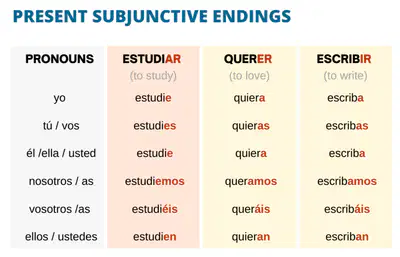
*if the 'yo' person is irregular, the subjunctive will take the same irregular form
5
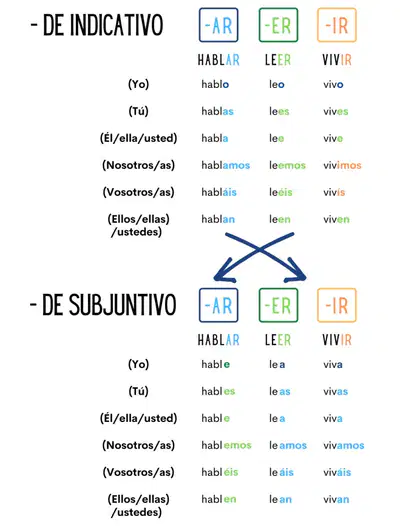
An easy way to learn the endings of the present subjunctive is to remember that the infinitive groups swap endings!
How does it work? Top tips

6
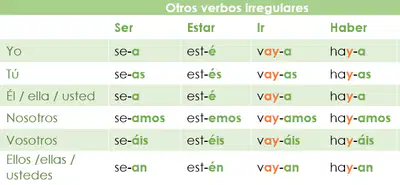
Irregular verbs
As in the present tense, some verbs are irregular in the subjunctive and we must memorise them:
7
When do we use it?
As we said, the subjunctive is used in Spanish to talk about desires, doubts and worries. It could also be used to express recommendations and requests that might not happen. Some specific situations include:
After cuando when talking about the future:
Cuando sea mayor, viviré en España --> When I am older I will live in Spain
With negative opinions:
No creo que sea útil --> I don't think it is useful
In impersonal structures of opinion:
Es esencial que reciclemos -->It is essential that we recycle
After verbs of wishing, command, request, emotion and purpose:
Quiero que escuches --> I want you to listen
After the expression ojalá:
Ojalá haga sol --> Let's hope it is sunny

8

9
Multiple Choice
Trabajar - Yo
Trabajo
Trabaje
Trabajes
Trabajemos
10
Multiple Choice
Terminar - Nosotros
Terminemos
Termines
Terminen
Termine
11
Multiple Choice
Ganar - Tú
Ganemos
Ganen
Ganes
Gane
12
Multiple Choice
Enamorarse - Ella
Se enamore
Te enamores
Se enamoren
Os enamoréis
13
Multiple Choice
Trabajar - Vosotros
Trabajéis
Trabaje
Trabajes
Trabajemos
14
Multiple Choice
Cantar - Yo
Cantemos
Canten
Cantes
Cante
15
Multiple Choice
Terminar - Ellos
Terminemos
Termines
Terminen
Termine
16
Multiple Choice
Cantar - Nosotros
Cantemos
Canten
Cantes
Cante
17
Multiple Choice
Ganar - Él
Ganemos
Ganen
Ganes
Gane
18
Multiple Choice
Comer - Tú
Comas
Coma
Coman
Coman
19
Multiple Choice
Beber - Ellos
Beba
Bebas
Beban
Bebamos
20
Multiple Choice
Aprender - Yo
Aprendamos
Aprenda
Aprendas
Aprendáis
21
Multiple Choice
Comprender - Vosotros
Comprendáis
Comprenda
Comprendamos
Comprendan
22
Multiple Choice
Correr - Él
Corras
Corramos
Corra
Corran
23
Multiple Choice
Leer - Yo
Lea
Leas
Lean
Leamos
24
Multiple Choice
Escribir - Tú
Escribamos
Escribáis
Escriba
Escribas
25
Multiple Choice
Vivir - Nosotros
Viva
Vivas
Vivan
Vivamos
26
Multiple Choice
Existir - Ellas
Existan
Exista
Existas
Existamos
Module 8 | Spanish Miss González
Show answer
Auto Play
Slide 1 / 26
SLIDE
Similar Resources on Wayground

20 questions
Possessive Adjectives
Presentation
•
9th Grade
21 questions
Iregulares del Preterito
Presentation
•
9th - 10th Grade
17 questions
La Ropa Review
Presentation
•
9th Grade
20 questions
Realidades 1 Cap 3B act 15 &17
Presentation
•
9th Grade
21 questions
Preterito con verbos de -car, -gar, zar
Presentation
•
8th - 10th Grade
21 questions
Climate Change
Presentation
•
9th Grade
18 questions
Le partitif Ch 3.1
Presentation
•
9th - 10th Grade
21 questions
Adjetivos Posesivos
Presentation
•
9th Grade
Popular Resources on Wayground
10 questions
Safety Day 2026 – Student Review

Quiz
•
9th Grade
21 questions
Continents and Oceans
Quiz
•
6th Grade
20 questions
Parts of Speech
Quiz
•
5th Grade
16 questions
Subject & Predicate
Quiz
•
5th Grade
25 questions
Multiplication Facts
Quiz
•
5th Grade
12 questions
Map Skills
Quiz
•
3rd Grade
22 questions
Continents and Oceans
Quiz
•
5th Grade
15 questions
Rounding Decimals
Quiz
•
5th Grade
Discover more resources for World Languages
20 questions
REGULAR Present tense verbs
Quiz
•
8th - 9th Grade
20 questions
Ser vs Estar
Quiz
•
9th Grade
21 questions
Spanish speaking countries and capitals
Quiz
•
9th Grade
20 questions
Present tense stem-changing verbs
Quiz
•
9th Grade
45 questions
Ser vs Estar
Quiz
•
9th Grade
10 questions
Spanish Greetings and Goodbyes!
Presentation
•
6th Grade - University
28 questions
Ser vs estar
Quiz
•
9th - 12th Grade
18 questions
Spanish Stem-Changing Verbs Quiz
Quiz
•
9th Grade