

indirect object

Presentation
•
English
•
2nd Grade
•
Practice Problem
•
Hard

Mae Dumanig
FREE Resource
11 Slides • 3 Questions
1
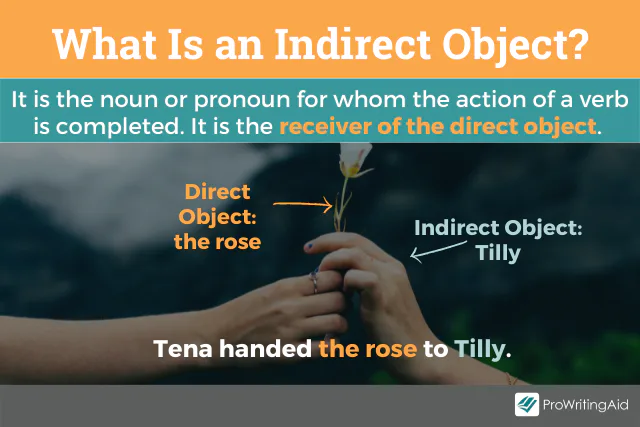
An indirect object is the noun or pronoun for which the action described by the verb takes place.
It often comes right before the direct object.
A sentence can have an indirect object only if it has a direct object.
To find the indirect object, ask To whom, To what? For whom? or For what? the action is performed.
2

Replace this with your body text.
Duplicate this text as many times as you would like.
Replace this with a header
3
Multiple Choice
Click on the indirect object in the sentence.
The blaring music at the concert gave me a terrible headache.
me
at the concert
headache
the blaring music
4
The indirect object receives the direct object of the sentence.
An indirect object is always a noun, and a direct object must exist before an indirect object can exist.
Here is an example of a sentence WITHOUT an indirect object:
Stan built a house.
Stan built what?
House is the direct object.
5
a direct object must exist before an indirect object can exist.
Example of a sentence WITH an indirect object:
Stan built Julie a house.
Stan built what?
A house.
House is the direct object.
Stan built a house for whom?
Julie is the indirect object.
6
Multiple Choice
How to Find the Indirect Object?
To find an indirect object, ask “to whom/what?” or “for whom/what” the direct object is intended.
To find an indirect object, ask “to where/what?”
To find an indirect object, ask “to which/what?”
To find an indirect object, ask “to which/where?”
7
Replace this with a header
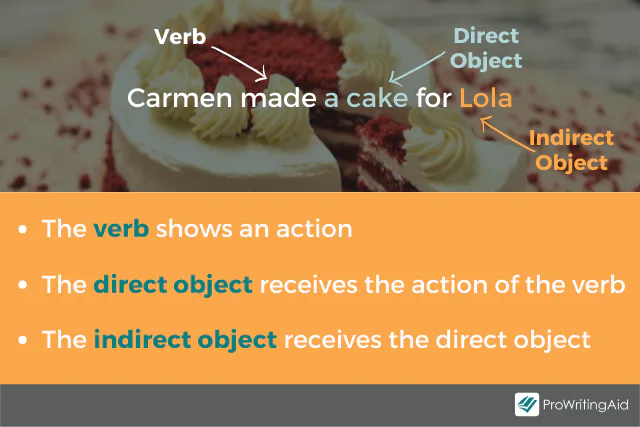
Dan made her a cake.
Dan made what? A cake.
Cake is the direct object.
To whom/what or for whom/what did Dan make the cake? Her.
Her is the indirect object.
8
Replace this with a header
Martina read Maria the book.
Martina read what? The book.
Book is the direct object.
To whom did Martina read the book? To Maria.
Maria is the indirect object.
9
Direct Object vs. Indirect Object
Direct Objects:
A direct object is the recipient of the action of the verb.
John threw Steve the ball.
What is it that John threw? He threw the ball.
Indirect Objects:
An indirect object receives the direct object.
John threw Steve the ball.
Who received the ball? Steve did.
If you ask yourself these questions, finding the direct object and indirect object is easy.
10
Messica told Gretchen the update.
(Gretchen is the indirect object, and update is the direct object.)
Messica -subject
told - verb
what did Messica tell? update
to whom? Gretchen
11
Multiple Choice
In this sentence, what is the indirect object:
I showed them a movie.
a movie
them
I
showed
12
Replace this with a header
Replace this text with your body text.
Duplicate this text as many times as you would like.
Subheader text
Replace this text with your body text.
Duplicate this text as many times as you would like.
Subheader text
13
Obi-Wan gave Luke Skywalker a lightsaber.
Indirect Object: Luke Skywalker. He is the noun for whom the verb (gave) was completed.
14
Subject + Verb + indirect Object + direct object
John bought his son a present
(For whom did John buy a present? = his son)
The office staff gave Phillip a card
(To whom did the staff give a card? = Philliip)
An indirect object is the noun or pronoun for which the action described by the verb takes place.
It often comes right before the direct object.
A sentence can have an indirect object only if it has a direct object.
To find the indirect object, ask To whom, To what? For whom? or For what? the action is performed.
Show answer
Auto Play
Slide 1 / 14
SLIDE
Similar Resources on Wayground

13 questions
Silent "e"
Presentation
•
2nd Grade
13 questions
Adverbs
Presentation
•
2nd Grade
10 questions
The Dog That Dug for Dinosaurs
Presentation
•
2nd Grade
10 questions
ABC Order
Presentation
•
2nd Grade
12 questions
Compare and Contrast Review
Presentation
•
2nd Grade
12 questions
Making Inferences
Presentation
•
2nd Grade
10 questions
Present Perfect
Presentation
•
KG - 3rd Grade
11 questions
Vertebrates - Invertebrates
Presentation
•
1st - 2nd Grade
Popular Resources on Wayground
10 questions
HCS SCI 03 Summer School Review 4

Quiz
•
3rd Grade
11 questions
HSMS - Standard Response Protocol
Quiz
•
6th - 8th Grade
16 questions
1.1-1.2 Quiz Review
Quiz
•
9th - 12th Grade
12 questions
Exponent Expressions
Quiz
•
6th Grade
20 questions
Adding and Subtracting Integers
Quiz
•
6th - 7th Grade
11 questions
Northeast States
Quiz
•
3rd - 4th Grade
10 questions
Characterization
Quiz
•
3rd - 7th Grade
10 questions
Common Denominators
Quiz
•
5th Grade