

The Great Depression

Presentation
•
History
•
11th Grade
•
Hard

Stephanie Jones
Used 1+ times
FREE Resource
43 Slides • 11 Questions
1

Great Depression
and the
New Deal
STAAR Review 8
2

The Great Depression
1929-1940
• Economies historically pass through good and bad
periods that regularly repeat themselves.
• These ups and downs are referred to as the
business cycle.
• The bad times are called a depression – these
usually include:
– Business failures
– High unemployment
– Falling prices
The Great Depression was the worst in our
nation’s history!
3

Causes of the Great Depression
Overproduction
• The 1920s saw a rapid economic expansion as
manufacturers made and sold new products like
cars, radios, refrigerators and numerous other
consumer items.
• By the end of the 1920s many consumers lacked
the money to buy all these new products.
• Manufacturers were soon producing more goods
than they could sell, no matter how low they
priced their goods.
4
Multiple Choice
What is called when manufacturers were soon producing more goods than they could sell, no matter how low they
priced their goods?
Overproduction
Consumer buying
Oversupply
unequal distribution
5


•
In the 1920s stocks soared in
value as people ‘speculated’
meaning they bought stocks
hoping to “get rich quick”.
•
This speculation caused the
price of stocks to rise higher
and higher each day as more
people invested in Wall Street.
•
By 1929 the price of stocks had
tripled since 1920.
Causes of the Great Depression
Speculation
6

Causes of the Great Depression
Buying on Margin
• In the 1920s, stocks could be purchased for a
10% down payment called buying on margin.
• The rest of the price of the stock was financed by
a loan from a stock broker or a bank.
• If a stock’s price fell, the purchaser was still
responsible for the whole price of the stock.
• As long as the price of stock went up there was
no problem, but if the stock prices decline there is
no way to pay off the borrowed money.
• People also invested in real estate (land or buildings)
with a similar hope of getting rich quick.
7

Causes of the Great Depression
Shaky Banking Methods
• Banks work by using money from depositors that
they then loan to businesses, the money they
earn they use to pay interest to these depositors.
• Most banks in the 1920s were honest and
followed good banking guidelines, however there
were some who invested their depositors money
in unsound investments.
• The government failed to regulate the banking
system or the stock market.
• People also bought more than they could afford
making the economy very shaky.
8

Causes of the Great Depression
Tariffs on International Trade
• The government also passed tariffs (a tax on
goods imported) making foreign imported goods
more expensive.
• Foreign nations retaliated by passing tariffs on
American made goods imported into their nations.
• The effect was that it made it harder for U.S.
businesses to sell their products to other nations.
• This shrinking of world trade contributed to the
Great Depression.
9
Multiple Choice
a tax on goods imported is what?
Profits
Quotas
Subsidies
Tariffs
10
Summary Causes of the Great Depression
Decline in agricultural prices
Unequal distribution of income
Overproduction of consumer goods
Consumers overconfidence & buying goods on credit
Buying stocks on margin for quick profit
Bank failures
11


The Stock
Market Crash
• On Black Thursday, October 24
the stock market began to decline
• Bankers tried to stop the decline
by buying stocks, but they were
able to only delay the drop.
• Five days later on October 29,
1929, aka Black Tuesday, the
stock market crashed.
• As stock prices dropped, people
couldn’t pay back their loans and
frantically tried to sell their stocks
driving the price of stocks down.
12


Effects of the Stock Market Crash
• Banks that had made bad loans on
risky stocks were losing money.
• People panicked and took their
money out of the banks, this only
made things worse for the banks.
• These bank runs forced many
banks to close their doors.
• When a bank closed its doors, the
people who had money deposited
there lost their money.
• Although the Stock Market Crash
did not cause the Great
Depression, it did make it worse.
13


• As more banks closed, so did more businesses.
• As businesses closed, people lost their jobs, and soon
their homes and farms.
• This caused a decrease in the demand for goods
causing more businesses to fail leading to more
people going broke.
Effects of the Stock Market Crash
14


• Instead of the optimism of
the 1920s, people began to
feel worthless.
• Soup kitchens and bread
lines appeared across the
nation.
• Churches and charities did
what they could to feed the
hungry.
• With no ‘safety net’ such as
unemployment insurance,
hundreds of thousands were
living on the streets.
Effects of the Great Depression
15
Multiple Choice
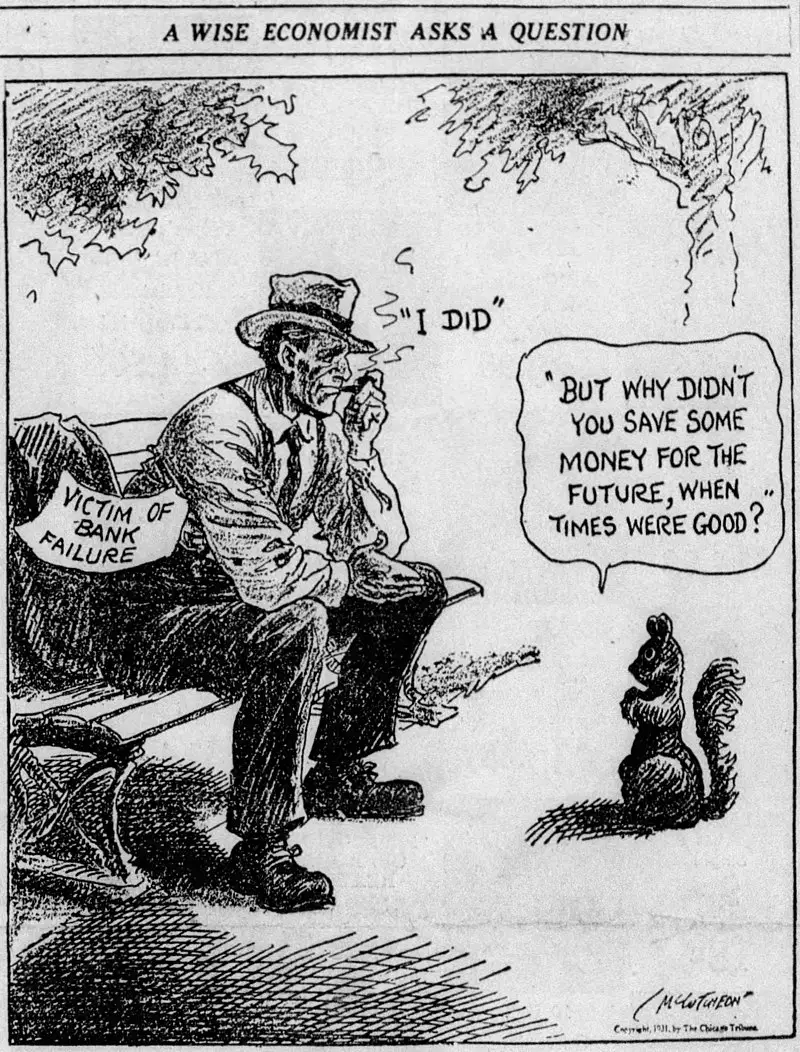
What event in American history is this political cartoon referring too?
World War I spending
Independence of flappers
Bank failures caused by
buying on margin
Effects of the Dust Bowl
16

The Dust Bowl
• Since the 1870s farmers had
been plowing up the Great
Plains to grow crops.
• During the early 1930s a severe
drought (a long period without
rain) hit the Great Plains region.
• The Great Plains stretches from
Texas to North Dakota.
• The ground cover that been
holding the soil in place was
gone and when the winds came
it simply blew that land away.
17


The Dust Bowl
The winds of the Dust Bowl blew for years!
18
Multiple Choice
What term is used to describe the area of the Great Plains where heavy droughts had dried up the farmland?
The Prairie Wasteland
The Dust Bowl
The Great American Desert
The Bowl
19


• Farmers packed up their
belongings and headed west to
California looking for work.
• So many of these migrants
came from Oklahoma, that as a
group these people became
known as Okies.
• This is another example of the
mass migration of people, much
like the Great Migration of
African Americans out of the
South or miners to the West.
Effects of the Dust Bowl
20


Documenting the Dust Bowl
• John Steinbeck wrote
“The Grapes of Wrath”
telling the story of Okies
as they became migrant
workers in California.
• Dorthea Lange took
pictures of the effect the
Dust Bowl and the Great
Depression had on the
American people.
21
Multiple Choice
Who wrote about telling the story of Okies
as they became migrant
workers in California during the Great Depression?
John Steinbeck
Ernest Hemingway
Harper Lee
F. Scott Fitzgerald
22


Mexican Repatriation
• The Immigration Acts of the
1920s limited European
immigration, but it didn’t limit
immigrants from Mexico.
• Mexican immigrants were
allowed to enter the U.S.A. as
long as they passed a medical
exam and a literacy test (given in
Spanish) and paid a small fee.
• Most had left Mexico because
of the Mexican Revolution and
came to the U.S.A. to work at
back-breaking low paying jobs.
23


Mexican Repatriation
• During the Great Depression jobs became harder
to find and white American farmers went after jobs
that had been filled by immigrants.
• A ½ million Mexicans came during the 1920s, but it
became more difficult for Mexican immigrants to
get into the U.S., as only 33,000 were allowed in
during the 1930s.
24


Mexican Repatriation
• As competition for work increased so did prejudice
and discrimination.
• In the 1930s, Pres. Hoover signed a special law
the ‘Mexican Repatriation Act’ that forced a half
million Mexican-Americans to be ‘repatriated’ or
sent back to Mexico.
25


Pres. Hoover’s Philosophy
• During the early years of the Great
Depression the government did not give
direct relief. (cash or food directly to the poor)
• Despite rising unemployment, Pres.
Herbert Hoover refused to get the
government involved.
• Hoover remained true to the idea of a
laissez-faire economy or no government
involvement in the economy.
• Hoover feared government intervention
would reduce the incentive to work and
undermine ‘rugged individualism’ that
he believed had made America great.
26


Pres. Hoover’s Efforts
• Hoover cut taxes, created a
federal agency to buy excess
farm crops, and increased federal
spending on public projects like
Hoover Dam.
• Hoover also established the
‘Reconstruction Finance Corp.’
that gave emergency loans to
banks and businesses hoping to
increase business.
• Hoover hoped money would soon
‘trickle down’ to the people.
27
Multiple Choice
What Government did President Hoover believe in?
Democracy
Communism
Capitalism
Laissez-Faire
28


More Problems for Hoover
• Shantytowns sprang up
everywhere and were
called Hoovervilles, a sign
of disrespect to Hoover.
• By this time over 100,000
businesses had failed and
25% of the population was
out of work.
• Hoover stuck to his idea of
‘rugged individualism’, but
he was nearing the end of
his political life.
29


Franklin Delano Roosevelt
• By 1932 the American public had
lost faith in Pres. Hoover and the
1932 presidential election saw
Franklin Roosevelt (FDR) win in
a landslide.
• FDR and his “Brain Trust” (his
advisors) had a plan to end the
depression and put the American
people back to work, FDR called
it the New Deal.
“FDR”
30
Multiple Choice
What is a Hooverville's?
Shantytowns on the outskirts of the cities of homeless & unemployed people
Temporary shelters for those in need
Areas of refuge for the destitute
Open-air encampments of the dispossessed
31


• The New Deal marked a change
away from the laissez-faire attitude
the government had previously
taken with the economy.
• It established the idea that the
government was responsible to
make sure the economy ran
smoothly.
The New Deal permanently
increased the size and power of
the federal government!
“FDR” and the New Deal
32


FDR a New Style of Leadership
• FDR used the radio to speak
directly to the American
people in his ‘fireside chats’.
• When FDR was 39, he was
struck by polio and he was
unable to walk by himself.
• FDR’s wife Eleanor, served as
his eyes and ears by traveling
the U.S. in his place.
• Eleanor spoke strongly for
women’s rights, the peace
effort, and the poor.
33


Women in the Great Depression
• Women often experienced the
Depression as mothers and
homemakers.
• Eleanor Roosevelt rallied women
with her book, ‘It’s Up to the Women”
as she helped them deal with getting
their families through the crisis.
• Frances Perkins the 1stfemale
member of the U.S. Cabinet served
as Secretary of Labor.
• Perkins played a big role in helping
FDR with his New Deal legislation.
34


• In FDR’s 1932 inaugural address he
reassured the American public with
his famous quote :
– “we have nothing to fear but fear itself”
• In the First Hundred Days of office
FDR was able to get Congress to
pass many new laws he proposed.
• FDR explained his New Deal in
terms of the Three R’s -
Relief, Recovery, & Reform.
• Programs would become known as
the Alphabet Soup Laws.
New Deal Legislation
Relief, Recovery, Reform
“We have
nothing
to fear
but fear
itself”
35


New Deal Legislation
Relief, Recovery, Reform
• Banking Crisis – banks had
been failing during the 1930s.
• Depositors feared banks were
unsound and removed their
$$$$.
• FDR closed all banks and put
them on a Bank Holiday until
new laws could restore faith in
the banks.
• Bank closings soon deceased.
36

New Deal Legislation
Relief, Recovery, Reform
• Relief for the Unemployed
– Federal Emergency Relief – gave money for
emergency relief to those in need.
– Civilian Conservation Corp. – gave young men
jobs planting trees, cleaning up parks, etc.
– Public Works Admin. – created jobs building
schools, roads, bridges, other public projects
– Works Progress Admin. – created jobs for artists,
writers, and musicians to create murals, plays, and
other public artworks.
Programs like the CCC, PWA, WPA, were called
the Alphabet Soup Laws
37

New Deal Legislation
Relief, Recovery, Reform
• FDR felt the way to recovery was
to stimulate demand for goods.
• Priming the Pump –
– FDR differed from Hoover’s
policy of giving money to the
public.
– FDR wanted to put money into
consumers hands hoping to
increase their spending
thereby increasing demand.
38


New Deal Legislation
Relief, Recovery, Reform
• National Recovery Admin.
– Set business codes regulating
wages, pricing, and practices.
• Agricultural Adjustment Act
– paid farmers to plant less to
increase crop prices.
Supreme Court ruled both the
NRA and AAA
were unconstitutional.
39

New Deal Legislation
Relief, Recovery, Reform
• Reforms were aimed at fixing the defects in
the American economy so the Depression
would not happen again.
• These reforms were based on belief that
government should protect individuals against
risks they could not handle on their own.
• This would increase the power and presence
of the national government in the lives of all
Americans into the future.
• Obamacare is an example of this today.
40


New Deal Legislation
Relief, Recovery, Reform
• Federal Deposit Insurance
Corp. – insured banks so
people would not lose any
savings in the event of a bank
failure. Restored faith in banks!
• Social Security Act - provided
the safety net to provide workers
with unemployment insurance,
an old age pension, or if they
died early.
41
Multiple Choice
What Act provided insurance for people's bank accounts?
Federal Deposit Insurance Corporation (FDIC)
Social Security Act
Securities & Exchanged Commission
(SEC)
Federal Reserve System
42
Multiple Choice
What provided the safety net to provide workers
with unemployment insurance,
an old age pension, or if they
died early?
The fair Labor Standards Act
The Affordable Care Act
The American Taxpayer Relief Act
Social Security Act
43


New Deal Legislation
Relief, Recovery, Reform
• Security & Exchange Comm.
– To regulate the stock market and
prevent fraud and future crashes.
• Tennessee Valley Authority
– Government owned dams to
generate electricity.
• National Labor Relations Act
– Gave workers right to form unions.
44
Multiple Choice
What is a government agency that regulates the stock market?
TVA (Tennessee Valley Authority)
FDIC (Federal Deposit Insurance Corporation)
SEC (Securities & Exchange Commission)
45
Multiple Choice
What program built dams in the Tennessee Valley are in order to control flooding & provide electric power?
Federal Deposit Insurance Corp. (FDIC)
Tennessee Valley Authority (TVA)
Securities & Exchanged Commission
(SEC)
Social Security Act
46

Impact of New Deal on Labor
• Union membership had its greatest growth during
the 1930s.
• FDR tried to raise wages of labor to help fight the
Great Depression.
• Norris-LaGuardia Act – prohibited the courts or
the government from stopping peaceful union
strikes as they had in the late 1800s.
• National Industrial Recovery Act - workers could
form unions and employers could not refuse to hire
union members.
• Wagner Act – stimulated unionization by giving
Unions the right to collective bargaining.
47


Reactions to the New Deal
The New Deal was generally popular with the
American public, but FDR did face criticism.
• Liberty League said FDR was a
traitor to his class and was
attempting to establish a popular
dictatorship with his new powers.
• Dr. Francis Townsend thought
FDR didn’t go far enough and
wanted to give citizens over 65 an
additional $200 a month.
48


Reactions to the New Deal
The New Deal was generally popular with the
American public, but FDR did face criticism.
• Huey Long – ‘The Kingfisher’ ran
for president promising each
American family $5,000 a year paid
by taxing the rich, he was later
assassinated before he ran.
• Father Coughlin – Catholic priest
who gave radio speeches that were
popular with nativists who distrusted
Wall St., were anti-Jewish, and
wanted the government to take over
the banks.
49

The Supreme Court and the New Deal
• The greatest threat to the New Deal was the
Supreme Court.
• Supreme Court struck down New Deal programs of
the National Industrial Recovery Act (NIRA) and the
Agricultural Adjustment Act (AAA), saying they
were unconstitutional.
• Supreme Court decision “Schechter v. U.S.” said
Congress could not give the President more
powers than those granted in the Constitution.
50

The Supreme Court and the New Deal
Political Cartoons
51


• After the Supreme Court decision of
Schechter, FDR feared they might
declare other New Deal laws as
unconstitutional.
• FDR believed the Supreme Court
Justices, most of who were over 70
years old – were out of touch with the
needs of the nation.
• FDR proposed a plan to allow the
President to add a new appointment
to the Supreme Court for each Justice
over 70 ½ years old.
FDR’s Court-Packing Scheme
52


FDR’s Court-Packing Scheme
• IF, FDR’s court-packing plan was
adopted it would give him the right to
appoint six Justices, giving him
control over the Supreme Court.
• FDR’s court-packing scheme was
viewed as attempting to upset the
traditional separation of powers
outlined in the Constitution.
• Despite FDR’s popularity, Congress
rejected the plan.
• However, the Supreme Court did
stop overruling New Deal legislation.
53


The Impact of the New Deal Reforms
• Under FDR’s New Deal the power
of the federal government increased
dramatically.
• The federal government went from
a regulatory role to one of taking
responsibility to make sure the
economy ran smoothly & efficiently.
• The New Deal agencies and their
regulations made it possible for the
government to control its citizens’
private lives!
• Taxes rose to fund these new
government programs.
54

New Deal Helps End the Depression
• Spending on the New Deal helped bring an end
to the Great Depression.
• But, it would take more than just this spending to
bring an end to this Great Depression, it would
take a war.
• As Hitler continued to become more aggressive
in Europe, the U.S.A. became more concerned.
It would finally take the massive spending of
our involvement in what would become World
War II to finally end the Great Depression.
Great Depression
and the
New Deal
STAAR Review 8
Show answer
Auto Play
Slide 1 / 54
SLIDE
Similar Resources on Wayground

44 questions
Maya, Aztec, Inca
Presentation
•
6th - 8th Grade
49 questions
Unit 2 Lesson 6: Nuclear Decay Reactions
Presentation
•
10th - 12th Grade
47 questions
Ser + Adjetivos
Presentation
•
12th Grade
46 questions
Emoji Chronicles
Presentation
•
11th Grade
48 questions
POPULAR MEMBER SERVICES DIAGNOSTICS, HOSPITILIZATION AND SURGERY
Presentation
•
KG
52 questions
APUSH 7.7, 7.8
Presentation
•
11th Grade
51 questions
Characteristics of Rational Functions
Presentation
•
11th Grade
48 questions
Ancient Mesopotamia
Presentation
•
10th Grade
Popular Resources on Wayground
10 questions
HCS SCI 03 Summer School Review 4

Quiz
•
3rd Grade
11 questions
HSMS - Standard Response Protocol
Quiz
•
6th - 8th Grade
16 questions
1.1-1.2 Quiz Review
Quiz
•
9th - 12th Grade
12 questions
Exponent Expressions
Quiz
•
6th Grade
20 questions
Adding and Subtracting Integers
Quiz
•
6th - 7th Grade
11 questions
Northeast States
Quiz
•
3rd - 4th Grade
10 questions
Characterization
Quiz
•
3rd - 7th Grade
10 questions
Common Denominators
Quiz
•
5th Grade