

Identifying Variables

Presentation
•
Physics
•
11th Grade
•
Practice Problem
•
Easy
+1
Standards-aligned

Stacey Kohler
Used 2+ times
FREE Resource
14 Slides • 8 Questions
1
2

If you ask me how much money I have, and I answer 5, you still don't know how much money I have. Do I have 5 dollars, or 5 cents. That word after the "5" is the unit. Units tell us how we measured the variable.
The chart to the right tells you the units we use in physics for each variable. You need to make certain that the unit for each variable is written down on your formula sheet. Do that now.
Variables and Units
3
Match
velocity
distance
acceleration
time
m/s
m
m/s/s
sec
m/s
m
m/s/s
sec
4
In the previous matching problem,
You should have matched distance with meters (m), time with seconds (sec), velocity with meters per second (m/s), and acceleration with meters per second per second (m/s/s). If you had trouble with this, make certain that you write down the units for each variable on your formula sheet. If you are still having trouble, please call your teacher to come explain!
5
Units are the secret to making this easier
When you read a word problem, look for all of the numbers. After each number, you'll see a unit, usually abbreviated. That unit tells you which variable is associated with that number. If you see 5 m, then you know that the distance is 5 meters. If you see 5 sec, then you know that the time is 5 sec.
6
Multiple Choice
A 50 pound dog walked 200 m in 300 sec. In this problem, the distance is:
50 pounds
200 meters
300 seconds
unknown
7
In the dog problem
You should have chosen 200 meters (m), because meters is the unit for distance.
50 pounds is a weight, and 300 seconds is a time.
8
Multiple Choice
A plane with 300 passengers accelerated to 250 m/s over the course of 1200 sec. What is the time in this problem?
250 m/s
300 passengers
1200 sec
unknown
9
In the plane problem,
You should have chosen 1200 seconds (sec) because seconds is the unit for time. 250 meters per second (m/s) is a velocity, and 300 is the number of passengers.
10
Dropdown
11
In the truck problem,
You should have chosen 15 meters per second (m/s) for the velocity, and 500 seconds (sec) as the time. The distance was unknown - that is the variable that you would have to solve for. The mass of the truck doesn't match with any of the variables, so you can ignore that for now.
12
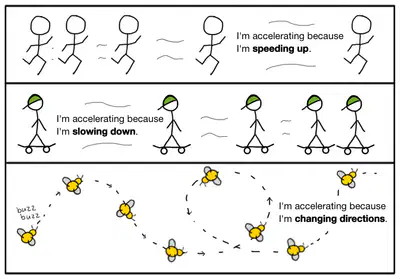
Acceleration happens any time something speeds up, slows down, or changes directions. In this class, you won't have to do any calculations on something changing directions, so we're going to concentrate on things that are speeding up and slowing down.
Acceleration
13
Initial velocity just means. "the velocity at the beginning of the problem". Final velocity means, "the velocity at the end of the problem". If the object is speeding up, the final velocity will be higher. If the object is slowing down, the final velocity will be slower.
14
Multiple Choice
A soccer ball is kicked. It accelerates from 2 m/s to 35 m/s in 0.5 sec. The initial velocity of the ball is:
2 m/s
35 m/s
0.5 s
9.8 m/s/s
15
In the first soccer ball problem,
The initial velocity is 2 m/s, because that is the velocity of the ball at the beginning of the problem.
16
Multiple Choice
A soccer ball is kicked. It accelerates from 2 m/s to 35 m/s in 0.5 sec. The final velocity of the ball is:
2 m/s
35 m/s
0.5 s
9.8 m/s/s
17
In the second soccer ball problem,
The final velocity is 35 m/s, because that is the velocity of the ball at the end of the problem.
18
A special note when the velocity is 0 m/s
Sometimes in a problem, an object isn't moving. You might see the words "not moving" or "stopped" or "at rest". The problem might even assume that you know that the object is stopped, for example if a car is at a red traffic light. If you see those words, the velocity at that time is 0 m/s. It's easy to accidentally find another number in the problem and use that instead, so be careful!
19
Dropdown
20
In the motorcycle problem
You should have chosen "0 m/s" as the initial velocity, because the motorcycle was at a red traffic light. That means it was stopped.
21
Dropdown
22
In the problem with the runner
You should have chosen "0 m/s" as the final velocity, because the runner is coming to a stop at the end of the race.
Show answer
Auto Play
Slide 1 / 22
SLIDE
Similar Resources on Wayground

20 questions
P.5F-Circuits
Presentation
•
11th Grade
18 questions
Força e Movimento
Presentation
•
11th Grade
15 questions
Speed
Presentation
•
10th Grade
18 questions
Subject Orientation
Presentation
•
11th Grade
19 questions
Diction and Syntax
Presentation
•
11th Grade
19 questions
osmosis
Presentation
•
11th Grade
17 questions
Unit 5 So Far
Presentation
•
11th Grade
15 questions
ELASTISITAS BENDA
Presentation
•
11th Grade
Popular Resources on Wayground
10 questions
Safety Day 2026 – Student Review

Quiz
•
9th Grade
21 questions
Continents and Oceans
Quiz
•
6th Grade
20 questions
Parts of Speech
Quiz
•
5th Grade
16 questions
Subject & Predicate
Quiz
•
5th Grade
25 questions
Multiplication Facts
Quiz
•
5th Grade
12 questions
Map Skills
Quiz
•
3rd Grade
22 questions
Continents and Oceans
Quiz
•
5th Grade
15 questions
Rounding Decimals
Quiz
•
5th Grade
