Search Header Logo
Viruses Lesson

Viruses Lesson

Assessment

Presentation

•

Biology

•

10th Grade

•

Medium

•
NGSS
HS-LS4-2, HS-LS4-4, MS-LS1-5

+1

Standards-aligned

Created by

Alexandra Osler

Used 19+ times

FREE Resource

19 Slides • 27 Questions

1

media

2

media

3

media

4

media

5

media

6

media

7

media

8

media

9

Multiple Choice

Viruses are not living, because they

1

are not cellular.

2

have no DNA.

3

do not reproduce.

4

lack a nucleus.

10

Multiple Choice

Cell theory states:

all living things are composed of one or more cells;

a cell is the smallest unit that still retains the properties of life;

and new cells only come from cells that already exist.

Based on cell theory, which of these answer choices would describe one reason a virus is considered nonliving?

1

A virus is too small to be considered a cell.

2

A virus does not contain genetic material.

3

A virus does not have a nucleus.

4

A virus cannot reproduce itself without a host

11

Multiple Choice

Viruses CANNOT

1

be crystallized.

2

live in bacteria.

3

cause disease in plants.

4

reproduce on their own.

12

media

13

media

14

media

15

media

16

Multiple Choice

The purpose of the protein coat surrounding a virus, other than to protect the virus, is to-
1

react with the cell wall of the host cell

2

release hereditary information into the host cell

3

produce proteins within the host cell

4

destroy the nucleus of the host cell

17

Multiple Choice

All viruses contain-
1

nucleic acids

2

ribosomes

3

mitochondria

4

cytoplasm

18

Multiple Choice

Question image
What part of the phage is the DNA?
1

A

2

B

3

C

4

D

19

Multiple Choice

Question image
A(n) _____ is a virus that enters a bacterial cell.
1

endospore

2

decomposer

3

plasmid

4

bacteriophage

20

Multiple Choice

What part of a virus is the protein capsule that houses the genetic material (DNA/RNA)?
1

tail

2

nucleus

3

capsid

4

glycoprotein

21

media

22

media

23

Multiple Choice

What happens in the lysogenic cycle? 
1

Virus goes in and leaves the host cell

2

Virus quickly kills the host cell

3

Virus inject the nucleic acid into the host cell, and the nucleic acid integrates into the host cell DNA, and stay dormant for a long time

4

Bacteria injects DNA into a host cell

24

Multiple Choice

Question image
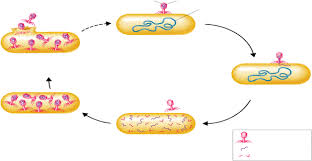
What process is this?
1

phagocytosis

2

lytic cycle

3

lysogenic cycle

4

formation of antibodies

25

Multiple Choice

Question image
What is shown here?
1

Lysogenic Cycle

2

Lytic Cycle

3

Binary Fission

4

Conjugation

26

Multiple Choice

Question image
The lysing of a cell occurs in which phase?
1

1

2

2

3

4

4

5

27

Multiple Choice

Question image

Host DNA is compromised and viral DNA takes over in which phase?

1

1

2

2

3

3

4

4

28

Multiple Choice

What is the 1st step of virus infection?
1

Entry

2

Attachment

3

Replication

4

Assembly

29

media

30

media

31

media

32

Multiple Choice

When a virus mutates this:

1

Helps the virus adapt to a new host

2

Can have no effect, be detrimental, or can be beneficial and help the virus adapt to its new host

3

Causes an outbreak

4

gives the virus super powers like shooting lasers out of it's eyes

33

Multiple Choice

Each of the following statements is true except -

1

viruses infect living cells

2

viruses can replicate without a host

3

viruses can cause illness

4

viruses come in different types

34

Multiple Choice

A virus infects a host in order to:

1

Take Nutrients

2

Make the host sick

3

Make copies of itself

4

Destroy the host cells

35

Multiple Choice

Identify the correct characteristic of life:

A lizard can change colors to blend in.

1

Levels of Organization

2

Adaptation

3

Homeostasis

4

Grows & Develops

36

Multiple Choice

Which characteristic of life describes a person touching a hot stove and jerking their hand back.

1

Organization

2

Maintaining Homeostasis

3

Respond to a Stimuli

4

Grows and Develops

37

Multiple Choice

Identify the correct characteristic of life: 

Fox chasing a rabbit—rabbit running away

1

Energy

2

Cells

3

Responds to a Stimuli

4

Maintains Homeostasis

38

Multiple Choice

Vaccines can be used to prevent viral infection by

1

destroying any viruses that enter the host.

2

creating a blocking protein on the cell.

3

creating an immune response in the host.

4

preventing replication of the virus.

39

Multiple Choice

Is this characteristic define as living organisms, viruses, or both:

Ability to reproduce independently.

1

Living Organisms

2

Viruses

3

Both

40

Multiple Choice

Is this characteristic define as living organisms, viruses, or both:

Not made of cells.

1

Living Organisms

2

Viruses

3

Both

41

Multiple Choice

Is this characteristic define as living organisms, viruses, or both:

Protein coat instead of membrane.

1

Living Organisms

2

Viruses

3

Both

42

Multiple Choice

Is this characteristic define as living organisms, viruses, or both:

May mutate and evolve.

1

Living Organisms

2

Viruses

3

Both

43

Multiple Choice

Is this characteristic define as living organisms, viruses, or both:

The ability to grow.

1

Living Organisms

2

Viruses

3

Both

44

Multiple Choice

Question image

Examine the model of a viral structure shown here. Select the choice that accurately compares and contrasts the structures of viruses and cells.

1

Viruses have the ability to maintain homeostasis.

2

Both cells and viruses have DNA/RNA.

45

media

46

media
media

Show answer

Auto Play

Slide 1 / 46

SLIDE