

Ch 3A Notes

Presentation
•
Science
•
12th Grade
•
Practice Problem
•
Easy
+6
Standards-aligned

Cristina Molina
Used 13+ times
FREE Resource
18 Slides • 7 Questions
1

2

3

4
Multiple Choice
Why did Robert Hooke name his observation a cell?
He thought it sounded cool
It reminded him of drawers
It was his middle name
It reminded him of rooms
5
6

7
Multiple Choice
What is an organelle?
a specialized part of a cell having some specific function; a cell organ
groups of cells that have a similar structure and act together to perform a specific function
a group of tissues in a living organism that have been adapted to perform a specific function
a group of organs that work together to perform a certain function in an organism's body
8

9

10

11

12

13
Multiple Choice
Which organelle is known as the "Powerhouse of the Cell"?
Nucleus
Mitochondria
Chloroplast
Vacuole
14

15

16

17

18

19
20

21

22
Multiple Choice
Which of the following organelles is not found in animal cells:
Nucleus
Mitochondria
Vacuole
Chloroplast
23
Multiple Choice
Who are known as the cleaning crew of the cell?
Vacuoles
Vesicles
Lysosomes
Ribosomes
24
Match
Match the following organelles to their function.
Nucleus
Mitochondria
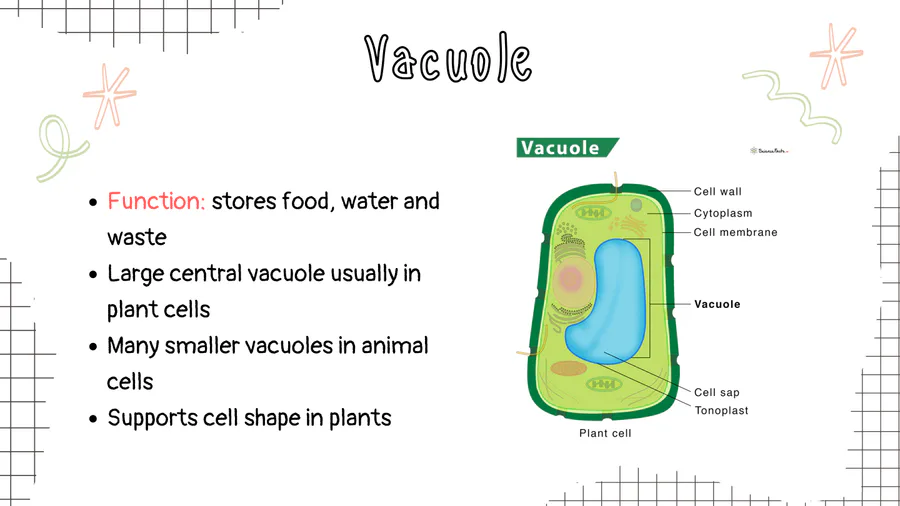
Vacuole
Cell Membrane
Golgi Apparatus
Stores DNA (genetic information)
makes cellular energy
stores food, water and
waste
Surrounds and protects
the cell
collects, modifies,
stores and delivers molecules
in the cell
Stores DNA (genetic information)
makes cellular energy
stores food, water and
waste
Surrounds and protects
the cell
collects, modifies,
stores and delivers molecules
in the cell
25
Match
Match the following organelles to their function.
Ribosome
Chloroplast
Lysosomes
Endoplasmic Reticulum
Cell Wall
makes proteins according to
DNA instructions
uses energy from the sun
to make food through photosynthesis
clean the cell
produce and transport lipids
and proteins
rigid, protective barrier (maintains plant cell
shape)
makes proteins according to
DNA instructions
uses energy from the sun
to make food through photosynthesis
clean the cell
produce and transport lipids
and proteins
rigid, protective barrier (maintains plant cell
shape)
Show answer
Auto Play
Slide 1 / 25
SLIDE
Similar Resources on Wayground

20 questions
Brain and Spinal Cord
Presentation
•
12th Grade
19 questions
Build a Sextant
Presentation
•
12th Grade
20 questions
Functions of the Integumentary System
Presentation
•
11th Grade
21 questions
Parent Function Review
Presentation
•
11th - 12th Grade
20 questions
THE CIRCULATORY SYSTEM
Presentation
•
KG - University
23 questions
Environmental Science Lesson 7.3-Protecting Biodiversity
Presentation
•
12th Grade
17 questions
Genetics & Biotechnology
Presentation
•
11th Grade
20 questions
Forensics Application of DNA Science
Presentation
•
12th Grade
Popular Resources on Wayground
10 questions
How much do you know about our Portrait of an Eagle?

Quiz
•
10th Grade
10 questions
Fast Food Slogans
Quiz
•
6th - 8th Grade
21 questions
Continents and Oceans
Quiz
•
6th Grade
20 questions
Parts of Speech
Quiz
•
5th Grade
16 questions
Subject & Predicate
Quiz
•
5th Grade
25 questions
Multiplication Facts
Quiz
•
5th Grade
12 questions
Map Skills
Quiz
•
3rd Grade
22 questions
Continents and Oceans
Quiz
•
5th Grade
Discover more resources for Science
22 questions
Periodic Table Review
Quiz
•
9th - 12th Grade
7 questions
Newton's Laws Video Quiz

Interactive video
•
9th - 12th Grade
17 questions
Unit 3A: Cells Vocab
Quiz
•
9th - 12th Grade
89 questions
Unit 1 (Ch 2 & 3) Test Review - Water/Ocean Currents
Quiz
•
9th - 12th Grade
58 questions
Biomolecule Test Corrections
Quiz
•
9th - 12th Grade
20 questions
Unit 2: Cell Energy Review
Quiz
•
9th - 12th Grade
17 questions
Explore Newton's Laws of Motion
Quiz
•
8th - 12th Grade
35 questions
Directional Terms, Body Cavities, Body Planes
Quiz
•
11th - 12th Grade