
Alignment Fundamentals PT1

Presentation
•
Other
•
University
•
Practice Problem
•
Medium

Chris Beutelschiess
Used 10+ times
FREE Resource
11 Slides • 19 Questions
1
Introduction
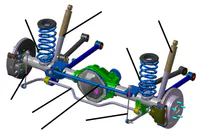
• Suspension and steering system components have to be
aligned correctly with one another and with the vehicle’s centerline.
• The wheels must be in proper alignment from the factory.
2
Wheel Alignment Fundamentals
(1 of 3)
• Explain the purpose and function of wheel alignment and the alignment angles.
• Little effort should be needed to turn the vehicle into curves or to let it return to the straight-ahead position
• Wheels are positioned on the suspension at certain angles to provide for easy driving of the vehicle
• The alignment of the wheels is maintained by the control arms, strut rods, tie rods, knuckles, and the vehicle frame to
obtain the proper angles
3

Wheel Alignment Fundamentals
(2 of 3)
• Alignments performed for:
- When handling issues related to alignment angles
– When tire wear shows any tire wearing angle issue
– When components are replaced that could affect the alignment
– Whenever new tires are being installed
A technician checking the alignment on a vehicle.
4
Wheel Alignment Fundamentals
(3 of 3)
• Primary and secondary alignment angles
• Primary angles consist of camber, caster, and toe, and are
more likely to be adjustable, but not always
• Secondary angles consist of toe-out-on-turns, steering axis inclination, included angle, scrub radius, thrust angle, centerlines, setbacks, and ride height
5

Camber
(1 of 2)
• Explain camber, its purpose, and effects.
• Side-to-side vertical tilt of the wheel
• A wheel that leans away from the center of the vehicle at the top is said to have positive camber
• A wheel that leans toward the center of the vehicle is said to have negative camber
6
Camber
(2 of 2)
• Camber tends to pull in the direction of the most positive
camber
• Affected by ride height
• Zero camber, or no tilt, to provide maximum tire patch contact with the road, as well as long tire life
7

Caster
(1 of 3)
• Forward or backward tilt of the steering axis from vertical when viewed from the side of the vehicle
• Backward tilt from the vertical is positive caster and forward tilt is negative
caster
8

Caster
(2 of 3)
Positive caster has a self-straightening effect on steering when the wheels are turned.
9
Caster
(3 of 3)
• Most vehicles have positive caster, because it causes the tires to travel in a straight line with minimal driver input
• As positive caster increases, more and more effort is needed to turn the steering wheel
• Differences in caster cause a pull to the side with the most negative caster
10

Toe-In and Toe-Out
(1 of 2)
• Toe is the angle of the tires relative to one another when viewed from above
• The condition in which the fronts of the wheels are closer together than the rears of the wheels is called
toe-in
• The condition in which the fronts of the wheels are farther apart than the rears is called toe-out
Toe is viewed from above the tire.
11
Toe-In and Toe-Out
(2 of 2)
• Designed into the vehicle based on several factors, such as front-wheel drive versus rear-wheel drive, front/rear brake system split versus diagonal brake system split, and specific desired handling characteristics
• Improper toe settings cause much faster tire wear than camber or caster
• Can be measured in inches, millimeters, or degrees
• Static toe setting is designed to compensate for slight wear in steering joints and components
12
Dropdown
13
Multiple Choice
A wheel that leans away from the center of the vehicle at the top is said to have_______.
positive camber
Negative camber
Positive caster
Negative caster
14
Multiple Choice
Forward or backward tilt of the steering axis from vertical when viewed from the side of the vehicle is _______.
Caster
Camber
Toe
Steer
15
Labeling
Label the Caster Measurements.
16
Dropdown
Secondary angles consist of toe-out-on-turns, steering axis inclination, included angle, scrub radius,
17
Multiple Choice
The alignment of the wheels is maintained by the control arms, strut rods, tie rods, knuckles, and the vehicle frame to obtain the proper angles
True
False
18
Labeling
Label the Camber
19
Multiple Choice
A wheel that leans toward the center of the vehicle is said to have _______.
negative camber
Positive camber
Toe-in
Toe-out
20
Multiple Choice
Side-to-side vertical tilt of the wheel is_______.
Camber
Caster
Toe-in
Toe-out
21
Multiple Choice
Camber tends to pull in the direction of the most __________.
Negative camber
Neutral camber
positive camber
Zero camber
22
Multiple Choice
Backward tilt from the vertical is __________.
Negative caster
Positive camber
positive caster
Negative camber
23
Multiple Choice
_________has a self-straightening effect on steering when the wheels are turned.
Positive caster
Negative caster
Negative camber
Positive camber
24
Labeling
Label these points.
25
Multiple Choice
Improper toe settings cause much faster ______ than camber or caster.
Tire wear
Brake wear
Suspension wear
Alignment issues
26
Multiple Choice
_______setting is designed to compensate for slight wear in steering joints and components.
Caster
Static toe
Camber
Thrust
27
Multiple Choice
Can be measured in inches, millimeters, or degrees.
Toe-in/toe-out
Positive / Negative Camber
Positive / Negative Caster
Ride height point
28
Multiple Choice
The condition in which the fronts of the wheels are farther apart than the rears is called ______.
toe-out
Toe-in
Camber
Caster
29
Labeling
Label the toe.
30
Multiple Choice
The condition in which the fronts of the wheels are closer together than the rears of the wheels is called ______.
Toe-in
Toe-out
Caster
Camber
Introduction
• Suspension and steering system components have to be
aligned correctly with one another and with the vehicle’s centerline.
• The wheels must be in proper alignment from the factory.
Show answer
Auto Play
Slide 1 / 30
SLIDE
Similar Resources on Wayground

24 questions
Olympics
Presentation
•
University
21 questions
IN ON AT prepositions of place
Presentation
•
University
21 questions
ATIN2_PART4_S26
Presentation
•
University
21 questions
AMDM Fermi Lesson
Presentation
•
KG - University
25 questions
Newtons 3 laws
Presentation
•
KG - University
23 questions
5B- GLOVING
Presentation
•
University
23 questions
RAD 281 Lecture 13
Presentation
•
University
24 questions
Credit & Debt Management
Presentation
•
University
Popular Resources on Wayground
10 questions
Safety Day 2026 – Student Review

Quiz
•
9th Grade
21 questions
Continents and Oceans
Quiz
•
6th Grade
20 questions
Parts of Speech
Quiz
•
5th Grade
16 questions
Subject & Predicate
Quiz
•
5th Grade
25 questions
Multiplication Facts
Quiz
•
5th Grade
12 questions
Map Skills
Quiz
•
3rd Grade
22 questions
Continents and Oceans
Quiz
•
5th Grade
15 questions
Rounding Decimals
Quiz
•
5th Grade
Discover more resources for Other
20 questions
Disney Trivia
Quiz
•
University
10 questions
Spanish Greetings and Goodbyes!
Presentation
•
6th Grade - University
20 questions
Physical or Chemical Change/Phases
Quiz
•
8th Grade - University
39 questions
Unit 7 Key Terms
Quiz
•
11th Grade - University
25 questions
SER and Subject Pronouns
Quiz
•
8th Grade - University
38 questions
Unit 6 Key Terms
Quiz
•
11th Grade - University
19 questions
Key Concepts in Buddhism
Quiz
•
University
0 questions
Cell Domain Basic Review (Biology)
Quiz
•
University