untitled
Presentation
•
Science
•
•
Practice Problem
•
Medium
Jovan Bellecoeur
Used 1+ times
FREE Resource
75 Slides • 134 Questions
1
2
Typhoons
3
Objectives
I can explain how typhoons form, and how to be prepared for them.
4
5
6
7
Multiple Choice
PAR stands for?
Philippine Area of Restriction
Philippine Autonomy and Responsibility
Philippine Area of Responsibility
Philippine Authority for Responsibility
SHOW ANSWER
8
Multiple Select
What causes damage in a hurricane/typhoon
Winds
Flooding
Strom Surge
all of the above
9
10
Multiple Choice
Tropical Cyclones are known by different names depending on the ________.
Wind
Strength
Location
11
12
Multiple Choice
Tropical cyclones in North Atlantic Ocean and Northeast Pacific are called ____________.
Typhoon
Hurricane
Cyclone
13
Multiple Choice
PAR stands for?
Philippine Area of Restriction
Philippine Autonomy and Responsibility
Philippine Area of Responsibility
Philippine Authority for Responsibility
SHOW ANSWER
14
Multiple Choice
Tropical cyclones in South Pacific and Indian Ocean are called ____________.
Typhoon
Hurricane
Cyclone
15
Multiple Choice
PAGASA stands for?
Philippine Atmospheric, Geographical and Astronomical Services Administration
Philippine Atmospheric, Geophysical and Astronomical Services Administration
Philippine Atmospheric, Geophysical and Astrological Services Administration
Philippine Atmospheric, Geophysical and Astronomical Services Authority
16
Multiple Choice
Tropical cyclones in Northwest Pacific Ocean are called ____________.
Typhoon
Hurricane
Cyclone
17
Multiple Choice
PAGASA stands for?
Philippine Atmospheric, Geographical and Astronomical Services Administration
Philippine Atmospheric, Geophysical and Astronomical Services Administration
Philippine Atmospheric, Geophysical and Astrological Services Administration
Philippine Atmospheric, Geophysical and Astronomical Services Authority
18
Multiple Choice
It is characterized by low atmospheric pressure, high winds, and heavy rain.
Wind
Typhoon
Earthquake
19
20
Multiple Choice
Tropical Cyclone with Maximum Speed kph of 118kph are considered ____________.
Tropical Storm
Typhoon
Super Typhoon
21
Multiple Choice
Every year, the Philippines experiences at least how many typhoons?
18
20
25
23
22
Multiple Choice
Tropical Cyclone with Maximum Speed kph of 220kph
are considered ____________.
Tropical Storm
Typhoon
Super Typhoon
23
Multiple Choice
Every year, the Philippines experiences at least how many typhoons?
18
20
25
23
24
Multiple Choice
PSWS #2 has a wind speed of ____________ kph.
30 to 60
62 to 120
121 t o170
25
Multiple Choice
Tropical storms in the Northwest Pacific are called
Hurricanes
Typhoons
Cyclones
Tornados
26
Multiple Choice
PAR stands for ____________
Philippine Area of Responsibility
Philippine Area of Relocation
Philippine Area of Reformation
27
Multiple Choice
What is the calm area in the center of a hurricane called?
wall
arm
eye
hole
28
Multiple Choice
Tropical storms in the Northwest Pacific are called
Hurricanes
Typhoons
Cyclones
Tornados
29
Multiple Choice
Tropical cyclones are called different names in different places. Tropical cyclones found in the northwestern Pacific are called..
Typhoon
Cyclonic storm
Hurricane
Willy-will
30
Multiple Choice
Tropical cyclones are called different names in different places. Tropical cyclones found in the USA are called...
Typhoon
Hurricane
Cyclone
Willy-willy
31
32
Multiple Choice
What is the calm area in the center of a hurricane called?
wall
arm
eye
hole
33
Multiple Choice
Refer to last question, rearrange the tropical cyclones in ascending order.
A. Super typhoon
B. Severe typhoon
C. Typhoon
D. Tropical depression
E. Tropical Storm
F. Severe tropical storm
A > B > C > F > E > D
D < E < F < C < B < A
E > F > D> C > B > A
C > B > A > D > E > F
34
35
Multiple Choice
Which of the following is a reason why in the Philippines are frequented by typhoons?
We are near the equator and hence we receive the most sunlight.
The climate is temperate as one.
The Philippines is surrounded by land mass.
The country experiences the four seasons.
36
Multiple Choice
Tropical cyclones are called different names in different places. Tropical cyclones found in the northwestern Pacific are called..
Typhoon
Cyclonic storm
Hurricane
Willy-will
37
Multiple Choice
Typhoon is locally known as ________________________
baha
ulan
bagyo
buhawi
38
Multiple Choice
39
Multiple Choice
40
Multiple Choice
41
Multiple Choice
42
Multiple Choice
43
Multiple Choice
wind speed
44
Multiple Choice
45
Multiple Choice
46
Multiple Choice
47
Multiple Choice
48
Multiple Choice
49
Multiple Choice
cumulus
cirrus
stratus
50
Multiple Choice
The PAGASA is obliged to do the following EXCEPT _____________.
Deliver weather forecasts and advisories
Provide information to the public about typhoon and flood warnings
Provide facts related to climatology, meteorology, and astronomy
Rescue trapped survivors of a disaster
51
Severe Weather - Thunderstorms
Do you know what causes a thunderstorm?
52
THUNDERSTORMS
A form of weather characterized by the presence of lightning & its acoustic effect - THUNDER
Cumulonimbus clouds form
Usually have strong winds, heavy rain, snow and hail
2,000 thunderstorms are happening on Mother Earth right now!
45,000 thunderstorms per day!
About 100 lightning strikes on Earth each second!
53
Multiple Choice
About how many thunderstorms happen total everyday?
200
2300
1800
384
54
Multiple Choice
Thunderstorms always have to have lightning.
False
True
55
Multiple Choice
56
What Causes a Thunderstorm?
Moisture
Unstable Air
Lift
57
Multiple Choice
58
59
Multiple Choice
What process forms cumulonimbus clouds?
Conduction
Convection current going upwards
Radiation
Precipitation
60
61
62
Multiple Choice
What causes storm clouds to develop?
Dry air rising & cooling
Humid air rising & cooling
Dry air descending & warming
Humid air descending & warming
63
64
65
Multiple Choice
What kind of air rises, then cools & condenses to make cumulonimbus clouds ?
Warm, humid air
Cold, humid air
Warm, dry air
Cold, dry air
66
Multiple Choice
67
Multiple Choice
68
Multiple Choice
69
70
Multiple Choice
71
72
73
Multiple Choice
Which two conditions must be present for a thunderstorm to be considered severe?
Winds 58mph or stronger and hail at least 1 inch around
100 lightning flashes per minute and high winds
Loud thunder and lots of lightning
Lots of rain and wind
74
Multiple Choice
Which tool measures wind speed?
wind vane
wind sock
anemometer
75
Multiple Choice
Can tornadoes also occur during a severe thunderstorm?
Yes
No
76
77
Multiple Choice
78
Multiple Choice
What is the best reason to stay away from metal objects during a thunderstorm?
Metal can be destroyed by thunder
Metal is a good conductor of electricity
Metal rusts when it rains
Metal heats up easily
79
Multiple Choice
Which is the safest place to be during a thunderstorm?
80
Multiple Choice
In the phrase, "The return stroke illuminated the night," what is the best synonym for "illuminated?"
Light up
Soaked
Roared through
Destroyed
81
Multiple Choice
Thunder is the sound of
Lightning hitting the ground
Water molecules colliding inside clouds
Electricity traveling through the air
Heated air expanding rapidly
82
Multiple Choice
83
Multiple Choice
84
Multiple Choice
Which type of severe event is most likely to occur when a cold front slams into warm, moist air?
Blizzard
Hurricane
Tornado
Drought
85
Severe Weather - Thunderstorms
Do you know what causes a thunderstorm?
86
THUNDERSTORMS
A form of weather characterized by the presence of lightning & its acoustic effect - THUNDER
Cumulonimbus clouds form
Usually have strong winds, heavy rain, snow and hail
2,000 thunderstorms are happening on Mother Earth right now!
45,000 thunderstorms per day!
About 100 lightning strikes on Earth each second!
87
Multiple Choice
About how many thunderstorms happen total everyday?
200
2300
1800
384
88
Multiple Choice
Thunderstorms always have to have lightning.
False
True
89
Multiple Choice
90
What Causes a Thunderstorm?
Moisture
Unstable Air
Lift
91
Multiple Choice
92
93
Multiple Choice
What process forms cumulonimbus clouds?
Conduction
Convection current going upwards
Radiation
Precipitation
94
95
96
Multiple Choice
What causes storm clouds to develop?
Dry air rising & cooling
Humid air rising & cooling
Dry air descending & warming
Humid air descending & warming
97
98
99
Multiple Choice
What kind of air rises, then cools & condenses to make cumulonimbus clouds ?
Warm, humid air
Cold, humid air
Warm, dry air
Cold, dry air
100
Multiple Choice
101
Multiple Choice
102
Multiple Choice
103
104
Multiple Choice
105
106
107
Multiple Choice
Which two conditions must be present for a thunderstorm to be considered severe?
Winds 58mph or stronger and hail at least 1 inch around
100 lightning flashes per minute and high winds
Loud thunder and lots of lightning
Lots of rain and wind
108
Multiple Choice
Which tool measures wind speed?
wind vane
wind sock
anemometer
109
Multiple Choice
Can tornadoes also occur during a severe thunderstorm?
Yes
No
110
111
Multiple Choice
112
Multiple Choice
What is the best reason to stay away from metal objects during a thunderstorm?
Metal can be destroyed by thunder
Metal is a good conductor of electricity
Metal rusts when it rains
Metal heats up easily
113
Multiple Choice
Which is the safest place to be during a thunderstorm?
114
Multiple Choice
In the phrase, "The return stroke illuminated the night," what is the best synonym for "illuminated?"
Light up
Soaked
Roared through
Destroyed
115
Multiple Choice
Thunder is the sound of
Lightning hitting the ground
Water molecules colliding inside clouds
Electricity traveling through the air
Heated air expanding rapidly
116
Multiple Choice
117
Multiple Choice
118
Multiple Choice
Which type of severe event is most likely to occur when a cold front slams into warm, moist air?
Blizzard
Hurricane
Tornado
Drought
119
Tracking of Tropical Cyclone
​
120
Recall
​
121
Multiple Choice
1. Which is better source of tropical cyclone?
a. Water vapor
b Landmasses
c. Ocean
122
Multiple Choice
2. Why do Philippines prone to typhoon?
a. Philippines is near the equator it receives direct sunlight and evaporation is faster
b. The Philippines ocean are warm which is 25.6 degrees suitable for the formation of typhoon
c. It surrounded by large bodies of water
d. The Philippines has cold ocean water suitable for the formation of typhoon
123
Multiple Choice
3.Landmasses and bodies of water affects typhoon. Which of these differentiate the characteristics of landmasses and bodies of water?
a. Landmasses have more water vapor than bodies of water.
b. Landmasses produce strong wind and heavy rain while bodies of water cannot
c. Landmasses strengthen typhoon while bodies of water disrupt the spin of a typhoon
d. Landmasses disrupt the spin of a typhoon while bodies of water strengthen typhoon.
124
Multiple Choice
4. Which of the following is the MOST probable cause why typhoons die out as it hit the landmass?
a. Its pressure remains constant
b. Its wind speed is affected by steep mountains
c. Its wind speed will be affected by the barrier trees
d. It has not enough fast rising water vapor to sustain it
125
Open Ended
1. Do you think typhoons can form in latitude away from the equator? Why or why not?
126
Study the map below. They tell us the tracks of four cyclones that enter the PAR in the past years.
​
127
Open Ended
Where did the tropical cyclone s form? in land or in water?
128
Open Ended
What can you say about the temperatures of bodies of water in the vicinity of the Philippines? is the water warm or cold?
129
Open Ended
In what direction did the tropical cyclones move?
130
Open Ended
Which part of the Philippines was hit by the four (4) tropical cyclones?
131
Open Ended
In the case of Agaton, Yoyong, and Huaning, where did they die out? Near land or in the middle of the ocean?
132
LEARNING OBJECTIVES
1. Trace and Plot the track of the tropical cyclone that enter the PAR using a map and tracking data
2. Understand the importance of tracking the tropical cyclone
3. Realized the effects of tropical cyclone and find ways how to lessen its effects
133
VOCABULARY WORDS
PAR- Philippine Area of the Philippines, the imaginary boundary in the pronouncement of incoming and outgoing of typhoon.
PAG-ASA-national institution dedicated to provide flood and typhoon warnings, public weather forecasts and advisories, meteorological, astronomical, climatological, and other specialized information and services primarily for the protection of life and property
Wind Speed-describes how fast the air is moving past a certain point.
Air pressure-the force exerted onto a surface by the weight of the air
134
Picture Analysis
What does the picture show?
135
Picture Analysis
What do you think is inside the tropical cyclone?
136
Picture Analysis
Explain what the picture is all about.
137
Acivity no. 1 Track the location of Tropical Storm Sendong and plot each latitude – longitude pair on the map with the PAR.
Procedure: Use the latitude and longitude (lat-long) in the table below to track the Location of Sendong. Plot each lat-long pair on the map with the PAR.
138
139
Open Ended
1. Where did tropical storm Sendong start form?
140
Open Ended
2. When did tropical storm Sendong enter the PAR?
141
Open Ended
3. When did tropical storm Sendong leave the PAR?
142
Open Ended
4. In what direction did tropical storm Sendong move?
143
Open Ended
5. Was your province hit by tropical storm Sendong?
144
145
Activity no. 2 Dissecting A Tropical Cyclone
146
What can you say about the two given illustrations?
The top one shows a tropical cyclone as seen at an angle. White rain bands move around the center or “eye”.
The bottom illustration shows a cross-section of a tropical cyclone. It is like slicing it in half and looking at it from the side.
147
Location E is within the eye of the tropical cyclone. Location F is within the clouds surrounding the eye. The clouds at F make up the eye wall. The wind speeds at the two locations are:
Location E- Wind speed (km/hr)=10
Location F- Wind speed( km/hr)= 200
Guide Question: Compare the wind speed within the eye and at the eyewall. What can you say?
148
Activity no.3 Use the latitude and longitude (lat-long) in the table below to track the location of Tropical storm “Auring”. ( DUJUAN) on Feb.20 as its latest track as monitored by PAG-ASA. Plot each lat-long pair on the map with the PAR.
149
150
151
Open Ended
What is the initial position of tropical cyclone Auring? Is it inside or outside the PAR?
152
Open Ended
Where do tropical cyclone Auring develop? Near land or in the middle of the ocean?
153
Open Ended
What are the places affected by tropical storm Auring on Feb.22, 2021
154
Open Ended
What is the direction of the tropical cyclone Auring?
155
Open Ended
According to the latest track of the tropical cyclone Auring will it affect the province of Cavite?
156
Open Ended
What precautionary measures will you do before it arrives?
157
Activity 5 Using the map of tropical storm track determine the latitude and longitude of the given storm
158
Tropical storm Sendong
159
Open Ended
Where is the Location of tropical storm Sendong on 16 Dec 2011
160
Tropical storm Pablo
161
Open Ended
Where is the Location of tropical storm Pablo on 16 Dec 2012
162
Super typhoon Yolanda
163
Open Ended
Where is the Location of super typhoon Yolanda on 18 Sept 2018
164
Assessment
165
Multiple Choice
Which statement is INCORRECT about tracking the typhoon?
A. Predicting the path as to where a typhoon will take its course.
B. It involves using a single weather instrument to predict its strength and movement.
C. It involves determining the position and strength of high-and-low pressure areas.
D. It involves predicting the movements of typhoons within 5 to 7 days, and in 6 to 12 hours whenever there is a storm.
166
Multiple Choice
Which best explains why the air in the surroundings moves towards the eye during the formation of typhoons?
A. Typhoons have no air pressure in the middle thus, pulling the air towards it.
B. Typhoons have normal air pressure in the middle thus, pulling the air towards it.
C. Typhoons have lower air pressure in the middle thus, pulling the air towards it.
D. Typhoons have higher air pressure in the middle thus, pulling the air towards it.
167
Multiple Choice
How often PAGASA monitors the weather and predicts typhoon movement in the Philippines?
A. daily
B. monthly
C. Yearly
D. Quarterly
168
Multiple Choice
Which part of the typhoon is a quiet, calm area at the center of it.
A. Eye
B. Eyewall
C. Rain band
D. outer rain band
169
Open Ended
As a student who has a concern on climate change and global warming. what should you do to lessen or minimize the effects of tropical cyclone?
170
Rubrics for Illustration/Drawing
Illustrate or draw ways on how to lessen the impacts or effects of tropical cyclones. Submit your output at my deped gmail account. On or before Feb.26, 2021
171
Global Winds and Ocean Currents
By Kristen Yarka
172
173
174
175
Wind is created by unequal heating and cooling.
Land heats up faster and cools down faster than water.
176
177
178
179
180
181
Multiple Choice
Objects in the NORTHERN Hemisphere deflect to which direction due to the Coriolis Effect?
Left
Up
Down
Right
182
Multiple Choice
Objects in the SOUTHERN Hemisphere deflect to which direction due to the Coriolis Effect?
Left
Up
Down
Right
183
Multiple Choice
The Coriolis Effect is caused by what?
The wind blowing
Earth's gravity pulling things down
The rotation of the Earth
The pull of the Moon
184
Multiple Choice
Winds blow from areas of what to what?
High temperature to high pressure
Low temperature to high pressure
High pressure to low temperature
Low temperature to high temperature
185
Multiple Choice
what is the coriolis effect?
change in location of warm and cold surface water every 2-7 years
tendency of objects moving large distances on Earth’s surface to bend to the right in the northern hemisphere & to the left in the southern hemisphere
winds in northern Indian ocean that blow from the southwest in the summer & from the northeast in winter
two layers of horizontal winds moving in opposite directions
186
Multiple Choice
The Coriolis effect causes ___________.
the Earth to rotate on its axis
earthquakes
global winds to move in a curved path instead of a straight line
the Earth to revolve around the sun
187
188
189
190
Multiple Choice
191
Multiple Choice
192
Multiple Choice
193
Multiple Choice
194
Multiple Choice
195
Multiple Choice
196
197
198
199
200
Multiple Choice
201
Multiple Choice
202
Multiple Choice
203
Multiple Choice
204
Multiple Choice
205
Multiple Choice
Air moves from _______ pressure to ________ pressure.
high to low
low to high
high to high
low to low
206
Multiple Choice
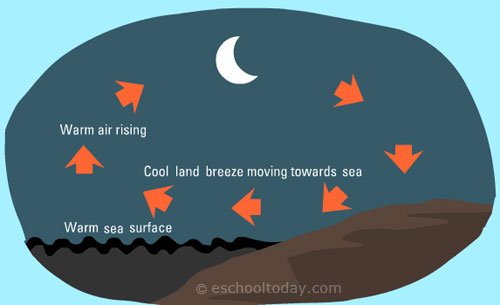
The arrow above the water is coming down and is blue because
the water is warm so it warms the air and warm air sinks.
the water is cold so it warms the air and cool air sinks.
the water is cold so it cools the air and cool air sinks.
the water is warm so it warms the air and cool air sinks.
207
Multiple Choice
Convection currents form when
there are no temperature differences.
there are temperature differences.
each surface is exactly the same temperature.
candy is given out for Halloween.
208
Multiple Choice
The arrow above the land is coming down and is blue because
the land is warm so it warms the air and warm air sinks.
the land is cool so it cools the air and cool air sinks.
the water is warm so it cools the air and warm air sinks.
the land is warm so it warms the air and cool air sinks.
209
Multiple Choice
The arrow above the water is going up and is red because
the water is warm so it warms the air and warm air sinks.
the water is warm so it cools the air and cool air sinks.
the water is warm so it warms the air and warm air rises.
the land is warm so it warms the air and cool air sinks.
Show answer
Auto Play
Slide 1 / 209
SLIDE

Similar Resources on Wayground
208 questions
UNIT 2- Cell Structure and Function
Presentation
•
11th Grade
202 questions
PGIS review - OB
Presentation
•
Professional Development
213 questions
Perkembangan Peradaban Islam di Dunia
Presentation
•
12th Grade
212 questions
ASSET PRACTICE
Presentation
•
5th Grade
197 questions
IELTS SPEAKING
Presentation
•
University
207 questions
Marine Science Ch 9
Presentation
•
9th Grade
200 questions
[GRADE 10] END OF TERM REVISION
Presentation
•
10th Grade
Popular Resources on Wayground
20 questions
"What is the question asking??" Grades 3-5
Quiz
•
1st - 5th Grade
20 questions
“What is the question asking??” Grades 6-8
Quiz
•
6th - 8th Grade
10 questions
Fire Safety Quiz
Quiz
•
12th Grade
20 questions
Equivalent Fractions
Quiz
•
3rd Grade
34 questions
STAAR Review 6th - 8th grade Reading Part 1
Quiz
•
6th - 8th Grade
20 questions
“What is the question asking??” English I-II
Quiz
•
9th - 12th Grade
20 questions
Main Idea and Details
Quiz
•
5th Grade
47 questions
8th Grade Reading STAAR Ultimate Review!
Quiz
•
8th Grade