

Lesson #4

Presentation
•
Physics
•
12th Grade
•
Easy

Kevin Correa
Used 20+ times
FREE Resource
106 Slides • 4 Questions
1
E.Q: How do the properties and differences between vectors and scalars influence our understanding and description of the physical phenomena in the world?

2
3

4
Multiple Choice
Choose which is NOT a vector quantity
volume
velocity
acceleration
force
5

SI units and conversions
6


Other systems of units
7

1 meter = 1 x10⁹ nanometers (nm)
1 miles (mi) = 1609.34 meter
1 kg = 2.20 lbs
1 year = 365.25 days
1 day = 24 hrs
1 hr = 3600 sec
1 min = 60 sec
Main conversions
The meters can
be change by
grams and the
conversions
will be the
same.
8

sinθ = Opposite _
Hypotenuse
cosθ = Adjacent _
Hypotenuse
tanθ = Opposite _
Adjacent
Equations for triangles
θ
This goes in the
section for side
equations
9

θ =sin-1 Opposite _
Hypotenuse
θ =cos-1 Adjacent _
Hypotenuse
θ =tan-1 Opposite _
Adjacent
Equations for triangles
θ
This goes in the
section for angle
equations
10

A lakefront drops off gradually at an angle. To provide
some info about the depth, a lifeguard rows straight
out from the shore a distance of 14m and drops a
weighted fishing line. By measuring its length, he
determines the depth to be 2.25m. (a) What is the
value of the angle? (b) What would be the depth of the
lake at a distance of 22m from the shore?
Example 2
11

Vectors
12

Vectors
1. Vector is a quantity that has magnitude and direction.
2. Scalar has magnitude without direction.
3. Magnitude = size (how big it is)
4. Direction = where the arrow is pointing (left, right, North,
South, 90 degrees, 240 degrees)
5. Resultant = final vector that results from the addition or
subtraction of multiple vectors
tail
head
vector
13

Mention different examples of:
Vectors
Scalars
Velocity
Displacement
Acceleration
Force
Impulse
Momentum
Time
Distance
Speed
Temperature
Work
Electrical Charge
EOC question
14


Remember to always use directions
90°
0°
180°
270°
Add this in
your notes.
Is REALLY
IMPORTANT
for vectors.
15

How to draw vectors?
Rules:
1. Draw the 1st vector.
2. The 2nd vector will always start where the 1st one
ends.
3. The resultant will form connecting the tail of the first
vector with head of the last one.
Ex.1:
A
B
Resultant
16
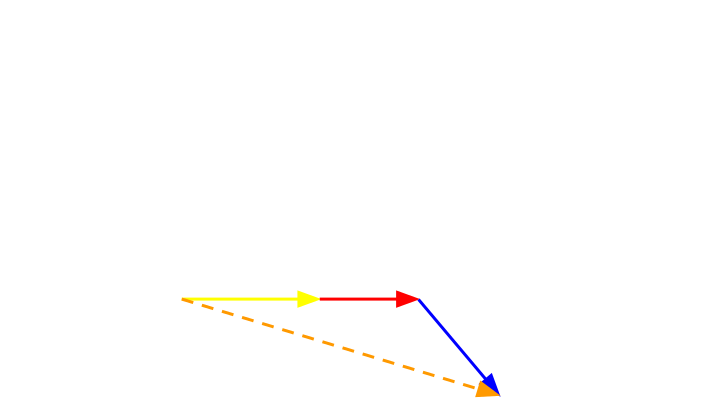
How to draw vectors?
Rules:
1. Draw the 1st vector.
2. The 2nd vector will always start where the 1st one
ends.
3. The resultant will form connecting the tail of the first
vector with head of the last one.
Ex. 2:
A
B
C
Resultant
17


Rules to add vectors mathematically
18

Rules to add vectors and scalars
Ex #1: A + B = R
Ex #2: A + (-B) = R
Ex #3: A + (-C) = 0
Ex #4: R = √A2 + B2
Find the values for
each examples if:
A = 12
B = 5
C = 12
19
Vector Practice Worksheet
� 1. If we add two displacement vectors with
magnitudes of 20 km and 9km. What will be
the maximum and minimum we can have?
Give ALL the possible answers (this means you
must find all the answers in different
directions).
20

Vector Practice Worksheet
�2. Add the following vectors. Use the
rules to draw them and add them
(mathematically). Find the magnitude of
the resultant vector and the direction.
�Vector A = 10 m North
�Vector B = 6m South
�Vector C = 13 m East
21


Vector Practice Worksheet
� 3. Train station #1 lies 13 km north
from train station #2. Train station
#3 lies 18.5km west away from
station #2. If we want to connect
stations 1 and 3, what will be
distance of the railroad track that
will connect them?
� Solve the problem, draw vectors
and give a direction to the resultant.
2
1
3
22

Check your answers
23

Problem #1 (Answer)
� If we add two displacement vectors with
magnitudes of 20 km and 9km. What will be
the maximum and minimum we can have?
Give all the possible answers (find different
directions).
� +/- 29 km
� +/- 11km
� 21.93 km
24

Problem #2 (Answer)
�Add the following vectors. Use the rules to draw
them and add them (mathematically). Find the
magnitude of the resultant vector and the
direction.
�Vector A = 10 m North
�Vector B = 6m South
�Vector C = 13 m East
� Answer: 13.6 m and the direction is 17.1°
� (internal angle will be 72.89°)
R
25


Problem #3 (Answer)
� Train station #1 lies 13 km north
from train station #2. Train station
#3 lies 18.5km west away from
station #2. If we want to connect
stations 1 and 3, what will be
distance of the railroad track that
will connect them?
� Solve the problem, draw vectors
and give a direction to the resultant.
�
� Answer: 22.61 km and the direction
is 35.1° from 3-1 and 54.9° from 1-3
2
1
3
R
26

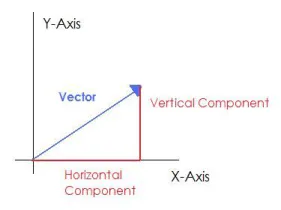
Vectors Components
27

How do we find vector components?
Component in X
Component in Y
35°
A
Ax
35°
Ay
Component in Y
28

How do we find vector components?
(create a table in your notebook similar to this)
When you have components
When you have the angle and the
vector
Page 16 of the
notebook
29
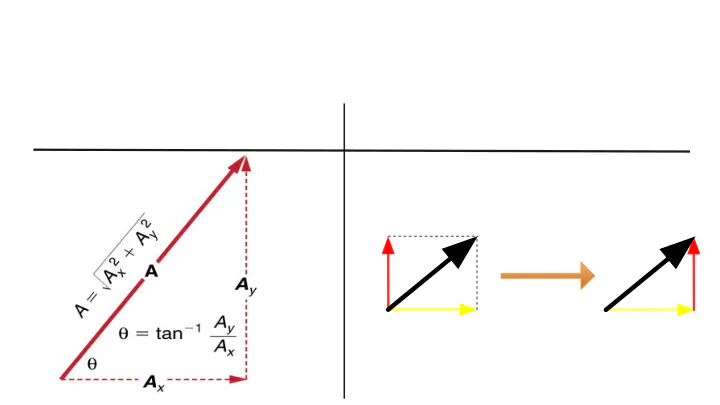
How do we find vector components?
(create a table in your notebook similar to this)
When you have components (Ax and Ay)
When you have the angle and the
vector
� To find Ax we use: Ax = A cos Ѳ
� To find Ay we use: Ay = A sin Ѳ
A
Ay
Ax
Ay
Ax
A
30


Think about it...
Which of the following
vectors have the
same y-component
as vector a? How
long is the
y-component?
31


Solution
Answers:
b and c
32

Practice problems
1. Find the x and y components of a 10.5 m vector
with a 35º angle.
2. Find mathematically the components in x and y
for an applied force of 25 Newton at 56 degrees.
What will be the new force if the y-component is
doubled?
33

Practice Problems (Vector Jamboard)
3. Find the each component (x and y) of the
vectors if they have the following measures:
a. 467.54 m with an Ѳ = 48°
b. 23.09 Km with an Ѳ = 77°
4. If the horizontal component is 34.9m and the
vertical component is 53.2m, what will be the
magnitude and direction of the vector?
34

Practice problems (Answers)
1. Find the x and y components of a 10.5 m vector
with a 35º angle.
Ax =8.6m Ay =6.02m
2. Find mathematically the components in x and y
for an applied force of 25 Newton at 56 degrees.
What will be the new force if the y-component is
doubled?
Ax =13.98N Ay =20.73N / New A = 43.75N
35

Practice Problems (Answers)
Find the each component (x and y) of the vectors
if they have the following measures:
a. Ax = 312.85m, Ay =347.45m
b. Ax = 5.19km, Ay = 22.5km
If the horizontal component is 34.9m and the
vertical component is 53.2m, what will be the
magnitude and direction of the vector?
A = 63.63m, θ = 56.73°
36


Combination of multiple vectors at
different angles (Sec. 1.8)
IMPORTANT:If our vectors have different angles we
can’t add them directly. We have to find the
components first.
Find your cornell notes
37

Combination of multiple vectors at
different angles
Step #1: Find the individual components for each vector (A and B)
using trigonometric functions (sin and cos).
Components: Ax , Ay , Bx and By
Step #2: Add all the components in x together and all the y’s
together.
Rx = Ax + Bx and Ry = Ay + By
38

Test Review
Unit #1
39

Instructions
You will work with the review in your notebook.
Label the section you are working on.
The review is on Canvas in Unit #1 Module.
Do it on pages 18-19, find the
notebook presentation on
Canvas.
40

Kahoot practice review game
Link:
https://kahoot.it/challenge/05398496?challenge-
id=6750d3aa-b5f2-4304-9979-98458f673438_1
629915023358
Pin: 05398496
41


Test Today
Instructions:
Get your computer, calculator, notecards, scratch paper and pencil. Put your backpacks
at the back of the classroom.
Your test will be done through Lockdown Browser. Find it on your desktop.
I will provide you with the password as soon as everyone is ready.
When you finish your test, you can work on your notebook or missing work.
Remember the due date for the notebook is today but your late date is Monday. The due
date for missing work it TODAY.
42

Password
Test#12021A
43

Maybe I will use it or maybe I
won’t
44

Vector doodles review
We will fill out a section of this
document in class but you
must complete the rest as
review.
45

Drawing vectors section
How to draw vectors (this goes where the stairs are):
1.
Draw the compass
2.
Start at the center
3.
Measure the correct angle with a protractor
4.
Draw a thin straight line
5.
Measure with a ruler
6.
Finish with a small arrow
After the steps, at the end of the page, there is a practice problem.
This section explain
in more detail what
we discussed in the
last slides.
46

Adding vectors section
Steps:
Step #1: Draw the 1st vector using the proper steps.
Step #2: Begin the 2nd vector exactly where the 1st vector
ended.
Step #3: The resultant vector begins with the 1st vector
and ends with the 2nd.
47

Links
P-2 →https://tinyurl.com/P-2VectorsPractice
P-3→https://tinyurl.com/P-3VectorsPractice
P-4→https://tinyurl.com/P-4VerctorsPractice
P-5→https://tinyurl.com/P-5VectorsPractice
P-6→https://tinyurl.com/P-6VectorsPractice
P-7→https://tinyurl.com/P-7VectorsPractice
48

Bellwork from Monday August
23rd
What will be the size of a shadow cast by a
flag pole 5.5 m tall if the angle created by the
Sun and the floor is 38 degrees? Draw the
picture and solve.
Solve this in the small paper
you took at the beginning of
class. While you are working, I
will sign the HW.
49

Bellwork (Answer)
What will be the size of
a shadow cast by a flag
pole 5.5 m tall if the
angle created by the Sun
and the floor is 38
degrees? Draw the
picture and show work.
38°
5.5m
tanϴ = opp
adj
tan38 = 5.5m
x
X = 7.04m
x
50

● Homework #1: Scientific Method
● Go to Canvas to find it.
● Due date: Wednesday August 22nd
Scientific Method or Cycle of Scientific Thinking
51

1. Are your measurements (if you don’t understand the
difference, find the definition online):
● Precise?
● Accurate?
● Reliable?
2. Why?
3. You think your measurements will change if you remeasure the
objects with a ruler? Why?
Bellwork: As soon as you enter, take a bellwork
document and answer the following questions on
Thursday’s space
52

Change the next four slides to a quiz
53

Let’s Practice
▪ Mario studied how far room temperature water would spurt
out of a plastic milk carton when 3mm holes were punched at
different heights from the bottom of the container. Identify
the DEPENDENT variable
▪ 3mm holes
▪ Distant water traveled out of carton
▪ Different heights of the holes in the container
▪ Ice water from Iceland
54

Let’s Practice (Answer)
▪ Mario studied how far room temperature water would spurt
out of a plastic milk carton when 3mm holes were punched at
different heights from the bottom of the container. Identify
the DEPENDENT variable
▪ 3mm holes
▪ Distant water traveled out of carton
▪ Different heights of the holes in the container
▪ Ice water from Iceland
55

Let’s Practice
▪ Mr. McNiece wanted to see how different types of music
affected students’ pulse rates. He played different types of
music: heavy metal, rap, R&B, alternative, pop, country, and
classical. What CONSTANT should be considered when doing
this experiment?
▪ Amount of time the music was played
▪ Use all dead people
▪ Using a different student for each music type
▪ Types of music
56

Let’s Practice (Answer)
▪ Mr. McNiece wanted to see how different types of music
affected students’ pulse rates. He played different types of
music: heavy metal, rap, R&B, alternative, pop, country, and
classical. What CONSTANT should be considered when doing
this experiment?
▪ Amount of time the music was played
▪ Use all dead people
▪ Using a different student for each music type
▪ Types of music
57

Problem:
� Marcos wants to measure the movement of a slug moving in
a straight line on the sidewalk. He recorded the following
table. Find the displacement from 5 to 25 seconds. Find the
average velocity from 10 to 15 seconds
Time (sec)
Position (mm)
0
20
5
23.4
10
26.8
15
24.6
20
31.9
25
34
58

Bellwork (August 19, 2019)
(3 min)
List the main steps to the scientific method (6
steps at least).
59

I will need 4 students who
speak another language
besides english. You will
have to translate a
message you will receive in
a card in that language.
Class:
If they were scientists and
they need to share their
research, what will they do
to communicate with each
other?
Class role play
60

Finish presentations
As soon as you enter show the
work for your problem on the
board.
61

Bellwork (Aug 25)
5 min
● Find the x and y components of a
18.9 m vector with a 24.6º angle.
● How the main vector will change if
the components are reduced by
half? Is the direction going to
change?
Use any scratch paper you have
available to do it.
62

Bellwork (Answers)
● Find the x and y components of a 18.9
m vector with a 24.6º angle.
○ Ax = 17.18 m, Ay = 7.87 m
● How the main vector will change if the
components are reduced by half? Is
the direction going to change?
○ A = 9.45 m, The angle will not
change.
63

Bellwork (Tuesday August 20,2019)
1. Why do we need a common system in the
scientific community?
2. Summarize in 4 steps how would you
convert a number from one unit to the
other? If you want use 3km = _____mm as a
reference.
64

Activity #1: Scientific Method
Write LAB on the Thursday and Friday section of your bellwork.
65

Go to Canvas and create a copy of the document: Activity #1:
Scientific Method
This will be the format your group will follow for the assignment. One
member of the group will make a copy of it and share it with the rest.
This will be your first assignment and practice for future labs.
Title the assignment: P#_Class Assignment#1:Scientific Method_Last
names and Initials
Writing portion:
66

Purpose: You will develop your own experimental
procedure and measurements.
Your objective is to develop your own problem,
hypothesis, observations, experimental procedure, data
analysis and possible answers (“conclusions”).
At the end, you must have your own measuring system.
Instructions for the Activity #1: Scientific Method
67


Using the materials on the counter measure the
following objects (you can use each material once):
1. A shortest pinky fingernail (from your
table)
2. The length of the classroom
3. The height of a tallest person in the table
4. The vertical distance between each slat
from the window blinds
Activity (15 min)
68

List of materials to measure the
objects:
Paperclip
Pencil
Wood stick
Box of markers
Band-aid
69

Check your Activity #1 document
Make sure you have the measurements of each
object.
At least, 5 observations.
The problem and your predictions.
Write up to 4 steps to explain the process you
did in class.
70

You need
Computers
Notecards
Pencil
Calculators
**Backpack at the front of the classroom.
71

Quiz
Go on Canvas and find the quiz titled Quiz #1 in the
Modules section.
You will have 10 minutes to answer your quiz. You need
your conversion factors.
You will work on the version assigned to your seat
number. (Versions are on the next slide.)
Do the math on paper.
72

Versions
Version A
1
5
9
13
17
21
25
Version B
2
6
10
14
18
22
Version C
3
7
11
15
19
23
Version D
4
8
12
16
20
24
73

● Measure with a ruler in cm each object (box of
markers, pencil, etc.) you used on the activity.
● Record the actual measurement of the object.
● Create a conversion factor.
● Example: 1 eraser (horizontally) = 5.3 cm
● Convert each measurement you got to its actual
value in cm.
Activity: (Part II)
74

Height of the person = 28 ¾ erasers
Step #1: 28 ¾ erasers = 28.75 eraser
Step #2: Conversion factor → 1 eraser = 5.3cm
Step #3: Convert
28.75 erasers 5.3 cm = 152.4 cm
1 eraser
Example
Actual size is:
_________
75

Complete the following sections
in the Activity
● Your observations
● Your prediction (you can talked about what will happen if
you use a ruler instead of those materials)
● Procedure (at least 5 steps)
● Measurement scale (Ex. band-aid horizontally = 4.2cm)
● Conclusions (address you problem)
● Submit it through Canvas
76

Bellwork (Answers)
1. 2.36 Km = 2360m
2. 40 days = 3456000 seconds
77

Bellwork: (As soon as you enter, answer the
following questions on Monday’s section) (4 min)
Solve and show work:
1. 2.36 Km = _______m
2. 40 days = _______seconds
78

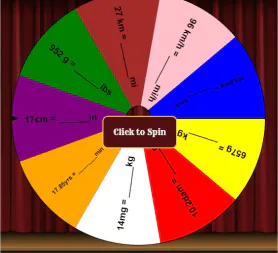
Each group will choose the problem and present it to the class.
Solving the problems
79

Bellwork (Thursday August 29, 2019)
(5 min) Start as soon as you enter!
� Find the resultant vector, the direction and
create the drawing for a person moving with
the following coordinates:
� 1050.6m with an Ѳ = 90°
� 30.5Km with an Ѳ = 180°
� 10 Km with an Ѳ = 360°
80

Bellwork (Thursday August 29, 2019)
Answer
Step #1: Convert the 1st coordinate from m to km.
Step #2: Draw your vectors.
Step #3: Classify your x’s and y’s based on your drawing. Subtract or add if
you have multiple vectors in the same axis.
Step #4: Use the total for your x’s and y’s and place it in the Pythagorean
theorem to find the magnitude of the resultant.
Step #5: Use the total for your x’s and y’s and find the direction using tan-1.
� Answer: 20.53 km and the direction is -87.1°
81

Bellwork (4 min)
What is the difference between a vector and a scalar?
Mention 2 examples of each.
Add the following vectors and determine the resultant
and its direction.
● 4.0 m/s, 90° and 2.0 m/s, 0° and 2.0 m/s, 270°
82

Bellwork (Answer)
Add the following vectors and determine the resultant and its
direction.
● 4.0 m/s, 90° and 2.0 m/s, 0° and 2.0 m/s, 270° (A: 2.83 m/s 45°)
83

Instructions
Go to the following link: https://tinyurl.com/Physics-InASecondLanguage
and read the article.
Discuss the following questions in your BBB group.
1.What is your perspective about the language barrier mention when we try to learn and teach
physics?
2.Do you think having a common language for scientific research affects the way we share
knowledge with other countries?
3.Why do you think was necessary to establish a common measuring system and language for
scientific research?
4.Is there any personal experience that relates to the article?
5.If you speak another language (other than english), try to talk using that language in you BBB small
group and see if other people can understand what you are saying.
84

Go on Canvas to find the EdPuzzle videos and answer
the questions.
Trigonometry (HW)
85

Example 1
R
A
B
Each vector has a
different magnitude
and direction. To add
them we have to look
for the components.
A=20
B=32
θa=50°
θb = 65°
86

Step #1:
Components
of A
Ax = A cosθ
Ay = A sinθ
A=20
θa=50°
87

Step #2:
Components of B
Bx = B cosθ
By = B sinθ
B=32
θb = 65°
88

If the components
are in the same
axis (x or y) they
will be grouped
together.
X components
Step #3: RX = AX + BX
89

Y components
Step #3: RY = AY + BY
90

Step #4:
The sum of the x'sand the y's creates
the components of the resultant.
To find the angle of the resultant:
θR = tan-1(Ry/Rx)
R = √Rx2 + Ry2
91

If you combine the vectors
components from A and B,
they will form the vector
component in x and y for the
resultant.
AX
BX
AY
BY
R
R = √Rx2 + Ry2
RX = AX + BX
RY = AY + BY
A=20
B=32
θa=50°
θb = 65°
92

Example 2
A
B
R
A=10
B=12
θa=30°
θb = 290°
93

Components
of A
A=10
θa=30°
94

Components
of B
By is going to
a negative direction
B=I2
θb = 290°
95

Displace the vector components
The blue
vector goes
on top of the red
96

Ry and R
will be negative
numbers.
97

Instructions
Go to the discussion board and answer the question.
After the discussion board we will complete the
problems we were working on yesterday.
When we finish the problems we will have a quiz.
Then we will do a vector review.
First test will be this Tuesday if nothing change.
98

Results
Ax =8.66 Ay = 5
Bx = 4.1 By = -11.28
Rx = 12.76
Ry = -6.28
R = 11.11
ϴR = -26.19° (334°)
99

A
B
C
R
Example 3
A=20
B=18
θa=30°
θb = 20°
C=44
θc=305°
100

A
B
C
R
Components
for A
A=20
θa=30°
101

A
B
C
R
Components
for B
B=18
θb = 20°
102

A
B
C
R
Components
for C
C=44
θc=305°
103

A
B
C
R
Displace the vectors
Ax
Bx
Cx
104
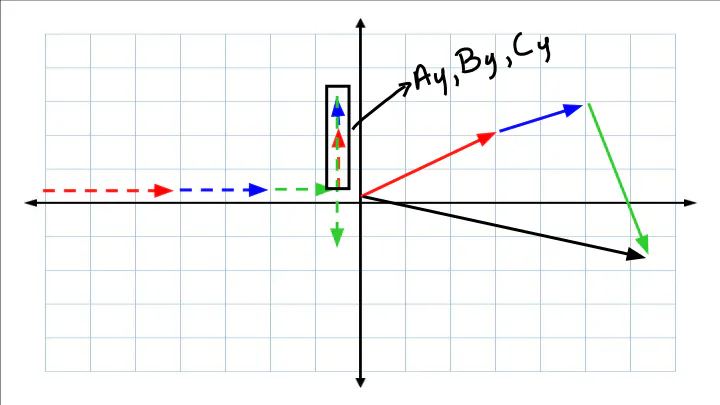
A
B
C
R
Displace the vectors
Ax
Bx
Cx
105

A
B
C
R
Transfer the resultant
106
Multiple Choice

What is the resultant of these two vectors?
+17 m
+3 m
-17 m
-3 m
107
Multiple Choice

The side of the right triangle of length A is __________ to angle α
adjacent
opposite
hypotenuse
inverse
108
Multiple Choice

The side of the right triangle of length B is called __________ to angle α
adjacent
opposite
hypotenuse
inverse
109
110

Bellwork (Sept 6, 2019) 5 min
Find the direction of the resultant vector
made by the combination of the following
displacement vectors:
� A = 105.6m with an Ѳ = 45°
� B = 0.305Km with an Ѳ = 80°
� Put your homework on the side of your desk.
E.Q: How do the properties and differences between vectors and scalars influence our understanding and description of the physical phenomena in the world?
Show answer
Auto Play
Slide 1 / 110
SLIDE
Similar Resources on Wayground

101 questions
DC US History
Presentation
•
12th Grade
102 questions
American Imperialism
Presentation
•
KG - University
100 questions
F6 E1 Past paper practice (DRQ on external processes)
Presentation
•
12th Grade
102 questions
DC US History Imperialism
Presentation
•
University
109 questions
C++ Basic Concepts
Presentation
•
11th Grade
105 questions
OP 4/3
Presentation
•
11th Grade
103 questions
Nervous system + plasticity
Presentation
•
12th Grade
99 questions
Periodic Motion
Presentation
•
12th Grade
Popular Resources on Wayground
10 questions
Safety Day 2026 – Student Review

Quiz
•
9th Grade
21 questions
Continents and Oceans
Quiz
•
6th Grade
20 questions
Parts of Speech
Quiz
•
5th Grade
16 questions
Subject & Predicate
Quiz
•
5th Grade
25 questions
Multiplication Facts
Quiz
•
5th Grade
12 questions
Map Skills
Quiz
•
3rd Grade
22 questions
Continents and Oceans
Quiz
•
5th Grade
15 questions
Rounding Decimals
Quiz
•
5th Grade
