
11.2.6

Presentation
•
History
•
12th Grade
•
Practice Problem
•
Easy

Andrew Lara
Used 10+ times
FREE Resource
8 Slides • 7 Questions
1

2
American industrialization began after the Civil War. The U.S. shifted from agriculture to industry.
Within 60 years after the Civil War, the U.S. grew to become the leading industrial power in the world.

-La industrialización estadounidense comenzó después de la Guerra Civil. Estados Unidos pasó de la agricultura a la industria.
-Dentro de los 60 años posteriores a la Guerra Civil, Estados Unidos creció hasta convertirse en la principal potencia industrial del mundo.
Agriculture to Industry
3
Multiple Choice
After the Civil War, the United States became a leader in ___
Después de la Guerra Civil, los Estados Unidos se convirtieron en un líder en ___
Industry
Industria
Agriculture
Agricultura
Military
Militar
Shipping
Naviero
4
Factors of Industrial growth
An abundance (a lot) of natural resources.
Government support for business.
A growing urban population provided cheap labor and a market for new products.
Many immigrants between 1880 and 1910 settled in eastern cities to work in the factories.
A transportation network of rivers, canals, roads, and railroads.

-Una abundancia (mucha) de recursos naturales.
-Apoyo gubernamental a las empresas.
-Una creciente población urbana proporcionó mano de obra barata y un mercado para nuevos productos.
-Muchos inmigrantes entre 1880 y 1900 se establecieron en las ciudades orientales para trabajar en las fábricas.
-Una red de transporte de ríos, canales, carreteras y ferrocarriles.
5
Multiple Choice
A growing ___ population provided cheap labor and a new market for industrial products.
Una creciente población ___ proporcionó mano de obra barata y un nuevo mercado para los productos industriales.
Urban
Urbano
Rural
Suburban
Suburbano
Subterranean
Subterráneo
6
Natural resources
Abundant deposits of oil, coal, and iron fueled technological growth.
In 1859 a steam engine was successfully used to drill for oil in Pennsylvania. This led to a boom in oil extraction in Texas, Kentucky, and Ohio.
The oil boom led to the rise of petroleum refining industries in Cleveland and Pittsburgh. Coal production grew from 33 million tons in 1800 to 240 million in 1900.

-Los abundantes depósitos de petróleo, carbón y hierro impulsaron el crecimiento tecnológico.
-En 1859 se utilizó con éxito una máquina de vapor para perforar en busca de petróleo en Pensilvania. Esto llevó a un auge en la extracción de petróleo en Texas, Kentucky y Ohio.
-El auge del petróleo llevó al surgimiento de las industrias de refinación de petróleo en Cleveland y Pittsburgh. La producción de carbón creció de 33 millones de toneladas en 1800 a 240 millones en 1900.
7
Multiple Select
Which of these resources provided fuel for technological growth?
¿Cuál de estos recursos proporcionó combustible para el crecimiento tecnológico?
Oil
Aceite
Coal
Carbón
Iron
Hierro
Wood
Madera
Diamonds
Diamantes
8
Steel production
Bessemer steel process was developed around 1850. It created steel, a lighter more rust-resistant metal than iron. Carnegie brought this process to the US.
The steel industry provided the material for thousands of miles of railroad tracks.
Steel also allowed new forms of construction, such as skyscrapers and the Brooklyn Bridge.


-El proceso de acero Bessemer se desarrolló alrededor de 1850. Creó acero, un metal más ligero y resistente a la oxidación que el hierro. Carnegie trajo este proceso a los Estados Unidos.
-La industria siderúrgica proporcionó el material para miles de kilómetros de vías férreas.
-El acero también permitió nuevas formas de construcción, como los rascacielos y el puente de Brooklyn.
9
Multiple Choice
Which industry helped expanded the railroads?
¿Qué industria ayudó a expandir los ferrocarriles?
oil
aceite
steel
acero
iron
hierro
lumber
madera
10
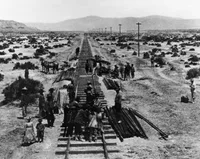
Transcontinental railroad
In 1869, the first transcontinental railroad was completed with government funding.
Federal government land grants and loans supported the completion of the railroad network.
Railroads provided rapid transportation of people, raw materials, farm produce, and finished factory products.
New towns and markets were built along the railroad lines.

-En 1869, el primer ferrocarril transcontinental se completó con fondos del gobierno.
-Las concesiones y préstamos de tierras del gobierno apoyaron la finalización de la red ferroviaria.
-Los ferrocarriles proporcionaron un rápido transporte de personas, materias primas, productos agrícolas y productos terminados de fábrica.
-Se construyeron nuevas ciudades y mercados a lo largo de las líneas ferroviarias.

11
Multiple Choice
What kind of support helped the completion of the Transcontinental Railroad?
¿Qué tipo de apoyo ayudó a la finalización del Ferrocarril Transcontinental?
Private investment
Inversión privada
Federal aid
Ayuda federal
Local donations
Donaciones locales
Foreign investment
Inversión extranjera
12
Need for foreign markets
Railroads had a great demand for iron, coal, steel, lumber, and glass, which fueled the growth of those industries.
Technological advances in the late 19th century led to overproduction in the United States. Farms and industries produced more products than American citizens could consume.
The United States looked to foreign trade for raw materials for manufacturing and new markets to sell U.S. agricultural products and manufactured goods.

-Los ferrocarriles tenían una gran demanda de hierro, carbón, acero, madera y vidrio, lo que impulsó el crecimiento de esas industrias.
-Los avances tecnológicos a finales del siglo 19 llevaron a la sobreproducción en los Estados Unidos. Las granjas y las industrias producían más productos de los que los ciudadanos estadounidenses podían consumir.
-Los Estados Unidos buscaron en el comercio exterior materias primas para la manufactura y nuevos mercados para vender productos agrícolas y manufacturados estadounidenses.

13
Multiple Choice
Overproduction of industrial goods and products resulted in the US having to___.
Overproduction of industrial goods and products resulted in the US having to___.
look for foreign markets
stop production
donate extra products to the poor
do nothing
14
15
Open Ended
What was the importance of trains and the Transcontinental Railroad to the United States?
¿Cuál fue la importancia de los trenes y el Ferrocarril Transcontinental para los Estados Unidos?
Show answer
Auto Play
Slide 1 / 15
SLIDE
Similar Resources on Wayground

12 questions
11.2.4
Presentation
•
12th Grade
11 questions
Monetary Policy
Presentation
•
12th Grade
10 questions
Processing
Presentation
•
12th Grade
12 questions
Levels of Organization
Presentation
•
12th Grade
12 questions
3A Gramática : -ER and -IR regular verbs
Presentation
•
KG - 12th Grade
11 questions
Société d'état et Société privée
Presentation
•
11th - 12th Grade
10 questions
Cultural Iceberg
Presentation
•
12th Grade
10 questions
La Cultura Griega
Presentation
•
12th Grade
Popular Resources on Wayground
10 questions
How much do you know about our Portrait of an Eagle?

Quiz
•
10th Grade
10 questions
Fast Food Slogans
Quiz
•
6th - 8th Grade
21 questions
Continents and Oceans
Quiz
•
6th Grade
20 questions
Parts of Speech
Quiz
•
5th Grade
16 questions
Subject & Predicate
Quiz
•
5th Grade
25 questions
Multiplication Facts
Quiz
•
5th Grade
12 questions
Map Skills
Quiz
•
3rd Grade
22 questions
Continents and Oceans
Quiz
•
5th Grade
Discover more resources for History
28 questions
US History QSE MP1 Review
Quiz
•
9th - 12th Grade
10 questions
The Punic Wars and the Rise of the Roman Republic

Interactive video
•
6th - 12th Grade
15 questions
The Bill of Rights
Quiz
•
8th - 12th Grade
17 questions
SSUSH10 Reconstruction
Quiz
•
10th - 12th Grade
37 questions
AP Euro Unit 2
Quiz
•
12th Grade