

1.2 Rates

Presentation
•
Mathematics
•
KG
•
Practice Problem
•
Easy
+2
Standards-aligned

Hoa Vo
Used 2+ times
FREE Resource
23 Slides • 12 Questions
1
Rates
Tutorial

Tỷ suất
Hướng dẫn
2

Objective
In this lesson, you will explore the concept of a unit rate and use rates to describe ratio relationships.
Mục tiêu
Trong bài học này, bạn sẽ được tìm hiểu khái niệm về tỷ suất đơn vị và sử dụng tỷ suất để mô tả các mối quan hệ tỷ lệ.
3

Introduction
Shannon loves going to fairs. This summer, Shannon's mother is taking her and her friend Emma to the Marion County Fair. Shannon and Emma are excited about trying the rides because they are now old enough to ride without an adult. They plan to go on every ride using the FunPasses that Shannon's mother bought them. A FunPass gets you 20 tickets for $10. Shannon wants to know the cost of one ticket. In this lesson, you'll see how to find the rate of one ticket and how to use rates in daily life.
Giới thiệu
Shannon thích đi hội chợ. Mùa hè này, mẹ của Shannon sẽ đưa cô và bạn của cô là Emma đến Hội chợ của quận Marion. Shannon và Emma rất hào hứng với việc thử các trò chơi cảm giác mạnh vì giờ họ đã đủ tuổi để có thể chơi mà không cần người lớn đi cùng. Họ dự định chơi tất cả các trò chơi cảm giác mạnh bằng cách sử dụng FunPass mà mẹ Shannon đã mua cho họ. FunPass giúp bạn mua được 20 vé chỉ với 10 đô. Shannon muốn biết một vé có giá là bao nhiêu.
Trong bài học này, bạn sẽ biết cách tính tỷ suất của một vé và cách sử dụng tỷ suất trong cuộc sống hàng ngày.
4

5
6
Rate and Unit Rate
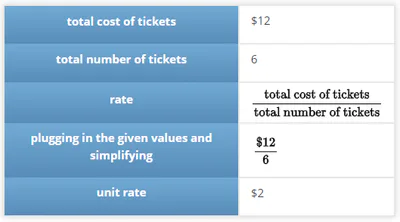
Just as we can simplify ratios with large numbers, we can simplify rates that involve large numbers by dividing the numerator by the denominator. Sometimes, after simplifying, we can write the rate with the number 1 in the denominator. A rate with the number 1 in the denominator is called a unit rate. For example, Tony is going to the movies with his friends. They buy six tickets for $12. What is the unit rate they pay for the tickets?
7
Tỷ suất và tỷ suất đơn vị
Nếu như chúng ta có thể rút gọn tỷ lệ của các số lớn, thì tương tự, chúng ta cũng có thể rút gọn tỷ suất của các số lớn bằng cách lấy tử chia cho mẫu. Đôi khi, sau khi rút gọn, chúng ta thu được tỷ suất với mẫu là 1. Tỷ suất có mẫu là 1 được gọi là tỷ suất đơn vị.
Ví dụ, Tony đi xem phim cùng một vài người bạn. Họ mua 6 vé với giá 12 đô. Tỷ suất đơn vị họ phải trả cho 6 vé là bao nhiêu?

8
Shannon is at the fair. She has already been on a couple of rides, and now she has only 13 tickets left. She wants to use her tickets wisely to get the maximum ride time with her remaining tickets. She wants to find the rates (ride time per ticket) of the different rides in the fair. This table shows the cost, in tickets, and the ride time for the six rides at the fair:
Activity

9
Labeling
Part A: Find the rate for each ride in seconds per ticket using the rate=number of ticketsride time . Type your answers in the table. The rate for the first ride has been filled in for you. Simplify each rate as much as possible.
10
Dropdown

Part B:
Based on the table in part a, on two rides 11
Dropdown
Part C: Based on the table in part a, on ride
12
Dropdown

Part D: Based on the table in part a, what is the difference of the highest and the lowest rates?
The
13
Dropdown

Part E: The Ferris wheel has the highest rate, which is 55 seconds per ticket. Straight Up! has the lowest rate per ticket, 5 seconds per ticket. The ratio of the rate for the Ferris wheel to the rate for Straight Up! is
14
Multiple Choice

Part F: The carousel has a rate of 25 seconds per ticket. Straight Up! has a rate of 5 seconds per ticket. The ratio of the rate for Carousel to the rate for Straight Up! is:
525=15
255=51
1550=310
32
15
Dropdown
Part G: If a ride has the highest rate in seconds per ticket, how would it benefit Shannon?
Answer: With a single ticket, Shannon can ride for the 16
Multiple Choice

Part H: If Shannon had to pay $0.50 for each ticket, what is the rate for bumper cars in seconds per dollar?
Hint: rate = cost of ticketsride time
140=40
401
240=20
402=21
17
Open Ended
Self-Evaluation
How did you do? Rate your work on a scale of 1 to 5, with 5 as the highest score. Then write a brief evaluation of your work below. Note what you learned and what challenged you.
18

19
20

Speed
Rates are used in many situations. One of the most common uses of rates is to state a speed. Speed can tell us how fast something is going or how long it will take to go a certain distance. When we talk about a speed, we are comparing a distance with the time it takes to travel that distance. Let's look at an example. Jamie rides his motorcycle for three hours and travels a distance of 150 miles. What is his speed in miles per hour?

21
Vận tốc
Tỷ suất được sử dụng trong nhiều trường hợp. Một trong những công dụng phổ biến nhất của tỷ lệ là biểu diễn vận tốc. Vận tốc cho chúng ta biết một vật đang chuyển động nhanh như thế nào, hoặc thời gian để vật đó đi được một quãng đường nhất định. Khi nói về vận tốc, chúng ta đang so sánh quãng đường với thời gian cần thiết để đi hết quãng đường đó.
Ví dụ. Trong 3 giờ, Jamie lái mô tô đi được quãng đường 150 dặm. Hỏi Jamie di chuyển với vận tộc bao nhiêu dặm mỗi giờ?
Tổng quãng đường Jamie đi được | 150 dặm |
Tổng thời gian mà Jamie đã đi | 3 giờ |
Viết tốc độ ở dạng tỷ lệ | Tổng quãng đường Jamie đi đượcTổng thời gian mà Jamie đã điTổng quãng đường Jamie đi đượcTổng thời gian mà Jamie đã đi
|
Thay các giá trị đã cho vào tử và mẫu rồi rút gọn | 150 dặm3 giờ150 dặm3 giờ
|
Vận tốc của Jamie | 50 dặm mỗi giờ |
22
Open Ended
Olivia is on a road trip with her family. During a three-hour stretch, they traveled 183 miles. How fast were they driving in miles per hour?
23

Unit Price
When a unit rate refers to the price of an item, it is called a unit price. So, the unit price of an item is the price of one unit of measure of that item. Knowing the unit price can help you buy items at the best rate when you're shopping. If you've set the maximum amount you can spend, you can use the unit price to find the quantity of the item to buy.
Here's an example. Suppose that four dozen apples cost $16. What is the unit price, or the price per dozen apples?

24
Đơn giá
Khi tỷ suất đơn vị đề cập đến giá của một mặt hàng, nó được gọi là đơn giá. Vì vậy, đơn giá của một mặt hàng là giá của một đơn vị đo lường mặt hàng đó. Khi đi mua sắm, việc biết được đơn giá sẽ giúp bạn mua được các mặt hàng với mức giá phù hợp nhất. Nếu đã thiết lập số tiền chi tiêu tối đa, bạn có thể sử dụng đơn giá để tính ra số lượng mặt hàng cần mua.
Ví dụ. Giả sử 4 tá (48) quả táo có giá 16 đô. Đơn giá hoặc giá của 1 tá (12) quả táo là bao nhiêu?

25
Multiple Choice
At the supermarket, Rick finds that 6 pounds of raisins cost $12. What is the price per pound of raisins?
$5
$1
$4
$2
26

27
28

A babysitter's weekly wages depend on the number of work hours and the wages per hour.
Wages
If we know how much someone earns in an hour, we can figure out how much that person earns in a day, a week, or other period of time. To make this calculation, we use the concept of unit wage. We can also do the opposite and find the unit wage using a person's earnings over a certain time.
For example, Nelly works as a babysitter 25 hours a week. Her weekly income is $225. What is her hourly wage, or rate per hour?

29
Tiền lương
Nếu biết số tiền mà một người kiếm được trong 1 giờ, chúng ta có thể tính được số tiền mà người đó kiếm được trong 1 ngày, 1 tuần hay một khoảng thời gian khác. Để làm được điều này, chúng ta sử dụng khái niệm tiền lương đơn vị. Ngược lại, chúng ta cũng có thể tính được tiền lương đơn vị khi biết thu nhập của một người trong một khoảng thời gian nhất định.
Ví dụ, Nelly làm công việc trông trẻ 25 giờ một tuần. Hàng tuần, Nelly kiếm được 225 đô. Hỏi mỗi giờ, cô ấy kiếm được bao nhiêu?

30

31
32
Multiple Choice
Debra travels a distance of 2 miles in 1 minute. How much distance can she cover in 25 minutes? Choose the correct equivalent rate.
25 minutes48 miles
25 minutes22 miles
25 minutes39 miles
25 minites50 miles
33
You can use unit rates to make cost-effective purchases at the supermarket.

Summary
In this lesson, you learned about rates and unit rates. These quantity comparisons are similar to ratios. While a ratio is used to compare any two quantities, a rate is a type of ratio that compares two quantities that have different units of measure.
Rates appear in many everyday situations. You can use the concept of rate to calculate cost of food and other everyday purchases. You can also use rates to find the speed something travels if you know the distance traveled and the time it took to travel that distance.
Unit rates are found by simplifying rates so that the second quantity is exactly 1. Unit rates are used when referring to miles per hour, price per pound, and wages per hour.
When a rate is given as a ratio, it can be simplified to a unit rate. The rate and the unit rate are equivalent, meaning that they state the same comparison.
34
Tóm tắt
Trong bài học này, bạn đã được học về tỷ suất và tỷ suất đơn vị. Những phép so sánh đại lượng này tương tự như tỷ lệ. Trong khi tỷ lệ được dùng để so sánh 2 đại lượng bất kỳ, thì tỷ suất là một loại tỷ lệ so sánh 2 đại lượng có đơn vị đo khác nhau.
Tỷ suất xuất hiện trong nhiều trường hợp của cuộc sống thường ngày. Bạn có thể sử dụng khái niệm này để tính chi phí để mua thực phẩm và các sản phẩm hay dịch vụ thường ngày khác. Bạn cũng có thể sử dụng tỷ suất để tìm vận tốc di chuyển của một vật khi biết quãng đường đã đi và thời gian cần thiết để đi hết quãng đường đó.
Chúng ta tìm tỷ suất bằng cách rút gọn tỷ lệ sao cho đại lượng thứ 2 (mẫu) bằng 1. Tỷ suất đơn vị được sử dụng khi đề cập đến số dặm đi được mỗi giờ, giá của mỗi pound và thu nhập mỗi giờ.
Khi một tỷ suất được cho dưới dạng tỷ lệ, nó có thể được rút gọn thành tỷ suất đơn vị. Tỷ suất và tỷ suất đơn vị là 2 tỷ suất tương đương, nghĩa là chúng thể hiện cùng một sự so sánh.
35

Congratulations!
You have completed the tutorial
Rates.
Chúc mừng!
Bạn đã hoàn thành hướng dẫn này
Tỷ suất.
Rates
Tutorial
Tỷ suất
Hướng dẫn
Show answer
Auto Play
Slide 1 / 35
SLIDE
Similar Resources on Wayground

28 questions
Best Measure of Center & Balance Point
Presentation
•
6th Grade
28 questions
Properties of Operations
Presentation
•
6th Grade
28 questions
Transformations of Exponential & Logarithmic Functions
Presentation
•
9th - 12th Grade
27 questions
Triangle Congruence Practice
Presentation
•
9th - 11th Grade
27 questions
Quadrilaterals
Presentation
•
4th Grade
30 questions
Inequalities
Presentation
•
5th - 8th Grade
28 questions
Operations with Scientific Notation
Presentation
•
8th Grade
28 questions
Dividing Fractions
Presentation
•
6th Grade
Popular Resources on Wayground
21 questions
Continents and Oceans

Quiz
•
6th Grade
20 questions
Parts of Speech
Quiz
•
5th Grade
16 questions
Subject & Predicate
Quiz
•
5th Grade
25 questions
Multiplication Facts
Quiz
•
5th Grade
12 questions
Map Skills
Quiz
•
3rd Grade
22 questions
Continents and Oceans
Quiz
•
5th Grade
15 questions
Rounding Decimals
Quiz
•
5th Grade
20 questions
Brand Labels
Quiz
•
5th - 12th Grade
Discover more resources for Mathematics
20 questions
Place Value
Quiz
•
KG - 3rd Grade
15 questions
tens and ones
Quiz
•
KG - 2nd Grade
15 questions
Single digit addition and subtraction
Quiz
•
KG - 1st Grade
10 questions
2-digit subtraction without regrouping
Quiz
•
KG - 2nd Grade
10 questions
addition with pictures
Quiz
•
KG
25 questions
Multiplication Facts
Quiz
•
KG - University
20 questions
Making 10
Quiz
•
KG - 1st Grade
11 questions
Counting to 10
Quiz
•
KG - 1st Grade