

The Protestant Reformation and the Counter Reformation

Presentation
•
History
•
9th - 12th Grade
•
Practice Problem
•
Easy

Preston Hill
Used 13+ times
FREE Resource
18 Slides • 2 Questions
1



The Protestant Reformation and the Counter Reformation
2
Open Ended
How familiar are you with the Protestant Reformation? List any important people, topics, or ideas you if you're familiar with them!
3

The Protestant Reformation and the Counter Reformation
What does
reformation mean?
Let’s break it down
Prefix Re
Root form
Suffix tion
4


The Catholic
Response
-The Catholic Reformation is the direct response
to the boom of Protestantism across Western
Europe and an attempt to fix the issues of the
Roman Catholic Church at the time. From
1545-1700, the Roman Catholic Church
launched a continent-wide campaign in an
attempt to win back over the same peasants they
had mistreated years ago while attempting to
rid itself of the systemic issues the church had
during this time period.
5


Prelude to Reformation and the Need for Reform
-During the second half of the 15th Century,
the classical learning that was part of Italian
Renaissance humanism makes its way from
Italy and into Northern Europe. The
combination of both Renaissance and
Northern European ideas spawned Christian
Humanism. Christian Humanism is the
belief that human freedom goes hand in
hand with Christianity and its doctrine.
-Desiderius Erasmus was the most famous
Christian Humanist of the time. Erasmus
believed that the Christianity could be more
than just the key to eternal salvation.
Salvation is the saving of one’s soul from
sin. According to Erasmus, the church
should be a guide to everyday life, not just
the key to salvation.
6


Prelude to Reformation and the Need for Reform
-The Roman Catholic Church dominated
Western European life. Entering the 1500s, the
Roman Catholic Church was the center of
power, influence, and salvation. Salvation is the
saving of one’s soul.
-A majority of Europeans were
extremely illiterate. According to
Queen’s University, the literacy rate of
all of Europe as of 1500 was 11%.
Monks and bishops were the only
people that learned logic, grammar, and
writing.
-For most Western Europeans, they had
no choice but to follow the command of
the Roman Catholic Church due to the
severe lack of other educational
institutions at the time.
7

Prelude to Reformation and the Need for Reform
-The Roman Catholic Church was
immensely corrupt at the time. Corruption
is the practice of dishonest conduct by those
in power.The RCC functioned more so as a
political organization than a religious
organization. High ranking RCC officials
benefitted on their connections to high
ranking politicians and monarchs.
-The Roman Catholic Church’s immense
wealth stemmed from indulgences.
-Indulgences were the forgiveness of sins in
exchange for financial compensation.
8

9
Open Ended
Are indulgences immoral? Is there a justification for charging one's way into Heaven?
10

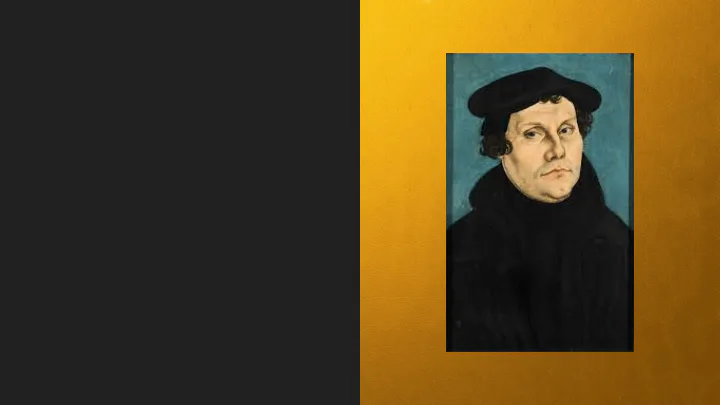
Martin Luther and the 95-Theses
-Martin Luther is credited with launching the Protestant
Reformation across Western Europe. Luther objected to
several of the Roman Catholic Church’s practices at the
time, including the enforcement of indulgences and the
divide the Church had created between God and
mankind.
-The former monk and teacher set the Protestant
Reformation in motion October 31, 1517 in Wittenberg
Germany when he nailed the Ninety-Five Theses to the
door of Castle Church
11

The Power of the 95
-The Ninety-Five Theses was the document that
single-handedly change the landscape of Christianity
across Western Europe. Luther’s stances on the Roman
Catholic Church serves as an excellent example to the
frustrations of European peasants as well as the
framework for what would become Protestantism. This
document can be credited with creating the first
denominations in world history. The first major
denominations that were founded across Europe include
the Lutheran, Calvinist, and Anabaptists Church.
12
Small Group
Discussion #1: The
Ninety-Five Theses
13


The Spread of
Protestantism:
England and
Switzerland’s
Changes
14

Reformation Reaches England
-King Henry VIII of England had fallen in
King Henry VIII was in love with Anne Boleyn despite being married
to Catherine of Aragon. However, when King
Henry VIII approached Pope Clement VII
about remarrying, he said that doing so
would result in England’s excommunication.
-In order to avoid excommunication, King
Henry VIII created the Church of England
while placing himself as the church’s head.
-The Church of England would be confirmed
when Parliament passed the Act of
Supremacy on November 3, 1534.
15
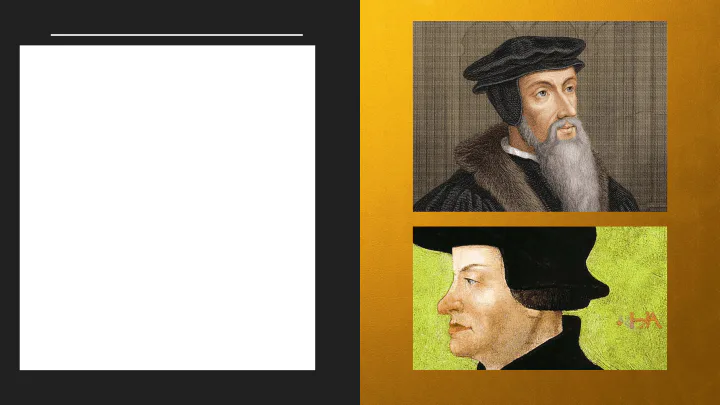
Reformation Reaches Switzerland
-While the Protestant Reformation
was taking off in Wittenberg,
thousands of Swiss university
students had not only heard of
Martin Luther’s ideas, but were
indoctrinated into Lutheranism.
These same students paired with
John Calvin and Huldrych Zwingli
were able to turn the Swiss city of
Geneva into “Protestant Rome” by
1536.
16

Small Group
Discussion #2: The
Act of Supremacy
17
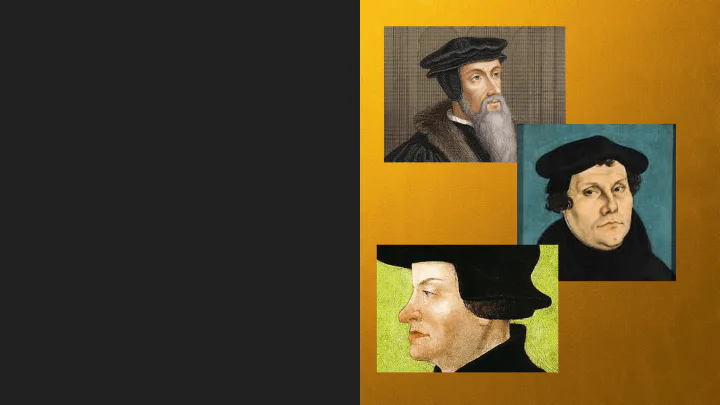
Denominational
Lightning Round:
Calvinism,
Lutheranism, and
Anabaptism
18

The Birth of Calvinism
-Calvinism was the first major
divergence from the Roman Catholic
Church that was spawned during the
Protestant Reformation. The Calvinist
movement was launched by John
Calvin and his teachings in
Switzerland and began teaching this
reformed doctrine in 1519.
-One of the key beliefs of Calvinism is
predestination. Predestination is the
belief that the world’s events and the
fate of one’s soul is already
determined by God.
Calvism is one of the first examples of Protestant
19


The Birth of Lutheranism
-Lutheranism was the direct result of the impact
of the Ninety-Five Theses. After Martin Luther
nailed the document to the doors of Centre
Church, the Roman Catholic Church
excommunicated the monk and teacher in an
attempt to annul Luther’s work. To annul
something is the act of cancelling or making
something invalid.
-After his excommunication, Luther founded the
“Churches of the Augsburg Confession” in 1517,
making the church the world’s first ever
Protestant church. If it were not for Lutheranism,
we would not have the Baptist, Methodist, or
Presbyterian churches today.
20


The Birth of Anabaptism
-Anabaptism was created as an offspring of Ulrich
Zwingli’s reforms in the Swiss church across the
1510s and into the 1520s. Swiss humanist Conrad
Gebel is credited with co-founding the Anabaptist
church in the city of Zurich only a few years after
John Calvin launched the Calvinist church in the
same city.
-Key beliefs of the Anabaptist church include that
baptism as an adult is the only proper way to be
baptised and that the public confession of one’s
sin is the only pathway to salvation.
The Protestant Reformation and the Counter Reformation
Show answer
Auto Play
Slide 1 / 20
SLIDE
Similar Resources on Wayground

15 questions
Naming Covalent Compounds
Presentation
•
9th - 12th Grade
15 questions
Math 3 EOC Review
Presentation
•
9th - 12th Grade
15 questions
Arithmetic Sequences
Presentation
•
9th - 12th Grade
15 questions
Redox Reactions
Presentation
•
9th - 12th Grade
15 questions
Reviewing Simplifying Rational Expressions by Factoring
Presentation
•
9th - 12th Grade
15 questions
Negation in French
Presentation
•
9th - 12th Grade
15 questions
Trigonometry Review
Presentation
•
9th - 12th Grade
15 questions
[AH2] Great Depression/FDR
Presentation
•
9th - 12th Grade
Popular Resources on Wayground
10 questions
HCS SCI 03 Summer School Assessment 1

Quiz
•
3rd Grade
15 questions
HCS SCI 05 Summer School Assessment 1 Review
Quiz
•
5th Grade
22 questions
Day 9 Equations and Inequalities Review
Quiz
•
9th Grade
10 questions
Writing and Identifying Ratios Practice
Quiz
•
5th - 6th Grade
7 questions
PYRAMID PERSPECTIVES part 1
Presentation
•
9th - 12th Grade
12 questions
Understanding the Fourth of July
Quiz
•
9th Grade
15 questions
Soccer World Cup Quiz Questions
Quiz
•
7th Grade