

Oh, California: Chapter 1 & 2 review

Presentation
•
Social Studies
•
4th Grade
•
Easy

Janina Brzechwa-Delgado
Used 4+ times
FREE Resource
44 Slides • 19 Questions
1

The first few slides are review, next will come vocabulary, and lastly will be a quiz to make sure we are ready to move on.
California - Regions to Archeology
2
- The Earth is round
- Globes represent the earth

3
- 7 Continents: Asia, Africa, North America, South America, Antarctica, Europe, Australia
- Asia is the biggest continent. Africa is the second biggest. Australia is the smallest.
- THEY ARE NOT COUNTRIES.
- Countries exist within continents
- Separated by land and ocean

4
- 4 Oceans
- Arctic, Indian, Pacific, Atlantic
- The Pacific Ocean is the biggest

5
- There is no center
- Maps show what the map-maker wants it to show
-This map shows the continents of the earth.

6
Labeling
Label the 7 continents
North America
Australia
Asia
Antarctica
South America
Africa
Europe
7
Labeling
Label the two oceans that border the United States
Pacific Ocean
Atlantic Ocean
8
Hotspot
Click on California
9
Coastal Region
Mountain Region
Desert Region
Central Valley Region

10
A region is an area with common features that set it apart from other areas.
Features can include landforms (mountain ranges, valleys, etc.), climate, soil, and natural vegetation.
11

12

13
the Sierra Nevada
the Coastal Range

14
The Sierra Nevada stretches about 450 miles from north to south.
It runs about 50 miles across, from east to west.
The Sierra Nevada region makes up about 25 percent of California’s land area.

15
Snowmelt from the Sierra provides water for farms and dairies.
It also provides drinking water for millions of California residents.

16


The Central Valley gets water from the snow melt of the Sierra Nevada Mountains. From earliest times, Californians have grown corn, wheat, and squash.
GROWING CROPS
With mild temperatures and plenty of grassland, herding cattle and raising chickens is one of California's largest economy producers.
RAISING LIVESTOCK
The Central Valley is an excellent location to grow grapes, almonds, walnuts, peaches, apples and so much more.
PLANTING ORCHARDS
17

18

19
Multiple Choice

This region borders the Pacific Ocean.
Central Valley
Desert
Coastal
Mountain
20
Multiple Choice

What region are these plants from?
Desert Region
Mountain Region
Central Valley
Coastal Region
21
Multiple Choice
Which region has long growing seasons allowing crops to be farmed 10 months of the year?
Central Valley
Desert Regions
Mountain Regions
Coastal Ranges
22
Multiple Choice
capital
valley
mountain
desert
23
Wind, Water, Sun and Geothermal

24

25

26

27

28

29

30

31

32

33

34

35
Multiple Choice

What is the most common natural resource important in both the Desert and Mountain regions?
timber
fish
oil
minerals
36
Multiple Select
What are the two natural resources found in California's environment?
trees
clouds
oil
soil
37
Multiple Choice
Minerals and petroleum are what type of resource?
rocks
nonrenewable
renewable
oil
38

39
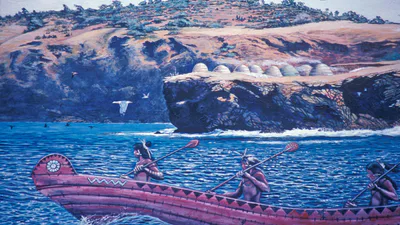
Native Californians and how they lived.
Discovering California
40
More than fifteen thousand years ago, huge sheets of ice covered much of Canada and
the northern United States. In some places the ice was thousands of feet thick

41
Some lands that are now under water were dry. That’s why dry land once connected Asia to North America. During the Ice Age, this dry land formed an area that scientists today call Beringia or the “land bridge.”

42

43
They had to look for plants and animals to eat. Small groups of just a few families, perhaps twenty-five to fifty people, helped each other as they moved around in search of food. People who live this way are called hunter-gatherers.

44
While the women and children of the Ice Age looked for plants and berries, the men and older boys hunted. They tracked herds of mammoth and musk ox back and forth across Beringia.

45
Between nine thousand and fifteen thousand years ago, groups of hunter-gatherers spread out through this new world. Little by little, they moved into the ice-free parts of North America. They walked everywhere—and traveled all the way to South America’s southern tip!

46

47

48
Multiple Choice
Huge sheets of thick ice are called _______.
Beringia
Strip
glaciers
49
Multiple Choice
What is the name of the bridge of land that connected Asian and North America?
Beringia
The Strip
Bridgeland
glaciers
50
Multiple Choice
What two Continents were connected by Beringia?
Europe and North America
Asia and North America
North and South America
51
Multiple Choice
How did hunter-gatherers find food?
They went to the supermarket
They followed herds and hunted animals
They grew crops
52
Multiple Choice
_______ are the tools, weapons, and other objects left behind by people of long ago.
archeologists
bones
artifacts
berries
53

54

55

56
Multiple Choice
The Yurok lived in the ________ corner of California.
northeast
southeast
northwest
southwest
57
Multiple Choice
What did the Yurok people collect to show wealth?
fish
shells
coins
bones
58

59

60

61

62
Multiple Select

What did the Chumash hunt for in the sea? (Hint: there is more than one answer)
whales
seals
deer
tuna
dolphins
63
Multiple Choice
The type of canoe that the Chumash built was called ________.
canoe
tomols
speedster
harpoons
The first few slides are review, next will come vocabulary, and lastly will be a quiz to make sure we are ready to move on.
California - Regions to Archeology
Show answer
Auto Play
Slide 1 / 63
SLIDE
Similar Resources on Wayground

59 questions
Comparing Fractions
Presentation
•
4th Grade
55 questions
Comma Rule Lesson
Presentation
•
5th Grade
58 questions
Get Smart Plus 4 Module 6: Getting Around (Page 59-61)
Presentation
•
4th Grade
56 questions
CKLA G5_U2_L2
Presentation
•
5th Grade
59 questions
FEB13 Point of View
Presentation
•
4th Grade
60 questions
FEB6 Inference Text Evidence
Presentation
•
4th Grade
54 questions
Battle of Hastings/Magna Carta 7.31 & 7.33
Presentation
•
5th Grade
58 questions
Percentage (Math 4)
Presentation
•
4th Grade
Popular Resources on Wayground
10 questions
Safety Day 2026 – Student Review

Quiz
•
9th Grade
21 questions
Continents and Oceans
Quiz
•
6th Grade
20 questions
Parts of Speech
Quiz
•
5th Grade
16 questions
Subject & Predicate
Quiz
•
5th Grade
25 questions
Multiplication Facts
Quiz
•
5th Grade
12 questions
Map Skills
Quiz
•
3rd Grade
22 questions
Continents and Oceans
Quiz
•
5th Grade
15 questions
Rounding Decimals
Quiz
•
5th Grade
Discover more resources for Social Studies
14 questions
Age of Exploration
Quiz
•
4th Grade
22 questions
Northeast states and capitals
Quiz
•
4th Grade
9 questions
Hardships In Jamestown Vs.3f
Quiz
•
4th - 5th Grade
11 questions
Northeast Region States
Quiz
•
4th Grade
5 questions
Math GI 2.1.4 Quiz Review
Presentation
•
1st - 5th Grade
25 questions
Virginia Studies Regions/Rivers
Quiz
•
4th Grade
12 questions
Unit 3 VS.3d
Presentation
•
4th Grade
5 questions
The Boston Massacre

Interactive video
•
4th Grade