

Inertia

Presentation
•
Science
•
8th Grade
•
Practice Problem
•
Hard
+4
Standards-aligned

Tabatha Duffey
Used 112+ times
FREE Resource
12 Slides • 0 Questions
1
You Will Need:
Chromebook, INB, Pencil, Paper off the back counter

S6E1. Obtain, evaluate, and communicate information about current scientific views of the universe and how those views evolved. d. Develop and use a model to explain the interaction of gravity and inertia that governs the motion of objects in the solar system.
2
Review:
Mass - How much matter an object has
- remains constant
- cannot be 0
- measured in kilograms (kg)
Weight - force of gravity on a object
- changes based on gravity
- measured in Newtons (N)

(F= force, M = Mass, A = Acceleration)
3

Inertia is the property of an object that makes it resist changes in its motion.
Objects want to keep doing what they're already doing.
If something is at rest (not moving), it wants to stay at rest.
If something is moving, it wants to keep moving in a straight line at the same speed.
4
Inertia and Mass:
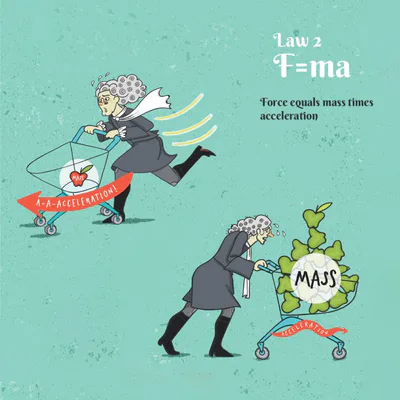
Inertia is related to an object's mass.
Objects with more mass have more inertia.
It's like they're "heavier" when it comes to resisting changes in motion.
So, a big heavy truck has more inertia than a small toy car.
5
In space, where there's no air resistance or friction, objects keep moving in a straight line at a constant speed unless something else, like a spaceship's engines, changes their motion.
Inertia in Space

6
7
Orbital Motion: Gravity and inertia work together to keep smaller celestial bodies, such as planets, moons, and satellites, in orbit around larger objects like stars or planets.

8
Gravity's Role: Gravity is the force of attraction between two masses. In the case of a planet orbiting a star, gravity pulls the planet toward the star.
9
Inertia's Role: Inertia is the tendency of an object to resist changes in its state of motion. In this scenario, the planet's inertia wants it to keep moving in a straight line, tangential to its orbit.
10
Balanced Forces: When gravity (magnetic force) pulls the planet toward the star, the planet's inertia (force of motion) keeps it moving forward. These forces balance each other, resulting in a curved path—the planet orbits the star instead of falling directly into it or drifting away into space.
11

12


You Will Need:
Chromebook, INB, Pencil, Paper off the back counter
S6E1. Obtain, evaluate, and communicate information about current scientific views of the universe and how those views evolved. d. Develop and use a model to explain the interaction of gravity and inertia that governs the motion of objects in the solar system.
Show answer
Auto Play
Slide 1 / 12
SLIDE
Similar Resources on Wayground

10 questions
Erosion by Wind & Waves
Presentation
•
9th Grade
10 questions
Heredity & Punnett Squares
Presentation
•
7th Grade
9 questions
Entrepreneur
Presentation
•
8th Grade
9 questions
Quadrant 1 Quiz
Presentation
•
8th Grade
9 questions
Friction
Presentation
•
8th Grade
9 questions
APE MAN
Presentation
•
8th Grade
12 questions
Adaptations
Presentation
•
8th Grade
12 questions
Which Chemical Reaction is Occuring
Presentation
•
8th Grade
Popular Resources on Wayground
10 questions
Safety Day 2026 – Student Review

Quiz
•
9th Grade
21 questions
Continents and Oceans
Quiz
•
6th Grade
20 questions
Parts of Speech
Quiz
•
5th Grade
16 questions
Subject & Predicate
Quiz
•
5th Grade
25 questions
Multiplication Facts
Quiz
•
5th Grade
12 questions
Map Skills
Quiz
•
3rd Grade
22 questions
Continents and Oceans
Quiz
•
5th Grade
15 questions
Rounding Decimals
Quiz
•
5th Grade
Discover more resources for Science
20 questions
Newton's Laws of Motion
Quiz
•
8th Grade
15 questions
potential and kinetic energy
Quiz
•
8th Grade
21 questions
Newton's Laws of Motion
Quiz
•
8th Grade
20 questions
Elements, Compounds and Mixtures
Quiz
•
8th Grade
10 questions
Exploring Chemical and Physical Changes

Interactive video
•
6th - 10th Grade
20 questions
Physical vs Chemical Changes
Quiz
•
8th Grade
20 questions
Conduction, convection, and Radiation Practice
Quiz
•
8th Grade
21 questions
Waves and Wave Properties
Quiz
•
6th - 8th Grade