1. Introduction to organic chemistry
Presentation
•
Chemistry
•
10th Grade
•
Medium
Faik Bolat
Used 54+ times
FREE Resource
21 Slides • 17 Questions
1
2
3
4
5
6
7
8
Multiple Choice
Which two elements do all organic compounds contain?
Carbon and hydrogen
Carbon and oxygen
Oxygen and hydrogen
Carbon and nitrogen
9
Multiple Choice
Which type of bonding is present within organic molecules?
Covalent bond
Ionic bond
Metallic bond
Hydrogen bond
10
Multiple Choice
There are millions of compounds in organic chemistry due to the bonding capacity of ..................element
Oxygen
Carbon
Hydrogen
Nitrogen
11
Multiple Choice
Which statement is correct?
All organic compounds contain carbon
All organic compounds contain hydrogen
12
Multiple Choice
Organic reactions are generally very ......................and .......................are needed
fast - inhibitor
slow -catalyst
fast - catalyst
slow - inhibitor
13
14
15
16
Multiple Choice
Using combustion reaction of an organic compound, the empirical formula of the compound is found as CH2O . If the molar mass of organic compound is 180g/mol what is the molecular formula of the compound ? (C:12g/mol, H:1g/mol, O:16g/mol)
17
18
19
20
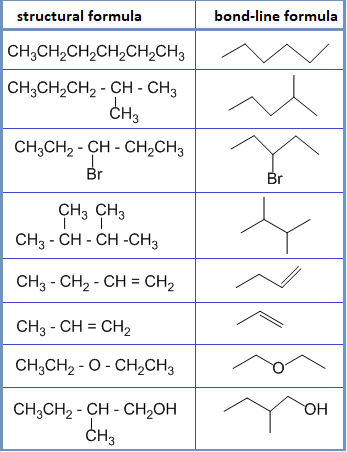
Drawing skeletal structures
Lewis structures show every atom and bond, which is impractical for large molecules. To simplify, chemists use bond-line structures. Bond-line structures focus on C–C bonds and bonds to heteroatoms (O, N, S, P). Carbons are not drawn, while heteroatoms are shown.
Full Lewis: shows all atoms and bonds.
Condensed Lewis: shows all atoms, but some bonds are omitted.
Bond-line: simplest form, uses lines to represent molecules while still giving the same information.
21
Quick Steps to Draw Bond-Line Structures:
1. Identify the carbon chain: Focus on the longest continuous chain of carbon atoms.
2. Use zig-zag lines: Each vertex or line end represents a carbon atom.
3. Show bonds: Lines represent C–C or C–heteroatom bonds. Triple bonds are straight.
4. Add heteroatoms: Always draw atoms like O, N, S, P; hydrogens on carbons are implied.
5. Place substituents properly: Attach side groups at the correct position on the main chain.
6. Check geometry: Ensure bond angles roughly reflect tetrahedral, trigonal, or linear geometry.
22
23
24
25
26
Multiple Choice
What is a functional group?
Atoms or group of atoms that give specific characteristics to a molecule
Group of molecules that make up a group of atoms
Group of molecules that give specific characteristics to an atom
Group of atoms that give specific characteristics to an element
27
Multiple Choice
How many hydrogens are missing from this extended structural formula?
6
7
8
9
28
Multiple Choice
What is the condensed formula of this structure?
CH3CH2CH2OH
CH3COCH3
CH3CH2CHO
CH3OCH2CH3
29
Multiple Choice
What is the condensed formula of this structure?
CH3CH2CH2OH
CH3COCH3
CH3CH2CHO
CH3OCH2CH3
30
Multiple Choice
The given structure is an example of ...
Expanded structure
Condensed structure
Skeletal structure
31
Multiple Select
If the given structure is converted to condensed structure, which will be its correct version?
CH3CH2CH2CH2CH2CH3
CH3(CH2)4CH3
C6H14
(CH3)2(CH2)4
32
Multiple Choice
What is the molecular formula for structure showed?
C8H18
C3H3
C8H3
C3H2(CH3)3
33
Multiple Choice
Carbon has _____ valence electrons.
2
4
6
8
34
Multiple Choice
Which of the two is an Organic Compound?
35
Multiple Choice
36
Multiple Choice
37
38
Show answer
Auto Play
Slide 1 / 38
SLIDE

Similar Resources on Wayground
35 questions
Periodic Table 2
Presentation
•
10th Grade
36 questions
Classifying Matter Review
Presentation
•
10th Grade
36 questions
Ions and Valence Electrons Octet Rule
Presentation
•
10th Grade
29 questions
The Periodic Table
Presentation
•
10th Grade
31 questions
Determining Half-Life Lesson
Presentation
•
9th Grade
30 questions
7.1 Stoichiometry Pt.2 Practice
Presentation
•
10th Grade
32 questions
Naming ionic and molecular compounds
Presentation
•
10th Grade
32 questions
Acids and Bases (Intro to pH)
Presentation
•
10th Grade
Popular Resources on Wayground
20 questions
STAAR Review Quiz #3
Quiz
•
8th Grade
20 questions
Equivalent Fractions
Quiz
•
3rd Grade
6 questions
Marshmallow Farm Quiz
Quiz
•
2nd - 5th Grade
20 questions
Main Idea and Details
Quiz
•
5th Grade
20 questions
Context Clues
Quiz
•
6th Grade
20 questions
Inferences
Quiz
•
4th Grade
19 questions
Classifying Quadrilaterals
Quiz
•
3rd Grade
12 questions
What makes Nebraska's government unique?
Quiz
•
4th - 5th Grade