AKS 9B - Electromagnetic vs. Mechanical Waves
Presentation
•
Science
•
8th Grade
•
Medium
+7
Standards-aligned
Marissa Brown
Used 41+ times
FREE Resource
8 Slides • 34 Questions
1
Electromagnetic vs. Mechanical Waves
2
​Types of Waves
Waves may be categorized based on whether or not they need a medium.
​There are two types of waves:
1.) Mechanical waves: require a medium (matter) to travel.
2.) Electromagnetic (EM) waves: do NOT require a medium to travel.
3
Multiple Choice
4
Multiple Choice
5
​Mechanical waves
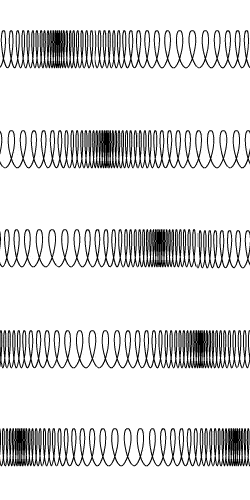
​These require a medium for the vibrations to travel and so cannot travel through space (vacuum)
​
​May either move as transverse or longitudinal waves.
​
​Ex. sound, water wave, slinky,
6
Multiple Choice
S8P4 a. When a mechanical wave travels through a medium,
energy and matter remain in one place.
matter is transferred from one place to another.
energy is transferred from one place to another.
matter and energy move from one place to another.
7
​​Mechanical waves
​The speed at which they travel depends on either the type of wave or the medium they are in.
​
​They travel fastest in more dense medium. Therefore, they move fastest in solids and slowest in gases.
​
​Generally, these have longer wavelengths than electromagnetic waves.
8
Multiple Choice
S8P4 a. When sound travels through air, the air particles vibrate
in the direction of the wave.
in all different directions.
perpendicular to the wave.
in a circular motion.
9
10
Multiple Choice
11
​Electromagnetic Wave
​A waves that does NOT require a medium (matter to travel), has an electric field component and a magnetic field component.
​
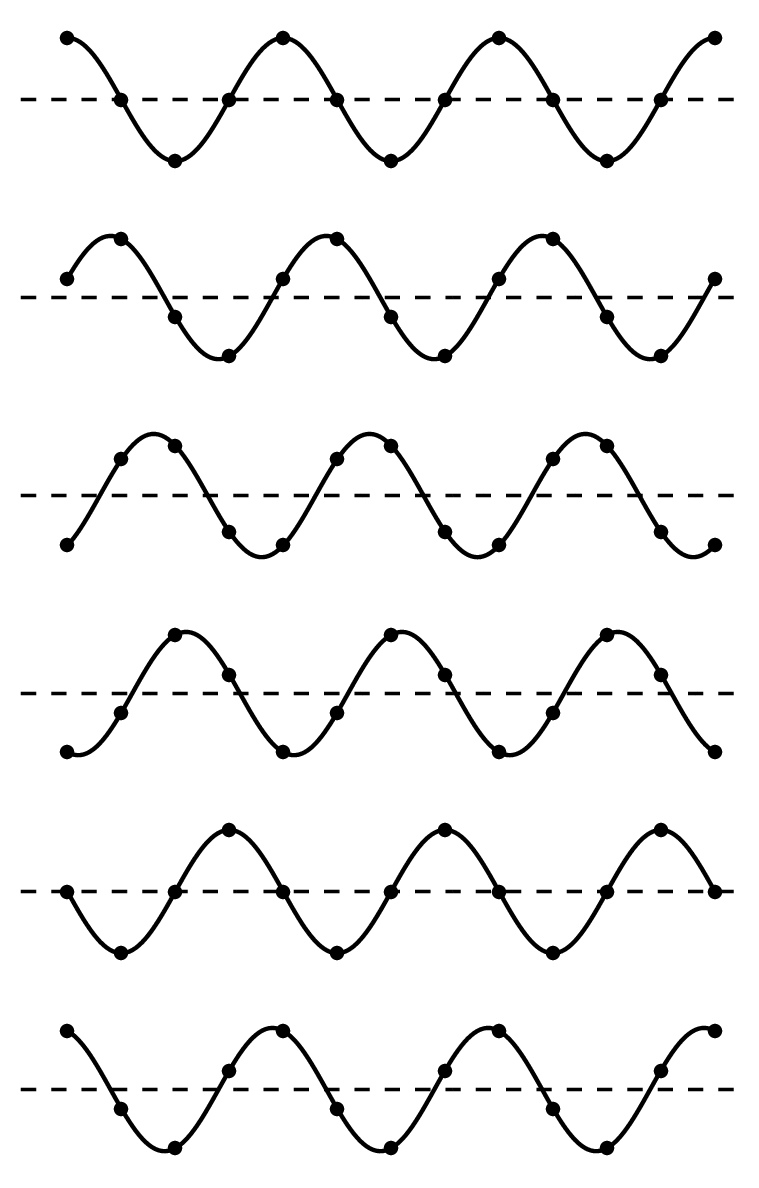
​These two fields move perpendicular to the propagation of the wave and so they are all transverse waves
12
Multiple Choice
13
​Electromagnetic waves
​All electromagnetic waves travels at the speed of light 3.0 x 10⁸ m/s in a VACUUM. However, they travels at different speeds when traveling through matter.
They travel fastest in less dense medium, so fastest in gases and slowest in solids.
Ex: Radio waves, Microwaves, Infrared, Visible Light, Ultraviolet, X-rays, and Gamma Ray.
14
Multiple Choice
15
​Electromagnetic Spectrum
​Shows a visual display of various electromagnetic waves to compare their relative wavelengths and frequencies.
16
Multiple Choice
17
Multiple Choice
Which type of waves must have a medium in order to travel?
electromagnetic wave
mechanical wave
18
Multiple Choice
19
Multiple Choice
Mechanical waves usually travel fastest through:
solids
liquids
gases
20
Multiple Choice
21
Multiple Choice
What type of wave is this?
Electromagnetic
Mechancial
Both Electromagnetic and Mechanical
22
Multiple Choice
23
Multiple Choice
A microwave is an example of what type of wave?
electromagnetic wave
mechanical wave
24
Multiple Choice
25
Multiple Choice
A water wave is an example of what type of wave?
electromagnetic wave
mechanical wave
26
Multiple Choice
Which one is an example of a transverse wave
Punching a bag
Loud Music
Sneezing
Water Waves
27
Multiple Choice
28
Multiple Choice
29
Multiple Choice
When the wavelength increases the frequency will
increase
decrease
remain same
none of these
30
Multiple Choice
31
Multiple Choice
Electromagnetic waves
Must travel through a vacuum
Can travel through a medium or a vacuum
Are the same type of wave as mechanical waves
Can only travel through a vacuum
32
Multiple Choice
33
Multiple Choice
34
Multiple Choice
*whether or not they require a medium to move through (EM vs mechanical) OR
*how the particles move in relation to the movement of the wave (transverse vs longitudinal).
A wave that requires a medium to move through is called a
(NOTE: Take time to study the chart before answering.)
35
Multiple Choice
When a wave is travelling through matter, what happens to the matter?
The matter is pulled along behind the wave as that makes it a longitudinal wave.
The wave is making the matter move back and forth as that will make a transverse wave.
The wave is making the matter move up and down.
The matter is pulled along behind the wave as that makes it a compressional wave.
The matter does not move along with the wave.
36
Multiple Choice
*whether or not they require a medium to move through (EM vs mechanical) OR
*how the particles move in relation to the movement of the wave (transverse vs longitudinal).
A wave that does NOT require a medium (can move through empty space) is a
37
Multiple Choice
It depends on the medium in which the wave is traveling. It varies in solids, liquids and gases.
Frequency
Wave speed
Amplitude
Wavelength
38
Multiple Choice
*whether or not they require a medium to move through (EM vs mechanical) OR
*how the particles move in relation to the movement of the wave (transverse vs longitudinal).
A wave in which the particles of the medium move up and down in relation to the wave is called a
39
Multiple Choice
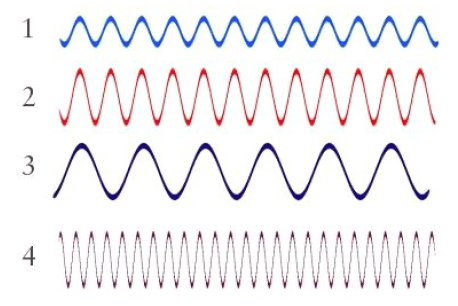
Which wave in the diagram has the greatest wavelength?
1
2
3
4
40
Multiple Choice
*whether or not they require a medium to move through (EM vs mechanical) OR
*how the particles move in relation to the movement of the wave (transverse vs longitudinal).
A wave in which the particles of the medium move back and forth along the path of the wave is called a
41
Multiple Choice
42
Multiple Choice
Electromagnetic vs. Mechanical Waves
Show answer
Auto Play
Slide 1 / 42
SLIDE

Similar Resources on Wayground
38 questions
Physical States and Temperature
Lesson
•
8th Grade
35 questions
Lesson 2: Energy and Conversions
Lesson
•
8th Grade
35 questions
Forces
Lesson
•
8th Grade
35 questions
Science 8 Year in Review- Unit D
Lesson
•
8th Grade
38 questions
Cahaya dan Alat Optik
Lesson
•
8th Grade
34 questions
Science 7 Year End Review - Unit D
Lesson
•
7th Grade
38 questions
temperature
Lesson
•
8th Grade
37 questions
Earthquakes and Earth's Layers
Lesson
•
8th Grade
Popular Resources on Wayground
10 questions
5.P.1.3 Distance/Time Graphs
Quiz
•
5th Grade
10 questions
Fire Drill
Quiz
•
2nd - 5th Grade
20 questions
Equivalent Fractions
Quiz
•
3rd Grade
15 questions
Hargrett House Quiz: Community & Service
Quiz
•
5th Grade
20 questions
Main Idea and Details
Quiz
•
5th Grade
20 questions
Context Clues
Quiz
•
6th Grade
20 questions
Inferences
Quiz
•
4th Grade
15 questions
Equivalent Fractions
Quiz
•
4th Grade
Discover more resources for Science
20 questions
Recognizing Violence and Being an Upstander
Quiz
•
8th Grade
19 questions
Introduction to Properties of Waves
Lesson
•
6th - 8th Grade
16 questions
Interactions within Ecosystems
Lesson
•
6th - 8th Grade
10 questions
Exploring the Layers of the Earth
Interactive video
•
6th - 10th Grade
20 questions
Newton's Laws of Motion
Quiz
•
8th Grade
46 questions
8th Science STAAR Review
Quiz
•
8th Grade
10 questions
Exploring the Dynamics of Ocean Currents
Interactive video
•
6th - 10th Grade
23 questions
Newton's 3 Laws of Motion
Quiz
•
8th Grade