
Levels of Organization - Cells to Biome
Presentation
•
Science, Biology
•
KG
•
Practice Problem
•
Medium
+3
Standards-aligned
Shelby Shuttlesworth Gleghorn
Used 33+ times
FREE Resource
19 Slides • 17 Questions
1
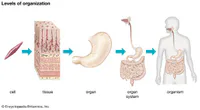
Levels of Organization
Today we are going to look at the different levels of organization and how they build upon one another.
2
Life is organized into different levels based upon size (from small to large).
3
Multiple Choice
Which of the following is the correct order of organization in living things from most basic (simple) to most complex?
organism, cell, tissue, organ, organ system
organ system, organ, tissue, cell, organism
cell, tissue, organ, organ system, organism
cell, organ, tissue, organism, organ system
4
Levels of Organization
Non-living
Living
Simple
Complex
Biomolecule
Life begins! →
INCREASING COMPLEXITY
DECREASING COMPLEXITY
5
Organisms and Cells
Some organisms are unicellular. This means they are made of only one cell. Ex: bacteria, yeast
Some organisms are multicellular. This means they are made of many cells. Ex: humans, trees
6
The basic unit of life.
CELL
7
Cell
The smallest unit of life (building blocks of life)
Cells are specialized by size and shape for the job they do.
Example: nerve cell, also called a neuron
8
Multiple Choice
The basic unit of structure and function of living organisms
organ
organ system
cell
tissue
organism
9
Tissue
The same type of cells grouped together that are working together to do a specific job.
Ex: nerve tissue, muscle tissue
10
TISSUE
Specialized cells working together to perform a specific function.
Animal Tissue
Plant Tissue
11
Multiple Choice
A group of similar cells that work together to form the same function is called .......
organ
cell
organ system
organism
tissue
12
Multiple Choice
What is the difference between a cell and a tissue?
cell is basic unit of life; tissue is group of cells that work as one
cell is group of tissues; tissue is basic unit of life
cell is basic unit of life; tissue is groups of different cells
cell is group of organs; tissue is group of different cells
13
ORGAN
A group of tissues working together to perform a specific
function.
PLANT ORGANS
14
Organ
A bunch of tissues working together to do a job.
Ex: brain, heart
15
Multiple Choice
A structure that is composed of different kinds of tissues
organ
cell
organ system
organism
tissue
16
A group of organs working together to perform a specific
function.
ORGAN SYSTEM
17
Organ System
A bunch of organs working together
Ex: nervous system, circulatory system, digestive system, etc.
18
Multiple Choice
A group of organs that work together to perform a major function....
organ
cell
organ system
organism
tissue
19
20
Organism
All cells, tissues, organs, and organ systems working together makes an organism.
Ex: human, animal
21
Multiple Choice
Any living thing made up of one or more cells....
organ
cell
organ system
organism
tissue
22
Multiple Choice
Which of the following is the correct order of organization in living things from most basic (simple) to most complex?
organism, cell, tissue, organ, organ system
organ system, organ, tissue, cell, organism
cell, tissue, organ, organ system, organism
cell, organ, tissue, organism, organ system
23
Multiple Select
Please choose from the options below, which are levels of organization.
cells
organ
body
skin
tissue
24
Levels of Organization
Non-living
Living
Simple
Complex
Biomolecule
Life begins! →
INCREASING COMPLEXITY
DECREASING COMPLEXITY
25
POPULATION
A group of plants, animals, or living organisms of the
same species.
26
COMMUNITY
A group of plants or animals living in the same place.
27
A biological community of interacting organisms which
include the biotic and abiotic factors.
ECOSYSTEM
28
BIOME
An ecosystem of plants and animals that have common
characteristics for the environment they live in.
29
Multiple Choice
Which of the following explains an ecosystem?
an interacting group of various species in a common location
all the organisms of the same group or species who live in a particular geographical area and are capable of interbreeding
a biological community of interacting organisms and their physical environment
a single individual, or being
30
Multiple Choice
Biologists organize the environment into ecological layers so they can communicate about the areas more efficiently. The diagram shows an example of the organization. If biologists were discussing an organism, which layer on the diagram would they most likely be referencing?
Layer A
Layer B
Layer C
Layer D
31
Multiple Choice
Biologists organize the environment into ecological layers so they can communicate about the areas more efficiently. The diagram shows an example of the organization. If biologists were discussing a population, which layer on the diagram would they most likely be referencing?
Layer A
Layer B
Layer C
Layer D
32
Multiple Choice
Biologists organize the environment into ecological layers so they can communicate about the areas more efficiently. The diagram shows an example of the organization. If biologists were discussing a community, which layer on the diagram would they most likely be referencing?
Layer C
Layer B
Layer A
Layer D
33
Multiple Choice
Biologists organize the environment into ecological layers so they can communicate about the areas more efficiently. The diagram shows an example of the organization. If biologists were discussing an ecosystem, which layer on the diagram would they most likely be referencing?
Layer A
Layer D
Layer C
Layer B
34
Multiple Choice
Biologists organize the environment into ecological layers so they can communicate about the areas more efficiently. The diagram shows an example of the organization. If biologists were discussing a howler monkey, which layer on the diagram would they most likely be referencing?
Layer A
Layer B
Layer C
Layer D
35
Multiple Choice
Biologists organize the environment into ecological layers so they can communicate about the areas more efficiently. The diagram shows an example of the organization. If biologists were discussing the African Savannah, which layer on the diagram would they most likely be referencing?
Layer A
Layer B
Layer C
Layer D
36
Multiple Choice
Place the categories in order from smallest to largest.
ecosystem, community, population, organism
organism, population, community, ecosystem
population, ecosystem, community, organism
organism, community, ecosystem, population
Levels of Organization
Today we are going to look at the different levels of organization and how they build upon one another.
Show answer
Auto Play
Slide 1 / 36
SLIDE

Similar Resources on Wayground
31 questions
Evolution terms part 1
Presentation
•
9th - 12th Grade
30 questions
Symbiosis
Presentation
•
9th Grade
30 questions
The Molecules of Life
Presentation
•
10th Grade
31 questions
Seafloor Spreading
Presentation
•
3rd - 8th Grade
31 questions
Cell terms part 2 - 2023
Presentation
•
10th Grade
31 questions
Composition of the Atmosphere
Presentation
•
7th Grade
31 questions
Genetic Engineering
Presentation
•
7th - 11th Grade
31 questions
Earth's Spheres
Presentation
•
6th - 8th Grade
Popular Resources on Wayground
10 questions
Fire Safety Quiz
Quiz
•
12th Grade
20 questions
Equivalent Fractions
Quiz
•
3rd Grade
20 questions
Main Idea and Details
Quiz
•
5th Grade
20 questions
Context Clues
Quiz
•
6th Grade
20 questions
Inferences
Quiz
•
4th Grade
36 questions
6th Grade Math STAAR Review
Quiz
•
6th Grade
19 questions
Classifying Quadrilaterals
Quiz
•
3rd Grade
12 questions
What makes Nebraska's government unique?
Quiz
•
4th - 5th Grade