
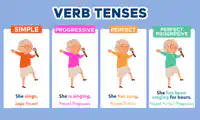
Verb & Tense

Presentation
•
English
•
University
•
Practice Problem
•
Hard
Standards-aligned

Haribabu Thammineni Lendi Institute of Engineering and Technology
Used 8+ times
FREE Resource
12 Slides • 0 Questions
1

VERB AND TENSES
2

INTRODUCTION
● Verbs and tenses are fundamental elements of
grammar.
● Understanding them is essential for effective
communication and writing.
3

Objectives
★ Define what verbs are and their types.
★ Explain the concept of verb tenses.
★ Explore different verb tenses and their uses.
★ Provide examples and exercises for practice.
4

What Are Verbs?
● Verbs are action words or words that express a
state of being.
● They are the heart of a sentence and convey
actions, occurrences, or conditions.
● Examples of verbs: "run," "jump," "is," "have."
5

Types of Verbs
●There are three main types of verbs: action verbs, linking verbs,
and helping verbs.
●Action verbs: Show physical or mental action (e.g., "sing," "think").
●Linking verbs: Connect the subject to a subject complement (e.g.,
"is," "seem").
●Helping verbs: Assist main verbs in expressing time or mood (e.g.,
"have," "will").
6

Action Verbs, Linking Verbs, Helping Verbs
Helping verbs assist main
verbs in expressing various
tenses and moods.
03
●She has sung beautifully.
●They will complete the project.
Action verbs indicate
actions performed by the
subject.
01
●She plays the piano.
●They ran a marathon.
Linking verbs connect the
subject to a subject
complement.
02
●She is a talented musician.
●He seems tired.
7

Tenses Overview
● Verb tenses indicate when an action occurred.
● The three primary tenses are past, present, and
future.
● Tenses help us understand the timing of events in
sentences.
8

Tenses
resent Tense f
Present Tense
Is used for actions happening now or regularly.
1.He reads books daily
2.The sun shines brightly.
Past Tense
I s used for actions that occurred in the past.
1. She visited Paris last year.
2. They cooked dinner yesterday
Future Tense
Is used for actions that will happen in future.
1. We will travel to Japan next month.
2. She shall arrive soon.
9

Simple Tenses vs. Perfect Tenses
●Simple tenses indicate actions without emphasizing their duration
or completion.
●Perfect tenses show actions completed or in progress.
●Examples:
●Simple present: She writes a book.
●Present perfect: She has written a book.
10

Progressive (Continuous) Tenses
● Progressive tenses indicate ongoing actions.
● Examples:
● They are studying for the exam.
● I was working when you called.
11

Perfect Progressive Tenses
●Perfect progressive tenses combine aspects of perfect and
progressive tenses.
●Examples:
●She had been studying all night.
●By 5 PM, he will have been waiting for an hour.
12

Common Verb and Tense Errors
●Common mistakes include using the wrong tense or mixing tenses within a
sentence.
●Tips: Proofread your writing, be consistent in tense usage.
Importance of Verb Tenses
●Understanding verb tenses enhances communication and clarity.
●Correct tense usage helps convey the timing and sequence of events
accurately.
VERB AND TENSES
Show answer
Auto Play
Slide 1 / 12
SLIDE
Similar Resources on Wayground

9 questions
SUFFIX -EN
Presentation
•
University
10 questions
Stative verbs
Presentation
•
University
11 questions
Correlative conjunctions
Presentation
•
University
9 questions
Future WILL
Presentation
•
University
7 questions
Future Perfect and Future Continuous
Presentation
•
University
9 questions
DIRECT OBJECT
Presentation
•
University
12 questions
Infinitives
Presentation
•
University
11 questions
Wh- Questions
Presentation
•
University
Popular Resources on Wayground
6 questions
PRIDE Always and Everywhere
Presentation
•
12th Grade
20 questions
Lab Safety Quiz

Quiz
•
6th Grade
26 questions
KOR Review Kahoot Questions
Quiz
•
8th Grade
21 questions
Continents and Oceans
Quiz
•
6th Grade
12 questions
Unit Zero lesson 2 cafeteria
Presentation
•
9th - 12th Grade
20 questions
Parts of Speech
Quiz
•
5th Grade
10 questions
Riddles Riddles fun Riddles
Quiz
•
6th - 12th Grade
16 questions
Subject & Predicate
Quiz
•
5th Grade