
8.2.3-Newton's 2nd Law of Motion

Presentation
•
Mathematics
•
9th Grade
•
Medium
Standards-aligned

Jessica Freeman
Used 2+ times
FREE Resource
44 Slides • 48 Questions
1
1. I understand the difference between acceleration and velocity.
2. I can describe the relationship between acceleration and force.
3. I can describe the relationship between acceleration and mass.
2

3

4

5
Multiple Choice
What is the SI Unit of Force?
Gram
Meter
Newton
m/s
6


© Kesler Science, LLC
Newton’s Second Law or
Law of Force and Acceleration
The acceleration (a) of an object is
dependent upon two variables:
a. the net force (F)
b. the mass of the object (m)
F
m x a
Newton’s Laws of Motion
7


© Kesler Science, LLC
Newton’s Laws of Motion
Newton’s Second Law (cont.)
•
Acceleration is produced when a
force acts on a mass
•
The greater the mass of the object
being accelerated the greater the
amount of force needed to
accelerate the object
m
F
x a
What does the “a” represent?
8
Fill in the Blanks
A 10 kg bowling ball would require what force to accelerate down an alleyway at a rate of 3 m/s2 ?
9
Fill in the Blanks
What is the mass of a falling rock if it produces a force of 147 N? (Hint: all objects accelerate at 9.8 m/s2 due to gravity)
10
Fill in the Blanks
What is the acceleration of a softball if it has a mass of 0.5 kg and hits the catcher's glove with a force of 25 N?
11
Fill in the Blanks
Your own car has a mass of 2000 kg. If your car produces a force of 5000 N, how fast will it accelerate?
12
Fill in the Blanks
Sally challenges you to a race. On the first turn you run off the course and your car strikes a large bale of hay. Your car still produces 5000 N of force, but now it accelerates at only 2 m/s2 . What is the mass of your car now that the bale of hay is stuck to it?
13
Multiple Choice
What was the mass of the bale of hay?
300 kg
500 kg
500 g
500 N
14
Multiple Choice
The mass of a helicopter is 4,500 kg and the net force on it is 18,000 N. At what rate is the helicopter accelerating?
f = m×a
4,500 = 18,000 × a
4,500÷18,000 = 0.25 m/s2
18,000 = 4,500 × a
18,000÷4,500=4 m/s2
15
Multiple Choice
A car is being towed. What is the car's mass if the net force on the car is 4,000 N and it has an acceleration of 2.5 m/s2?
f=m×a
4000 N = m×2.5
4000÷2.5 = 1,600 kg
4,000 N = m×2.5
4,000 ×2.5 = 10,000 kg
16
Multiple Choice
What is the net force on a car with a mass of 1000kg, if it accelerates at 35 m/s2?
f = m×a
1000x35 = 35,000 N
1000/35 =
28.6 N
17

18
19


Newton’s 2nd Law of Motion
• 2nd Law States that a
force on an object will move the object in the direction of the force.
• F = m x a
UNIT for Force:
Newtons (N)
UNIT for mass:
Kilograms (Kg)
UNIT for acceleration:
m/s²
20


Force
• A force is a push or
a pull.
• F = m x a


21


(A) 4 N
(B) 8 N
(C) 20 N
(D) 40 N
A man hits a golf ball (0.2 kg)
which accelerates at a rate of
20m/s/s. What amount of force
acted on the ball?

22
Multiple Choice

What is the formula for the 2nd law of motion?
a = lw
F = mama
F = ma
F = llama
23
Multiple Choice
A 20 kg bike accelerates at 10 m/s2. what was the force?
F = m x a
25 Newtons
20 Newtons
200 Newtons
10 Newtons
24
Multiple Choice
7.) An object with a mass of 120 kg. has a force of 12,000 newtons applied to it. What is the resulting acceleration of the object?
150 m/s2
200 m/s2
100 m/s2
25
Multiple Choice

26
An object at rest stays at rest,
An object in motion stays in motion,
Unless acted on by an unbalanced force.

27
Multiple Choice
28
Multiple Choice
What is Newton's First Law
F=ma
Every action has an equal and opposite reaction
An object at rest stays at rest, an object in motion stays in motion, unless acted on by an unbalanced force
Friction
29
Multiple Choice
A person is pushed forward into their seatbelt when a car suddenly stops
1st Law
2nd Law
3rd Law
30
Multiple Choice

A steel ball is at one end of a box that is moving forward as shown. The box suddenly stops. According to Newton's first law, what happens to the steel ball just after the box stops?
Because of friction, the ball continues rolling forward at the same speed.
Because of friction, the ball rolls forward at an increase speed.
Because of inertia, the ball continues rolling forward at the same speed.
Because of inertia, the ball rolls forward at an increased speed.
31
Multiple Choice
The ______ the mass of an object, the ______ force it will take to accelerate.
smaller, more
greater, more
greater, less
smaller, less
32
Multiple Choice
33
Multiple Choice
34
Multiple Choice

If both rocks are pushed with the same amount of force, which rock would accelerate more?
The 400kg Rock because it weighs more.
The 40kg rock because it weighs less.
35
Multiple Choice

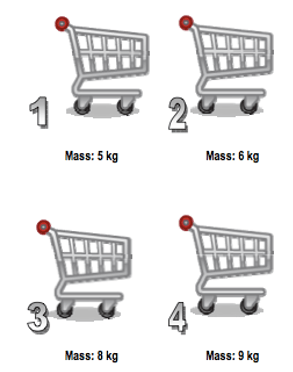
Which grocery basket will have the least acceleration, if both grocery baskets are pushed with the same amount of force?
The one without groceries because it has more mass.
The one with groceries because it has more mass.
The one without groceries because it has the least mass.
The one with groceries because it has least mass.
36
Multiple Choice

If the man pushes with an equal amount of force, which object will accelerate more?
Car because it has more mass
Lawnmower because it has less mass
Car because it has less mass
Lawnmower because it has more mass
37
Multiple Choice
38
Multiple Choice

39
Multiple Choice

40
41
42
Velocity is the speed of something in a direction at a particular time.
Acceleration is the CHANGE in velocity over a certain distance

43
44
It's also when it slows down and changes direction.

45
46
f=m*a
Force = mass * acceleration
acceleration of an object is directly proportional to the net force and inversely proportional to its mass.
47
F=m*a

48
1Acceleration is the result of unbalanced forces.
2A larger force makes a proportionally larger acceleration.
3Acceleration is inversely proportional to mass.
49
*INVERSELY kind of means opposite. This means that acceleration is oppositely related to mass. When one goes up, the other goes down. This is their relationship.

50
For example, this guy easily lifts this little car and knocks it over. But, if we increase the mass and made it a large truck and he used the same force, it wouldn't accelerate as much. This is because acceleration and mass are inversely related.

51
Draw
Circle the graph that represents the relationship between force and acceleration.
52
Draw
Circle the graph that represents the relationship between mass and acceleration.
53
REMEMBER: as mass increases, so does the object's inertia.
SINCE inertia is an objects resistance to change in velocity...
THEN an increase mass would also resist acceleration.
54
1. The net force is what causes acceleration.
2. If there is no acceleration, the net force must be zero.
3. If there is acceleration, there must also be a net force.
4. Force causes acceleration.
5. Mass resists acceleration.
55
Multiple Choice
A skydiver is moving downward with decreasing speed as her parachute opens.
Which statement describes the skydiver's motion?
The skydiver is accelerating.
The skydiver has a constant velocity.
56
57
Multiple Choice
Which of the following boxes are accelerating? Select all that apply.
A box of books that a woman is pushing across the floor with increasing speed.
A box of jewelry that a girl is holding still in her lap.
A box of cereal that is moving along a straight conveyor belt at a steady speed.
58
It's also when it slows down and changes direction.
59
60
Draw
Draw an example of an object accelerating by speeding up, slowing down, or changing directions.
61
This means it contains speed and direction. So changing direction, even when staying at the same speed, is considered accelerating.

62
acceleration of an object is directly proportional to the net force and inversely proportional to its mass.
63
f=m*a
Force = mass * acceleration
acceleration of an object is directly proportional to the net force and inversely proportional to its mass.
64
1Acceleration is the result of unbalanced forces.
2A larger force makes a proportionally larger acceleration.
3Acceleration is inversely proportional to mass.
65
Unbalanced forces are required for motion and acceleration to occur. A net force is when the forces add up to more than zero.

66
67
A larger force on something with the same mass, leads to a larger acceleration.

68
This is like saying Fernando Tatis Jr. will accelerate the ball greater than I will, because he will hit the same ball with a much greater force.

69
This is the relationship between force and acceleration. As force increases, acceleration does at the same rate.

70
*INVERSELY kind of means opposite. This means that acceleration is oppositely related to mass. When one goes up, the other goes down. This is their relationship.
71
For example, this guy easily lifts this little car and knocks it over. But, if we increase the mass and made it a large truck and he used the same force, it wouldn't accelerate as much. This is because acceleration and mass are inversely related.
72
Draw
Circle the graph that represents the relationship between force and acceleration.
73
Draw
Circle the graph that represents the relationship between mass and acceleration.
74
Circular motion is any motion in which an object is moving along a curved path. There are two primary forces occurring during circular motion: the force of the object moving forward (shown in blue), and the force called centripetal force (shown in red). Each of these forces are constantly causing acceleration in the object.

75
Centripetal force is the force which acts perpendicular to the direction of motion, toward the center of the curve. The motions of satellites and planets are also circular motion and are subject to centripetal force just like a yoyo being spun around or your keys on your lanyard when you spin them.
76
Multiple Choice

Centripetal force is indicated by the __________ ray.
black
green
77
Multiple Choice
Which of the following is the correct formula for force?
f = ma
f = m/a
f = a/m
f = a + m
78

79
Multiple Choice
Any object that travels around another object in space is a satellite.
True
False
80
Multiple Choice
Satellites in orbit around the Earth travel in almost circular path because Earth is
centripetal
free falling
curved
massive
81

82

83
Multiple Choice
An object traveling in a circle is accelerating because it is constantly changing
speed
velocity
direction
force
84
Multiple Choice
The force that causes an object to move in a circle is called centripetal force?
True
False
85
Multiple Choice
If you could turn off a centripetal force, ___________ would cause the object to fly off in a straight line.
inertia
momentum
Earth
force
86
Multiple Choice
______________ is the centripetal force that causes a satellite to move in a circle.
String
Space Shuttle
Gravity
Helicopter
87
Multiple Choice
Any object that travels around another object in space is a satellite.
True
False
88
Multiple Choice
Satellites in orbit around the Earth travel in almost circular path because Earth is
centripetal
free falling
curved
massive
89
Multiple Choice
An object traveling in a circle is accelerating because it is constantly changing
speed
velocity
direction
force
90
Multiple Choice
The force that causes an object to move in a circle is called centripetal force?
True
False
91
Multiple Choice
If you could turn off a centripetal force, ___________ would cause the object to fly off in a straight line.
inertia
momentum
Earth
force
92
Multiple Choice
______________ is the centripetal force that causes a satellite to move in a circle.
String
Space Shuttle
Gravity
Helicopter
1. I understand the difference between acceleration and velocity.
2. I can describe the relationship between acceleration and force.
3. I can describe the relationship between acceleration and mass.
Show answer
Auto Play
Slide 1 / 92
SLIDE
Similar Resources on Wayground

83 questions
Inequality
Presentation
•
8th - 9th Grade
88 questions
Virus
Presentation
•
9th - 10th Grade
84 questions
Analyze Characters
Presentation
•
9th Grade
83 questions
1st Semester Review
Presentation
•
8th Grade
87 questions
The Great War 1914-1920
Presentation
•
9th Grade
86 questions
PhySci Final Review 7: Compounds
Presentation
•
9th Grade
85 questions
Complex Numbers Flipbook
Presentation
•
10th Grade
90 questions
التراكيب والعضيات
Presentation
•
9th Grade
Popular Resources on Wayground
10 questions
Safety Day 2026 – Student Review

Quiz
•
9th Grade
21 questions
Continents and Oceans
Quiz
•
6th Grade
20 questions
Parts of Speech
Quiz
•
5th Grade
16 questions
Subject & Predicate
Quiz
•
5th Grade
25 questions
Multiplication Facts
Quiz
•
5th Grade
12 questions
Map Skills
Quiz
•
3rd Grade
22 questions
Continents and Oceans
Quiz
•
5th Grade
15 questions
Rounding Decimals
Quiz
•
5th Grade
Discover more resources for Mathematics
12 questions
Absolute Value Equations
Quiz
•
9th Grade
20 questions
Function or Not a Function
Quiz
•
8th - 9th Grade
11 questions
Slope from 2 points
Quiz
•
8th - 9th Grade
10 questions
Exploring the Basics of Exponents

Interactive video
•
6th - 10th Grade
10 questions
Solving Absolute Value Equations
Quiz
•
9th Grade
18 questions
SB 12.2 Write in point slope form
Quiz
•
9th Grade
12 questions
Identify Rigid Transformations
Quiz
•
8th - 12th Grade
10 questions
Complementary, Supplementary, Vertical, and Linear Pairs
Quiz
•
9th - 12th Grade