
Exploring the World of Organic Food

Presentation
•
Science
•
6th - 8th Grade
•
Practice Problem
•
Medium
+5
Standards-aligned

Gabriella Berritto
Used 3+ times
FREE Resource
9 Slides • 4 Questions
1
Discover the world of organic food and its benefits for your health and the environment. Learn about sustainable farming practices, natural ingredients, and the importance of choosing organic products for a healthier lifestyle.
2
Understanding Organic Food
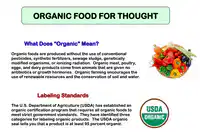
Organic food is produced without pesticides, synthetic fertilizers, GMOs, or ionizing radiation. It also prohibits the use of antibiotics or growth hormones in animal products. Organic farming promotes renewable resources and soil/water conservation. The USDA organic seal guarantees at least 95% organic content.
100% Organic: Contains 100% organic ingredients
Organic: Contains at least 95% organic ingredients
Made with Organic: Contains at least 70% organic ingredients
3
Multiple Choice
What does the USDA organic seal guarantee?
At least 70% organic content
No use of antibiotics or growth hormones
Renewable resources and soil/water conservation
At least 95% organic content
4
USDA Organic Seal
Trivia: The USDA organic seal guarantees that a product has at least 95% organic content. It ensures that the product is made with renewable resources and promotes soil and water conservation. The seal also prohibits the use of antibiotics or growth hormones.
5
Exploring Organic Food
6
Multiple Choice
What are the benefits of consuming organic food?
Minimize pesticide exposure and reduce intake of additives
Increase pesticide exposure and intake of additives
No benefits compared to conventional food
Unknown benefits
7
Benefits of Organic Food
8
Exploring Organic Food
Organic fruits and vegetables are generally healthier, but some still contain high levels of pesticide residue. The Environmental Working Group (EWG) has identified the 'Dirty Dozen' - the 12 most contaminated produce items. These should be bought organic whenever possible. On the other hand, the 'Consistently Clean' list includes onions, which are least contaminated and don't necessarily need to be bought organic.


9
Multiple Choice
Which produce items are included in the 'Dirty Dozen' list?
Apples and strawberries
Onions and carrots
Bananas and oranges
Tomatoes and cucumbers
10
Dirty Dozen
Did you know? The 'Dirty Dozen' is a list of produce items that have the highest levels of pesticide residue. Apples and strawberries are two of the fruits that often make it to this list. It's important to wash these fruits thoroughly before consuming them to reduce exposure to pesticides. Stay healthy!
11
Organic vs. Local Food
While organic food is grown using environmentally friendly methods, long-distance transportation creates pollution that outweighs the positive effects. Local food reduces pollution but may not be organic. Both organic and local foods are great choices when in season.
12
Multiple Choice
What are the potential drawbacks of long-distance transportation for organic food?
It reduces the positive effects of organic food
It increases pollution
It affects the taste of organic food
It decreases the availability of organic food
13
Long-Distance Transportation
Discover the world of organic food and its benefits for your health and the environment. Learn about sustainable farming practices, natural ingredients, and the importance of choosing organic products for a healthier lifestyle.
Show answer
Auto Play
Slide 1 / 13
SLIDE
Similar Resources on Wayground

10 questions
Minerals
Presentation
•
6th - 8th Grade
10 questions
Variables
Presentation
•
6th - 8th Grade
10 questions
Bacteria- Lesson
Presentation
•
6th - 8th Grade
10 questions
Urbanization
Presentation
•
6th - 8th Grade
10 questions
Tides
Presentation
•
6th - 8th Grade
10 questions
Heredity & Punnett Squares
Presentation
•
7th Grade
9 questions
CAST Practice 1
Presentation
•
6th - 8th Grade
12 questions
Genes, Chromosomes, and DNA
Presentation
•
7th - 8th Grade
Popular Resources on Wayground
10 questions
Safety Day 2026 – Student Review

Quiz
•
9th Grade
21 questions
Continents and Oceans
Quiz
•
6th Grade
20 questions
Parts of Speech
Quiz
•
5th Grade
16 questions
Subject & Predicate
Quiz
•
5th Grade
25 questions
Multiplication Facts
Quiz
•
5th Grade
12 questions
Map Skills
Quiz
•
3rd Grade
22 questions
Continents and Oceans
Quiz
•
5th Grade
15 questions
Rounding Decimals
Quiz
•
5th Grade
Discover more resources for Science
20 questions
Newton's Laws of Motion
Quiz
•
8th Grade
20 questions
Elements, compounds, and mixtures
Quiz
•
6th Grade
10 questions
6.6D - Relative Density Review
Quiz
•
6th Grade
15 questions
potential and kinetic energy
Quiz
•
8th Grade
21 questions
Newton's Laws of Motion
Quiz
•
8th Grade
20 questions
Elements, Compounds and Mixtures
Quiz
•
8th Grade
10 questions
Exploring Chemical and Physical Changes

Interactive video
•
6th - 10th Grade
20 questions
CONDUCTION,CONVECTION AND RADIATION
Quiz
•
6th Grade