
8.E.2.2

Presentation
•
Science
•
8th Grade
•
Practice Problem
•
Medium
+12
Standards-aligned

Robert Mann
Used 22+ times
FREE Resource
11 Slides • 5 Questions
1
Exploring the evidence of Earth's history
2
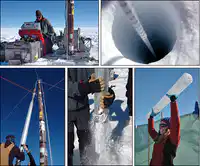
Ice Cores:
Uncovering Earth's Secrets: Ice cores are cylindrical samples of ice that provide valuable information about Earth's climate history.
Exploring the Evidence of Earth's History: By analyzing the layers of ice cores, scientists can determine past temperatures, atmospheric composition, and even ancient air trapped in the ice.
Unlocking Earth's Climate History: Ice cores help us understand how Earth's climate has changed over thousands of years and provide insights into future climate patterns.
3
Multiple Choice
What valuable information can be obtained by analyzing ice cores?
Past temperatures and atmospheric composition
Future climate patterns and ancient air
Earth's climate history and future climate patterns
Past temperatures and ancient air
4
Past Temperatures and Atmospheric Composition
5
Uncovering Earth's Secrets
6
Multiple Choice
What method do scientists use to determine the age of fossils?
Radiometric dating
Carbon dating
Stratigraphic analysis
Paleontological examination
7
Radiometric Dating
Radiometric dating is the method scientists use to determine the age of fossils. It relies on the decay of radioactive isotopes in the fossils to calculate their age. This technique has revolutionized our understanding of Earth's history and the evolution of life. Carbon dating is a type of radiometric dating specifically used for organic materials. Other methods, such as stratigraphic analysis and paleontological examination, are also important in determining the age of fossils.
8
Decoding Sedimentary Rocks
9
Multiple Choice
What can scientists uncover about Earth's history by studying sedimentary rocks?
Information about past environments and events
The composition, structure, and fossils of sedimentary rocks
Environmental clues found in sedimentary rocks
The accumulation of sediment over time
10
Uncovering Earth's History
Trivia: By studying sedimentary rocks, scientists can gather information about past environments and events. They can also analyze the composition, structure, and fossils within these rocks. Sedimentary rocks provide valuable environmental clues and reveal the accumulation of sediment over time.
11
Understanding Faults and Earthquakes
12
Multiple Choice
What is the significance of studying faults and earthquake activity?
To understand Earth's history
To predict future seismic events
To explore the evidence of Earth's history
To uncover Earth's secrets
13
Predicting Seismic Events
Did you know? Studying faults and earthquake activity helps scientists predict future seismic events. By analyzing past earthquakes and fault movements, scientists can identify patterns and potential areas of high seismic activity. This knowledge is crucial for developing early warning systems and implementing measures to mitigate the impact of earthquakes on human lives and infrastructure.
14
Interpreting Igneous Rock Formations
Igneous rocks are formed from the solidification of molten material, such as lava or magma.
Volcanic activity plays a crucial role in the formation of igneous rocks.
By studying the composition, texture, and structure of igneous rocks, scientists can gain insights into Earth's history and geological processes.
Understanding igneous rock formations helps uncover the secrets of Earth's past and provides valuable information for various fields of study, including geology, archaeology, and environmental science.
15
Multiple Choice
What can scientists learn by studying the composition, texture, and structure of igneous rocks?
The age of the Earth
The causes of volcanic activity
The history of Earth's geological processes
The impact of igneous rocks on the environment
16
The History of Earth's Geological Processes
Trivia: By studying the composition, texture, and structure of igneous rocks, scientists can uncover the ancient volcanic activity that shaped our planet. This knowledge provides insights into the formation of continents, plate tectonics, and even the evolution of life.
Exploring the evidence of Earth's history
Show answer
Auto Play
Slide 1 / 16
SLIDE
Similar Resources on Wayground

13 questions
Human Impact
Presentation
•
7th - 8th Grade
15 questions
Chemical Reactions & the Conservation of Mass
Presentation
•
8th Grade
11 questions
8.11A Lesson
Presentation
•
8th Grade
11 questions
Structure of the Hydrosphere
Presentation
•
8th Grade
12 questions
Lab Safety Symbols
Presentation
•
8th Grade
14 questions
Weathering and Erosion
Presentation
•
8th Grade
10 questions
Phase Change Diagrams
Presentation
•
8th Grade
9 questions
Geological versus Biological Evolution
Presentation
•
8th Grade
Popular Resources on Wayground
10 questions
How much do you know about our Portrait of an Eagle?

Quiz
•
10th Grade
10 questions
Fast Food Slogans
Quiz
•
6th - 8th Grade
21 questions
Continents and Oceans
Quiz
•
6th Grade
20 questions
Parts of Speech
Quiz
•
5th Grade
16 questions
Subject & Predicate
Quiz
•
5th Grade
25 questions
Multiplication Facts
Quiz
•
5th Grade
12 questions
Map Skills
Quiz
•
3rd Grade
22 questions
Continents and Oceans
Quiz
•
5th Grade
Discover more resources for Science
20 questions
Scientific Method and Variables
Quiz
•
8th Grade
20 questions
Scientific method and variables
Quiz
•
8th Grade
27 questions
Counting Atoms - Subscripts
Quiz
•
8th Grade
20 questions
Claim, Evidence and Reasoning (CER)
Quiz
•
6th - 8th Grade
18 questions
Counting Atoms
Quiz
•
7th - 8th Grade
20 questions
Elements, Compounds and Mixtures
Quiz
•
8th Grade
10 questions
Exploring Chemical and Physical Changes

Interactive video
•
6th - 10th Grade
10 questions
Decoding the Periodic Table of Elements
Interactive video
•
6th - 10th Grade