

The Myth of Multitasking

Presentation
•
•
Practice Problem
•
Hard

Leslie Schaffer
Used 1+ times
FREE Resource
7 Slides • 3 Questions
1
A common misconception that multitasking is efficient and productive. However, research shows that our brains are not designed to handle multiple tasks simultaneously. Instead, it leads to decreased productivity and increased errors.
2
Multitasking Myths
Despite popular belief, our brains are not designed for multitasking.
When we try to do multiple tasks at once, our attention becomes divided, leading to decreased performance. It's better to focus on one task at a time for optimal results.
3
The Myth of Multitasking
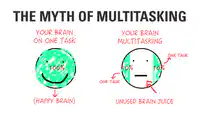
Multitasking is a common belief that we can perform multiple tasks simultaneously without a loss of speed or accuracy. However, research shows that our brains are not designed for multitasking.
When we switch between tasks, our attention is divided, leading to decreased productivity and increased errors. Instead, focus on one task at a time to maximize efficiency and quality of work.
4
Multiple Choice
According to the passage, what does research show about multitasking?
Our brains are designed for multitasking
Multitasking improves productivity and reduces errors
Multitasking does not affect productivity or accuracy
Multitasking decreases productivity and increases errors
5
Task-switching:
Impact on productivity: Task-switching reduces efficiency and leads to errors.
Effects: It hampers concentration and performance.
Trivia: Multitasking can decrease productivity by up to 40%.
6
The Myth of Multitasking
Multitasking is a myth; people are actually task-switching - rapidly shifting focus from one task to another. Task-switching can lead to errors and reduced efficiency, negatively impacting productivity. Instead, focus on single-tasking to improve concentration and performance. Avoid the temptation to multitask and prioritize tasks to maximize productivity.
7
Multiple Choice
What is the impact of task-switching on productivity?
Task-switching improves productivity
Task-switching has no impact on productivity
Task-switching reduces efficiency and leads to errors
Task-switching enhances concentration and performance
8
Effects of Multitasking
9
The Myth of Multitasking
10
Multiple Choice
What are the negative effects of multitasking?
Increased stress and frustration
Improved cognitive abilities and productivity
Enhanced efficiency and accuracy
Reduced impulsive behavior
A common misconception that multitasking is efficient and productive. However, research shows that our brains are not designed to handle multiple tasks simultaneously. Instead, it leads to decreased productivity and increased errors.
Show answer
Auto Play
Slide 1 / 10
SLIDE
Similar Resources on Wayground

8 questions
Chronological and Problem-Solution
Presentation
•
5th Grade
7 questions
Connectors
Presentation
•
12th Grade
7 questions
3a1.Prokaryote vs Eukaryote
Presentation
•
9th - 10th Grade
6 questions
CLOTHES
Presentation
•
2nd Grade
6 questions
Gratitude Lesson Template (SEL)
Presentation
•
KG - Professional Dev...
6 questions
Central Message Practice
Presentation
•
3rd Grade
8 questions
Health
Presentation
•
6th - 10th Grade
8 questions
Dashes
Presentation
•
6th Grade
Popular Resources on Wayground
10 questions
Safety Day 2026 – Student Review

Quiz
•
9th Grade
21 questions
Continents and Oceans
Quiz
•
6th Grade
20 questions
Parts of Speech
Quiz
•
5th Grade
16 questions
Subject & Predicate
Quiz
•
5th Grade
25 questions
Multiplication Facts
Quiz
•
5th Grade
12 questions
Map Skills
Quiz
•
3rd Grade
22 questions
Continents and Oceans
Quiz
•
5th Grade
15 questions
Rounding Decimals
Quiz
•
5th Grade
Discover more resources for
10 questions
Safety Day 2026 – Student Review
Quiz
•
9th Grade
21 questions
Continents and Oceans
Quiz
•
6th Grade
20 questions
Parts of Speech
Quiz
•
5th Grade
16 questions
Subject & Predicate
Quiz
•
5th Grade
25 questions
Multiplication Facts
Quiz
•
5th Grade
12 questions
Map Skills
Quiz
•
3rd Grade
22 questions
Continents and Oceans
Quiz
•
5th Grade
15 questions
Rounding Decimals
Quiz
•
5th Grade