Energy Flow in Ecosystems
Presentation
•
Science
•
•
Practice Problem
•
Easy
+1
Standards-aligned

Aaron Gunn
Used 5+ times
FREE Resource
12 Slides • 11 Questions
1
Multiple Choice
Where does almost all of the energy that drives life on Earth originate?
Producers
Hydrothermal vents
Sun
Composers
2
General Rules:
Producers (autotrophs) are always first.
Consumers (heterotrophs) are eaters.
Primary consumers are herbivores.
Each step on the food chain is called a trophic level.
Energy decreases with each trophic level.
Food Chains
3
Categorize
Plants
Algae
Autotrophs
Herbivores (plant eaters)
Elephants
Rabbits
Omnivores
Phytoplankton
Eat the primary consumers
3rd consumer
Hawk
4
Drag and Drop
5
Drag and Drop
6
Multiple Choice
In ecology, there is a term called primary productivity. This is the rate at which an ecosystem's producers make chemical energy.
Which level on the food chain shown is the only one involved with primary productivity?
Plants
(Autotrophs)
Insects
Cows
Horses
Frogs
Lizards
Lions
Wolves
Snakes
7
Multiple Choice
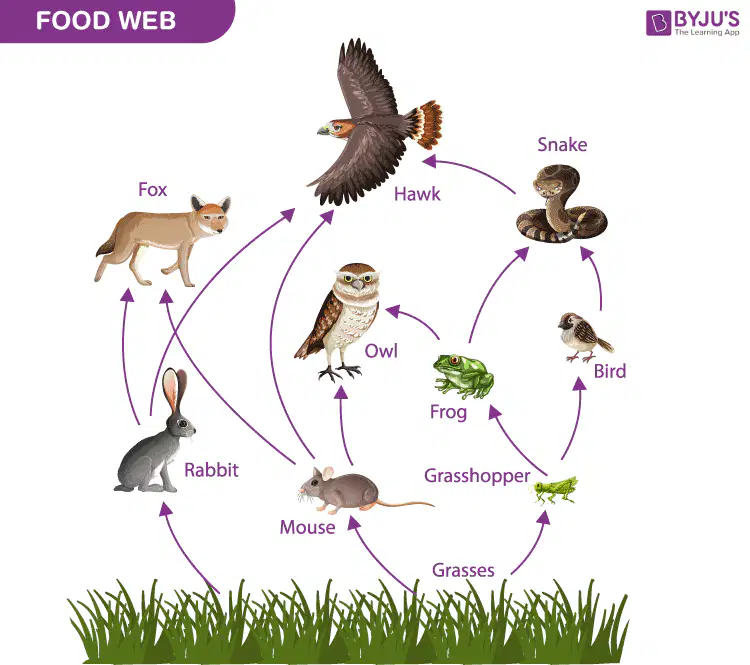
Which is TRUE of this image?
There are multiple food chains to be seen.
This is a food web.
It shows that more than one consumer may eat the same thing.
All of these are true regarding the image.
8
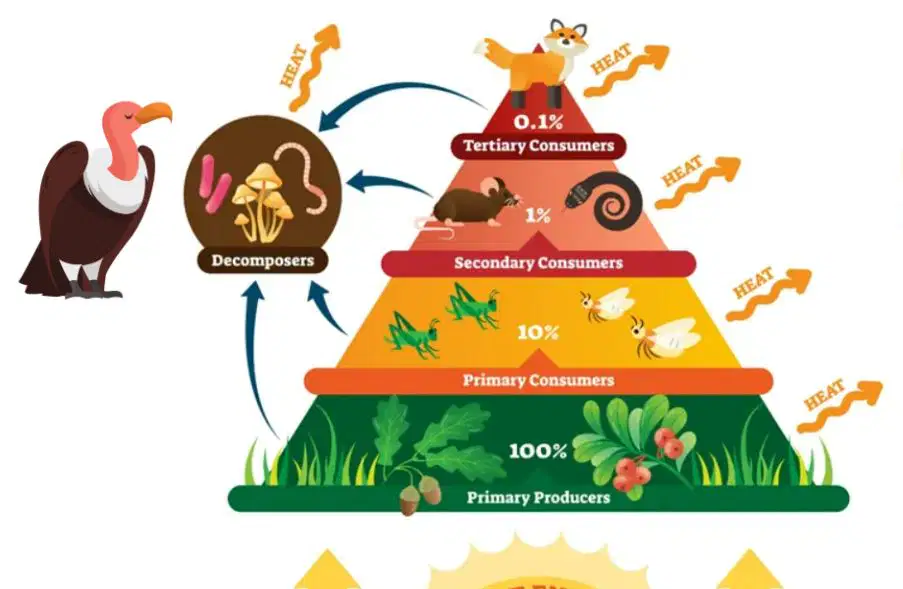
Look at this energy pyramid.
Take a mental note of all of the things you notice or already know about energy pyramids.
Energy Pyramids
9
Could this energy pyramid be diagrammed as a food chain?
A trophic level is each step on the energy pyramid. Producers are on the first level at the bottom.
Notice the percentages at each trophic level.
Also notice how the size of each level gets smaller.
10
Multiple Choice
How much energy is transferred to each trophic level?
100%
90%
50%
10%
11
Multiple Choice
What happens to the other 90% of the energy?
It is lost
goes back into the sun
burned off in the form of heat when our bodies use the energy
It is destroyed
12
Open Ended
Notice on this energy pyramid that the vulture has been placed next to the decomposers. Vultures are what we call scavengers.
Why would the vulture be placed on the decomposer trophic level?
13
Drag and Drop
14
Multiple Choice
True or False?
Scavengers can also be described as opportunistic feeders.
True
False
15
16
Joules (J)is a unit of energy!
Energy pyramids are a way to show the energy that’s transferred.
Large amounts of energy are “lost” between trophic levels!
Energy Pyramids
17
These show the amount of BIOMASS that is present at each trophic level.
What environment would you find this pyramid in? (aquatic or terrestrial?)
Biomass Pyramid
18
This is an aquatic biomass pyramid.
Producers are always on the bottom, remember?
So, phytoplankton are the producers in this pyramid.
Normally though, the producers is the largest level, right??
Biomass Pyramid
19
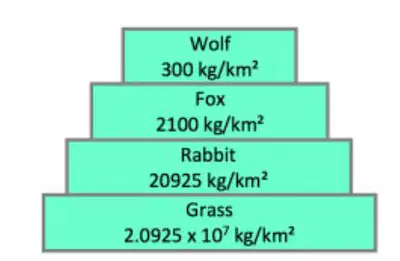
Here is a biomass pyramid found on land.
Notice the producers actually ARE the largest trophic level.
Let's look back at the aquatic pyramid real quick though!
Biomass Pyramids
20
Think about how tiny and small phytoplankton really are!
They weigh very little and take up so little space!
That makes sense then that the phytoplankton trophic level is the smallest on a BIOMASS pyramid!
21
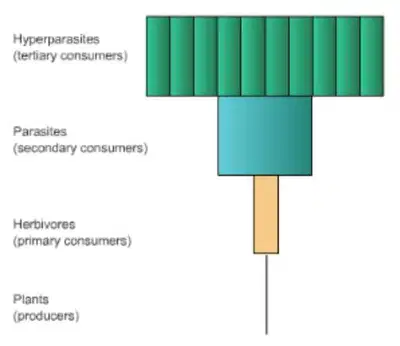
This is a parasite pyramid. Think fleas on a dog!
Parasites may produce different shapes of pyramids.
Usually widest at the top—inverted—because a large number of parasite organisms often feed on one host organism.
Parasite Pyramids
22
Summary
Today we talked all about ENERGY!
The sun is what is driving the energy on Earth!
Food chains and food webs are diagrams that show how and where energy is being transferred.
We learned about producers, primary, secondary, tertiary consumers, decomposers, scavengers, & opportunistic feeders!
There is more than one way to place information on a pyramid.
Each step on a pyramid is referred to as a trophic level.
We learned about energy pyramids, biomass pyramids, and parasite pyramids.
23
Where does almost all of the energy that drives life on Earth originate?
Producers
Hydrothermal vents
Sun
Composers
Show answer
Auto Play
Slide 1 / 23
MULTIPLE CHOICE

Similar Resources on Wayground
18 questions
Calculating Speed
Presentation
•
6th - 8th Grade
18 questions
Geologic Time Scale
Presentation
•
6th - 8th Grade
18 questions
Lunar Cycle
Presentation
•
8th Grade
18 questions
Layers of Atmosphere Notes
Presentation
•
9th - 10th Grade
18 questions
Newton's Laws
Presentation
•
5th Grade
18 questions
Nervous System
Presentation
•
4th - 6th Grade
18 questions
Measuring Volume
Presentation
•
6th - 10th Grade
18 questions
Work And Energy
Presentation
•
5th Grade
Popular Resources on Wayground
6 questions
Secondary Safety Quiz
Presentation
•
9th - 12th Grade
10 questions
MyPath Diagnostic Overview
Presentation
•
6th - 8th Grade
20 questions
Lab Safety Quiz
Quiz
•
6th Grade
21 questions
Continents and Oceans
Quiz
•
6th Grade
20 questions
Adding and Subtracting Decimals
Quiz
•
5th Grade
20 questions
Parts of Speech
Quiz
•
5th Grade
16 questions
Subject & Predicate
Quiz
•
5th Grade
21 questions
Lab Safety
Quiz
•
10th Grade
Discover more resources for Science
20 questions
Place Value
Quiz
•
KG - 3rd Grade
16 questions
Lab Equipment
Quiz
•
KG
20 questions
Community helpers
Quiz
•
KG - 3rd Grade
15 questions
Subject and Predicate
Quiz
•
KG - 3rd Grade
12 questions
Nouns and Verbs
Quiz
•
KG - 2nd Grade
10 questions
Four Types of Sentences
Quiz
•
KG - 12th Grade
12 questions
Globes and maps
Presentation
•
KG
15 questions
Digraph Practice
Quiz
•
KG