
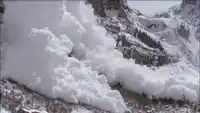
Avalanche

Presentation
•
English
•
9th - 12th Grade
•
Practice Problem
•
Hard
Standards-aligned

Kristina Lutton
Used 5+ times
FREE Resource
8 Slides • 3 Questions
1
Understanding the dangers and precautions of avalanches to ensure safety in snowy mountainous regions.
2
Avalanche Awareness
3
Multiple Choice
What are some signs of danger when it comes to avalanches?
Snowpack instability, weather conditions, and human activity
Recent avalanches, cracking sounds, and visible weak layers
Educate yourself, carry essential gear, and travel with a partner
Rapid flows of snow down a slope
4
Avalanche Warning Signs
5
Avalanche Causes
6
Multiple Choice
What are some factors that can trigger avalanches?
Heavy snowfall and strong winds
Steep slopes and rapid temperature changes
Weak layers within the snowpack
Skiing and snowboarding
7
Avalanche Triggers
Did you know? Heavy snowfall and strong winds are two major factors that can trigger avalanches. Other factors include steep slopes and rapid temperature changes, as well as weak layers within the snowpack. Skiing and snowboarding, however, do not directly trigger avalanches.
8
Avalanche Awareness
9
Multiple Choice
Which of the following is a sign of an avalanche?
Cracking or collapsing snow
Recent earthquake activity
Unusual rain conditions
Whistling sounds
10
Sign of an Avalanche
11
Avalanche Safety Tips
Understanding the dangers and precautions of avalanches to ensure safety in snowy mountainous regions.
Show answer
Auto Play
Slide 1 / 11
SLIDE
Similar Resources on Wayground

15 questions
Compound-complex sentences
Presentation
•
9th - 12th Grade
9 questions
Short Story-Introduction
Presentation
•
10th - 12th Grade
10 questions
Allegory
Presentation
•
9th Grade - University
11 questions
Introductory Commas
Presentation
•
9th - 12th Grade
9 questions
Appendages of the Skin- Lesson: Hair, Hair Follicles and Nails
Presentation
•
9th - 12th Grade
13 questions
Ecological Succession
Presentation
•
9th - 12th Grade
11 questions
Color Theory
Presentation
•
9th - 12th Grade
10 questions
Volcano Eruptions
Presentation
•
8th - 12th Grade
Popular Resources on Wayground
10 questions
How much do you know about our Portrait of an Eagle?

Quiz
•
10th Grade
10 questions
Fast Food Slogans
Quiz
•
6th - 8th Grade
21 questions
Continents and Oceans
Quiz
•
6th Grade
20 questions
Parts of Speech
Quiz
•
5th Grade
16 questions
Subject & Predicate
Quiz
•
5th Grade
25 questions
Multiplication Facts
Quiz
•
5th Grade
12 questions
Map Skills
Quiz
•
3rd Grade
22 questions
Continents and Oceans
Quiz
•
5th Grade
Discover more resources for English
15 questions
Simple, compound, and complex sentences
Quiz
•
9th Grade
16 questions
Ethos, Pathos, Logos Practice
Quiz
•
9th Grade
20 questions
Context clues
Quiz
•
10th Grade
20 questions
Parts of Speech Review
Quiz
•
9th Grade
15 questions
ENG 10 Grammar: 18.1 Prepositions or Adverbs P. 34
Quiz
•
10th Grade
10 questions
Making Inferences and Drawing Conclusions

Interactive video
•
6th - 10th Grade
10 questions
Crafting an Effective Thesis Statement
Interactive video
•
6th - 10th Grade
10 questions
Exploring Coordinating Conjunctions with FANBOYS
Interactive video
•
6th - 10th Grade