

Fire Safety: From Understanding to Action

Presentation
•
Education
•
University
•
Practice Problem
•
Hard

ROSLINA (PSP)
FREE Resource
47 Slides • 4 Questions
1
Fire Safety:
Understanding and taking action to prevent fires
2
Fire Safety Basics
3
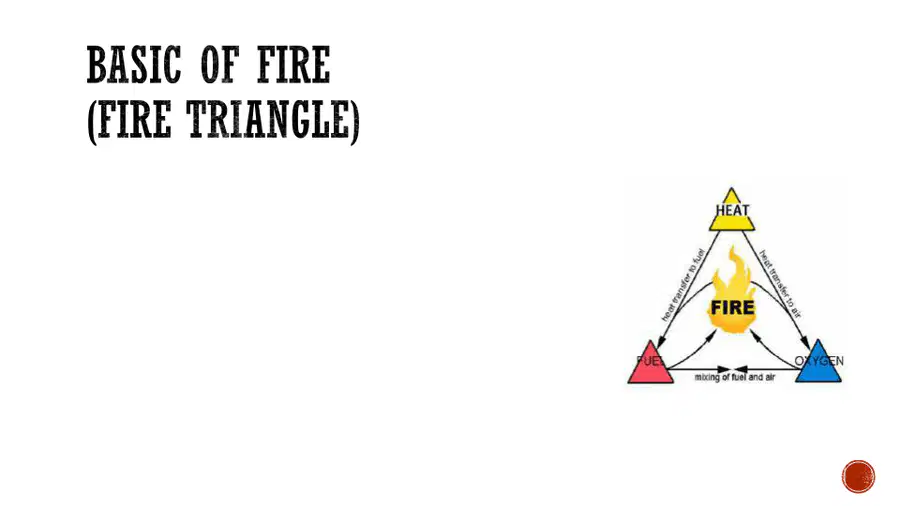
• Fire is combustion or burning, in which substance
combine chemically with oxygen from the air and
typically gives out bright light, heat and smoke
For a fire to thrive and spread it requires three things:
Fuel for the fire to burn
Oxygen for the fire to breathe
Heat for the fire to continue burning
Removal of any one of the sides of this Fire Triangle will
extinguish the fire.
4

A fire triangle is used as a model for conveying the
components of a fire.
The fire triangle’s three sides illustrate the three
elements of fire, which are heat, fuel, and oxidization.
The three elements must be combined in the right
proportions for a fire to occur.
If any of these three is missing, fires cannot start or
keep burning.
5

FUEL
If fuel is removed, the fire will starve and be extinguished.
With bushfires this can be done through a number of pre-
emptive methods, including prescribed burning or physical
removal of the fuel.
During wildfire suppression the removal of fuel can be done
physically through the raking of fire line or the use of bulldozers
to clear a fire line.
The removal of fuel can also be done through the lighting of
small controlled fires to remove the fuel ahead of the fire.
These fires, called burn-out fires, are lit from control lines and must
only be done by experienced fire-fighters and well-supervised
crews.
6

AIR / OXYGEN
If air is removed, the fire will suffocate – because of a lack of
oxygen – and go out.
The removal of air from a bushfire is quite difficult as fires are
normally quite big and encompass considerable area.
The removal of heat is the most common form of fire suppression.
There are methods of suppression, however, that work on the basis
of suffocating the fire.
Water-based foam sprayed on to the fire will act as a blanket
between the fire and the air.
A layer of dirt shoveled onto the fire will act as a blanket.
The removal of air from a fire is a form of attack that is normally
only limited to small or easily accessible fires.
7

HEAT
The removal of heat or the cooling of a fire is the most common form of
suppression.
In most cases water is used to essentially soak up the heat generated by
the fire
This heat turns the water in to steam, thereby robbing the fire of the heat
used
Without energy in the form of heat the fire cannot heat unburnt fuels to
ignition temperature and the fire will eventually go out.
The water can act to smother the flames and suffocate the fire.
Chemicals can be added to water to improve the heat removal
properties of water, or to improve the ability of the water to stick to
unburnt fuel.
8
Multiple Choice
What are the three elements of fire?
Heat, fuel, and oxygen
Water, fuel, and oxygen
Heat, water, and oxygen
Heat, fuel, and carbon dioxide
9
Fire Elements
Did you know? The three elements of fire are heat, fuel, and oxygen. Without any of these elements, fire cannot exist. Heat provides the energy, fuel acts as the source of combustion, and oxygen supports the chemical reaction. Remember, fire needs all three to burn!
10
Fire Safety Planning
11
Multiple Choice
What is the role of the Fire Safety Director?
Responding to premises after being contacted by the fire department
Notifying Protective Services during emergencies
Evacuating occupants during fire incidents
Confining and extinguishing fire
12
Fire Safety: Evacuation Control
Fire Safety Director: Responds to premises after being contacted by the fire department
Emergency Procedures: Fire alarm, notifying Protective Services, evacuating occupants, confining and extinguishing fire
Supervisory Staff: Appointed and trained for fire safety duties
Building Fire Emergency Systems: Type, location, and operation documented
Fire Drills: Held regularly
Fire Hazards: Controlled in the building
Inspection and Maintenance: Ensured for building facilities
High-Rise Buildings: Additional requirements
13

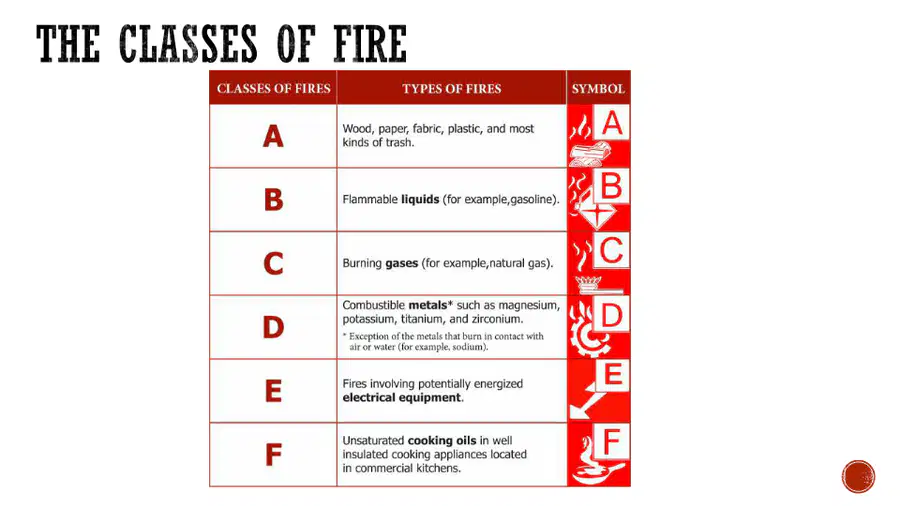
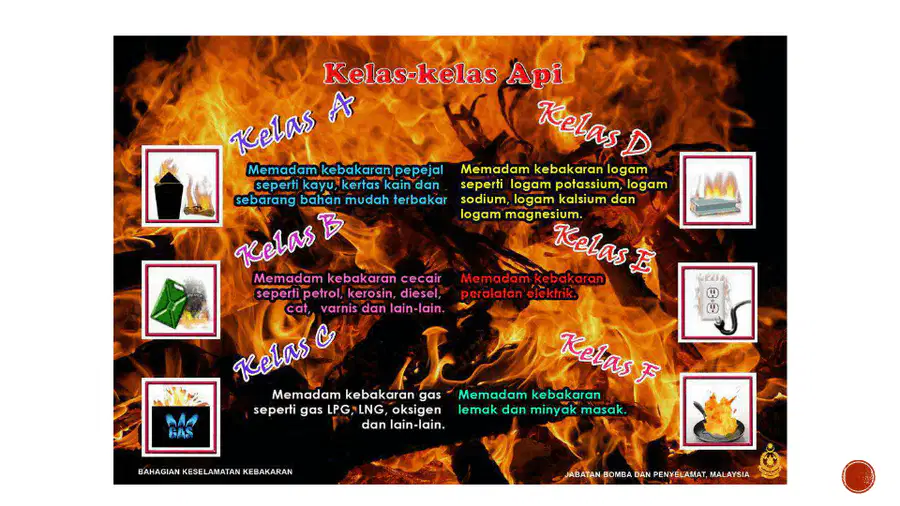
CLASS
OF
FIRE
Class
A
Class
B
Class
C
Class
D
Class
E
Class
F
14
15
16

17
Fire Safety
To ensure fire safety in the workplace, it is crucial to monitor hazards and review controls. This helps identify fire hazards, assess the risks they pose, and implement measures to control those risks. By doing so, workplaces can create a safer environment for everyone. Remember, fire safety is everyone's responsibility!
18
Multiple Choice
What is the purpose of monitoring the hazards and reviewing the controls in the workplace?
To identify fire hazards in the workplace
To assess the risks posed by the hazards
To put measures in place to control the risks
To ensure fire safety in the workplace
19
A fire safety plan is a detailed document that covers all aspects of
fire safety for a specific building or property. The plan will outline:
A safe and orderly way for occupants to evacuate the building.
Proper maintenance and housekeeping required to prevent fires.
Methods of control that minimize the damage from fires when they do
occur.
Fire Safety Planning has 3 primary objectives:
Fire Hazard Control
Fire Protection System Maintenance
Emergency Evacuation
20

These fires involve
combustible metals, such as magnesium, titanium, zirconium,
sodium, lithium and potassium.
21
Fire Safety Planning
prevents the occurrence of fire by the
control of fire hazards in the building,
ensures operation of
fire protection systems by establishing maintenance
procedures, and
provides a systematic method of safe and
orderly evacuation of the building in the event of fire.
22

Fire hazards can arise in a variety of environments or while undertaking certain
activities. Of course, the risk of fire is more likely in situations when flammable chemicals
or combustible materials are being used, but even in offices and other lower risk
environments, the risk of fire is always prevalent
Your health and safety obligations regarding fire safety include your need to understand:
how to manage fire risks in your workplace;
how to develop and maintain efficient fire safety procedures;
how to introduce and maintain appropriate fire safety equipment; and
how to train your workers in these matters.
23
1. Identify any fire hazard in workplace, e.g. presence of ignition sources
(heaters, lighting, electrical equipment, etc.) and fuel (packaging, plastics,
rubber, petrol, chemicals, etc.).
2.Assess the risks posed by the hazards that have identified – this will
determine which hazards need the most urgent attention.
3.Put measures in place to control the risks – the hierarchy of control is a
useful tool to use here, e.g. eliminate work processes that could generate an
explosive atmosphere, service and clean all machinery as recommended
by manufacturers, switch off electricity points when the business is
unattended, remove waste material (e.g. fuel) that could act as fuel, store
and dispose of flammable substances correctly.
4.Monitor the hazards and review the controls – this will ensure that the
controls are minimizing the risks effectively.
24
Trained supervisory staff can be of great value in directing, and assisting the orderly
movement of people in the event of a fire, and performing fire control until the fire
department arrives.
Evacuation procedures relying heavily on supervisory staff are complex, in that such
staff require continued training, frequent drilling, and must be continuously on the
premises in order to fulfill their responsibilities during an emergency.
Following the implementation of the plan, the time required for continued training and
drilling, and the coordination necessary to maintain supervisory staff on the premises
is extreme.
Based on these facts, the evacuation objective outlined in this guide is met simply and
realistically without evacuation control officers or the fire safety director's involvement
in evacuation control.
25
During an emergency, a fire alarm will sound, and all occupants will exit
the building via a safe exit.
Persons with disabilities should proceed with their assistants (if
available) to the nearest safe exit.
The Fire Safety Director should be available to respond to the premises after
being contacted by the fire department.
26
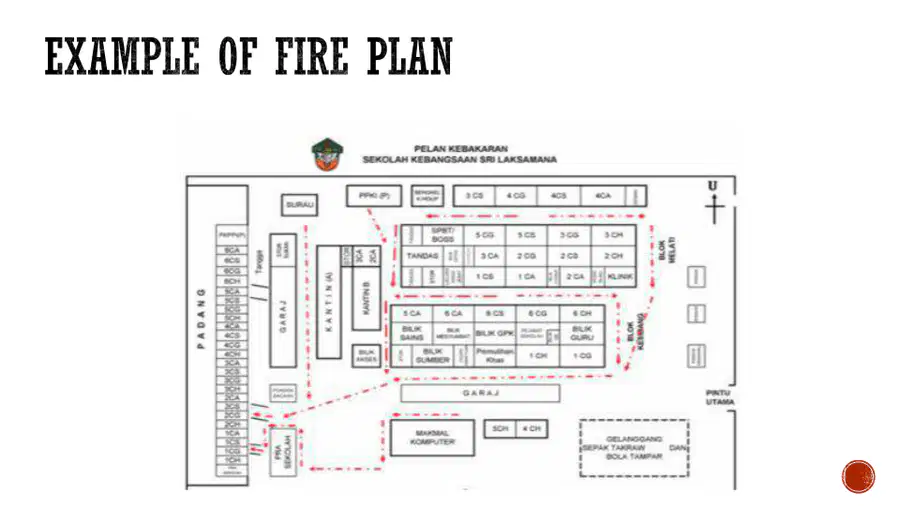
27
Below concept should/will
ensure a systematic method of safe and
orderly evacuation of the building in the event of fire:
1.
A copy of the fire emergency procedures and other duties for
supervisory staff, as laid down in the Fire Safety Plan, shall be
given to all
supervisory staff.
2.
The Fire Safety Plan shall be
kept in the building for reference.
28
3.
The
District Fire Inspector may, upon request and if required,
provide advice, clarification and guidance for the preparation of a
fire safety plan.
4.
The Fire Safety Plan shall be
reviewed at intervals not greater than
12 months to ensure it takes into account changes in the use and
other characteristics of the building.
5.
The Fire Safety Plan should
deal only with matters which pertain
specifically to the particular building.
29
6.
A Fire Safety Plan must be
implemented in:
a) every building containing an
assembly or a care or detention occupancy,
b) every building
required by the National Building Code to have a fire alarm
system,
c)
demolition and construction sites regulated under the National Fire Code,
d) indoor and outdoor
storage areas regulated under the National Fire Code,
e) areas where
flammable liquids or combustible liquids are stored or handled,
including refineries and process plants,
f)areas where
hazardous processes or operations occur.
30
7. The Fire Safety Plan shall
include:
a) The
emergency procedures to be used in case of fire including
sounding the fire alarm,
notifying the Protective Services,
instructing occupants on procedures to be followed when the fire alarm sounds,
evacuating occupants, including special provisions for persons requiring assistance,
confining, controlling and extinguishing the fire,
b) the
appointment and organization of designated supervisory staff to carry out fire
safety duties,
c) the
training of supervisory staff and other occupants in their responsibilities for fire
safety,
d)
documents, including diagrams, showing the type, location and operation of the
building fire emergency systems,
e) the holding of
fire drills,
f)the
control of fire hazards in the building,
g) the
inspection and maintenance of building facilities provided for the safety of
occupants, and
h) additional requirements for High-Rise Buildings.
31
Fire control is the
practice of reducing
the heat output of a fire or
reducing the
area over which the fire exists or
suppressing or extinguishing the fire
by depriving a fire of fuel, oxygen or
heat.
32

The most common method to control a class-A fire is to remove heat by
spraying
the burning solid fuels with water.
Another method of controlling a class-A fire would be to
reduce the oxygen content
of the atmosphere in the immediate vicinity of the fire (i.e., "smother" the fire), such
as by the introduction of an
inert gas such as
carbon dioxide.
33

Spraying
with water
Carbon
Dioxide
Extinguisher
Hose Reel
Fire Buckets
34

Some Class-B fires (hydrocarbons, petroleum, and fuels on fire)
cannot
be
efficiently
controlled
with
water.
Fuels with a specific gravity less than water, such as gasoline or oil, float
on water, resulting in the fire continuing in the fuel on top of the water.
The application of a
combination
of
fire
suppressant
foam
mixed
with
water is a common and effective method of forming a blanket on top of the
liquid fuel which eliminates the oxygen needed for combustion.
The configuration of some fuels such as coal and baled waste paper, result
in a deep seated and burrowing fire, resulting in less effective fire control
by the application of water on the outer surfaces of the fuel. Some Class-B
fires can be controlled with the application of
chemical
fire
suppressants.
35

Fire Blanket
Chemical fire
suppressants.
36

Class-C fires
involve electricity as a continuous power source for the ignition of the
fuels associated with electrical equipment, such as plastic cable jackets.
The application of water does not always result in effective fire control, and there is
a general
concern regarding conductivity and personnel safety.
37
Blanketing
or
smothering
this
type
of
fire
with
a
non
-
conducting
extinguishing
agent is of prime importance.
Water
or solutions containing water, is
never to be used on a Class "C" fire.
Extinguishers suitable for Class "C" fires
should
be
identified
by
a
circle
containing the letter "C".
Extinguishers suitable for more than one
of the three classes of fire defined above
may be identified by multiple symbols
(ABC). Generally the extinguishing agent
is referred to as
DRY
CHEMICAL.
Dry Powder
Extinguisher
(Special
Powders)
38

Class- D fires
involve
combustible metals, such as
magnesium, titanium, zirconium,
sodium, lithium and potassium.
Generally the extinguishing
agent is referred to as
DRYPOWDER.
Dry Powder
Extinguisher
(Special
Powders)
39

These are fires in
cooking appliances that
involve combustible cooking media such as
vegetable or animal oils and fats.
The extinguishing agent is referred to as
WET
CHEMICAL.
These extinguishers should be identified by
the letter “K.”
Dry Powder
Extinguisher
(Special
Powders)
40
The fundamental purpose of fire protection systems is to firstly
prevent
the
passage
and
spread
of
smoke
and
fire, from one area of
the building to another, to allow for the safe escape of the building
occupants.
Secondly, to
prevent
or
reduce
the
amount
of
damage to the building
structure, neighbouring structures and reduce the risk of collapse for
the emergency services.
41

BUILDING'S
FIRE
PROTECTION
Active
system
Passive
system
42

Protection and fire control systems are
installed permanently in the building
consists of three actions to
track and signalling,
control and
fire
-
fighting
manually
or automatically.
This system
required a certain amount of motion/or action in order to work
properly.
Some of these actions could be
slowing the progress of the fire,
putting out the fire,
or
notifying of the fire and smoke conditions.
43

The overall aim of Active System is to extinguish the fire by:
Detecting the fire early and evacuate the building.
Alert emergency services at the early stage of the fire.
Control the movement of smoke and fire.
Suppress and/or starve the fire of oxygen and fuel.
44

Fire
Extinguisher
Fire Blanket
Fire Bucket
Sprinkler
System
45

Protection and fire control
system found in the design of a building which
serves to
restrict the spread of fire and smoke that residents have shelter use it as a way out
to a safe place.
This system
does not require motion/and or action in order to work.
It is used
to contain and slow the spread of the fire.
46

The overall aim of passive systems is to contain the fire by:
Use
of fire rated partitions and doors to prevent the fire and smoke from moving from one
compartment to another.
Delay the collapse of the building structure.
Delay the growth of the fire.
47

Fire dampers
Fire rated
doors
Fire
walls/barriers
48
Fire Safety Director
Trivia: The role of a Fire Safety Director includes responding to premises after being contacted by the fire department, notifying Protective Services during emergencies, evacuating occupants during fire incidents, and confining and extinguishing fire. They play a crucial role in ensuring the safety of occupants and coordinating emergency response efforts.
49
Fire Safety
50
Multiple Choice
What is the purpose of using fire suppressant foam mixed with water?
To eliminate the oxygen needed for combustion
To restrict the spread of fire and smoke
To extinguish Class-C fires involving electricity
To form a blanket on top of liquid fuel
51
Fire Suppressant Foam:
Fire Safety:
Understanding and taking action to prevent fires
Show answer
Auto Play
Slide 1 / 51
SLIDE
Similar Resources on Wayground

46 questions
IKM RA
Presentation
•
KG
45 questions
ICT In Education
Presentation
•
University
45 questions
Plans and Dreams
Presentation
•
University
46 questions
P.c s3
Presentation
•
12th Grade - University
48 questions
PRACTICE WHAT YOU PREACH
Presentation
•
University
43 questions
Hablemos de Psicología Educativa
Presentation
•
University
43 questions
English 1 UNIT 3 Extended Family
Presentation
•
University
45 questions
L18 Unemployment Policy Solutions
Presentation
•
University
Popular Resources on Wayground
6 questions
PRIDE Always and Everywhere
Presentation
•
12th Grade
20 questions
Lab Safety Quiz

Quiz
•
6th Grade
26 questions
KOR Review Kahoot Questions
Quiz
•
8th Grade
21 questions
Continents and Oceans
Quiz
•
6th Grade
12 questions
Unit Zero lesson 2 cafeteria
Presentation
•
9th - 12th Grade
20 questions
Parts of Speech
Quiz
•
5th Grade
10 questions
Riddles Riddles fun Riddles
Quiz
•
6th - 12th Grade
16 questions
Subject & Predicate
Quiz
•
5th Grade
Discover more resources for Education
10 questions
Soup, Salad, or Sandwich?
Quiz
•
1st Grade - Professio...
20 questions
Disney Trivia
Quiz
•
University
8 questions
Extracted Quiz
Quiz
•
University
23 questions
Subject Verb Agreement
Quiz
•
9th Grade - University
67 questions
Unit 3 Random Questions
Quiz
•
11th Grade - University
64 questions
USHC 4 Key Terms 22-23
Quiz
•
11th Grade - University
12 questions
This or That...
Quiz
•
1st Grade - University
25 questions
Comma CFA
Quiz
•
6th Grade - University