
Summative Unit 2 Review
Presentation
•
Science
•
6th Grade
•
Easy
Bette Horsington
Used 9+ times
FREE Resource
7 Slides • 21 Questions
1
Review for Unit 2
Summative
13/11/2023 Science 6
2
Review of
Formative
Assessment
3
Multiple Choice
4
Multiple Choice
5
Multiple Choice
6
Genetically Isolated
- Temporal, Physio/Behavioral, Geographical, Genetic
7
Multiple Select
Which of the following are ways a species of organisms can be "genetically isolated" from another species.
Geographical
Temporal
Behavioral
Genus
Genetic
8
Multiple Choice
A horse and a donkey are the same species?
True
False
9
10
Multiple Select
Which of the following are autotrophs?
Archaebacteria
Eubacteria
Protista
Fungi
Plantae
11
Multiple Choice
Cells that do not have a nucleus?
eukaria
autotrophs
Fungi
prokaryotic
12
13
Multiple Select
Pick all examples of a living thing
A human
A rock
A dog
Sand
14
Multiple Choice
15
Multiple Choice
16
Multiple Choice
17
Multiple Choice
Heterotrophs- obtain food from other animals.
Observing the table above, Fungi and Animals are________?
18
Multiple Choice
19
Multiple Choice
20
Multiple Choice
21
Multiple Choice
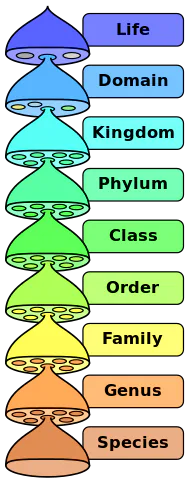
the largest classification category
Kindgom
Phylum
Order
Species
22
Multiple Choice
the smallest, most specific classification category
Genus
Phylum
Order
Species
23
Multiple Choice
Which of the following is the correct order from broadest to smallest?
Kingdom, Class, Order, Family, Genus, Species, Phylum
Species, Genus, Family, Order, Class, Phylum, Kingdom
Kingdom, Phylum, Order, Class, Family, Genus, Species
Kingdom, Phylum, Class, Order, Family, Genus, Species
24
Multiple Choice
Binomial nomenclature is made up of
Family & order
Phylum & class
Kingdom & species
Genus & species
25
Multiple Select
Which of the following is a reason scientists use scientific names as opposed to their common names?
Scientists around the world use the same names so there is no language barrier
No two species have the same name, so there is no confusion about which organism is being studied
Scientific names can help you know which organisms are related if they share a common genus name
All of the above
26
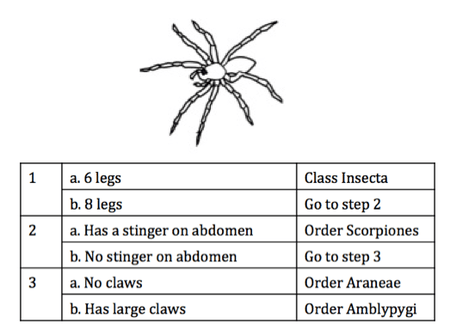
Use a Field Guide - either a paper copy or go to the internet and look it up.
How to determine the species given a picture of a leaf?
27
Fill in the Blanks
How do you determine the species of a leaf?
28
Review for Unit 2
Summative
13/11/2023 Science 6
Show answer
Auto Play
Slide 1 / 28
SLIDE

Similar Resources on Wayground
21 questions
Chemical Properties of Matter
Presentation
•
5th Grade
20 questions
Sedimentary Rock and Fossil Fuels Recap
Presentation
•
5th Grade
23 questions
7th Science- Intro to Ecology
Presentation
•
7th Grade
21 questions
Unit 5 Test- Layers of the Earth
Presentation
•
6th Grade
23 questions
DIGESTIVE SYSTEM
Presentation
•
6th Grade
20 questions
Science Midterm Review 6th Grade
Presentation
•
6th Grade
18 questions
Gravity and Inertia
Presentation
•
6th Grade
18 questions
Plants
Presentation
•
6th - 8th Grade
Popular Resources on Wayground
10 questions
How much do you know about our Portrait of an Eagle?
Quiz
•
10th Grade
10 questions
Fast Food Slogans
Quiz
•
6th - 8th Grade
21 questions
Continents and Oceans
Quiz
•
6th Grade
20 questions
Parts of Speech
Quiz
•
5th Grade
16 questions
Subject & Predicate
Quiz
•
5th Grade
25 questions
Multiplication Facts
Quiz
•
5th Grade
12 questions
Map Skills
Quiz
•
3rd Grade
22 questions
Continents and Oceans
Quiz
•
5th Grade
Discover more resources for Science
10 questions
6.6D - Relative Density Review
Quiz
•
6th Grade
20 questions
Claim, Evidence and Reasoning (CER)
Quiz
•
6th - 8th Grade
20 questions
Density
Quiz
•
6th Grade
10 questions
Exploring Chemical and Physical Changes
Interactive video
•
6th - 10th Grade
20 questions
Food Chains & Food Webs
Quiz
•
5th - 7th Grade
18 questions
Interpreting Distance/Time Graphs
Quiz
•
6th Grade
10 questions
Decoding the Periodic Table of Elements
Interactive video
•
6th - 10th Grade
15 questions
Potential and Kinetic Energy
Quiz
•
6th Grade