Enzymes
Presentation
•
Biology, Science
•
9th - 12th Grade
•
Practice Problem
•
Medium
+4
Standards-aligned
Karen Wolfe
Used 13+ times
FREE Resource
16 Slides • 47 Questions
1
2
Enzymes are Biological Catalysts
They are proteins
Catalysts speed up chemical reactions
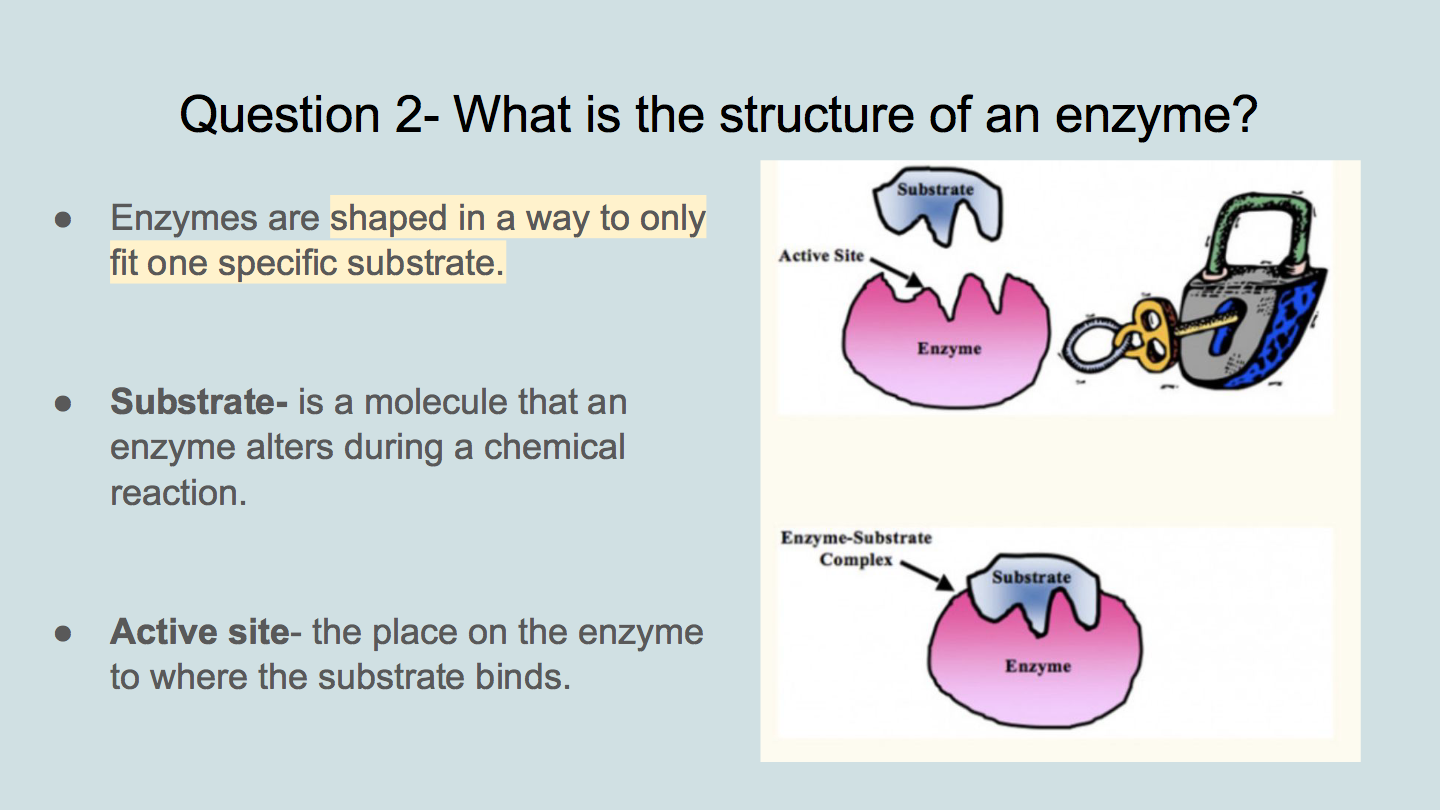
Structure = Function: Enzymes are specific to their Substrate (reactants). Active site of the enzymes fits together with the substrate(s)
Different reactions require different enzymes
3
Enzyme Specificity - The shape of the enzyme (structure) fits it's substrate (function)
4
The induced-fit model is the more accurate model
5
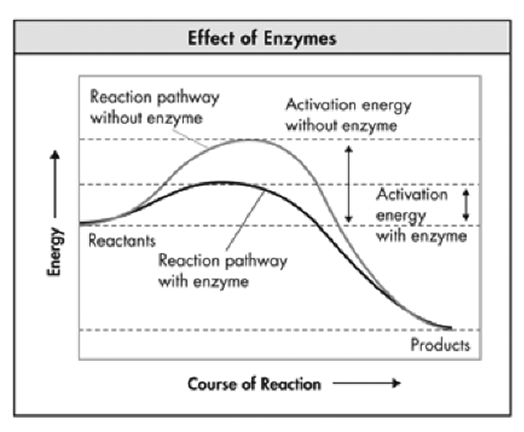
Enzymes speed up chemical reactions (Catalysts)
Activation energy is the energy needed to start a chemical reaction.
The less activation energy needed (smaller hill to climb) the faster the reaction will happen
Enzymes speed up reactions by lowering the activation energy
6
Factors affecting reaction rates
Substrate concentration
Enzyme concentration
pH, temperature, and ion concentrations
7
Denaturation = to lose shape
Structure (shape) = function
If enzymes lose their shape they no longer function correctly
Lower enzyme function = slower reaction rates
Factors that can affect shape & function of enzymes: Temperature, pH, salinity (ion concentration)
8
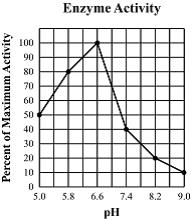
Optimal Enzyme Function
When the reaction rate is the highest!
9
Multiple Choice
10
Multiple Choice
11
Multiple Choice
12
Multiple Choice
13
Multiple Choice
14
Multiple Choice
15
Multiple Choice
16
Multiple Choice
17
Multiple Choice
18
Multiple Choice
19
Multiple Choice
20
21
Multiple Choice
Enzymes are
Lipids
Protein
Carbohydrates
Nucleic Acids
22
Multiple Choice
Which of these is most likely an enzyme?
Sucrose
Galactose
Fructose
Amylase
23
24
Multiple Choice
25
Multiple Choice
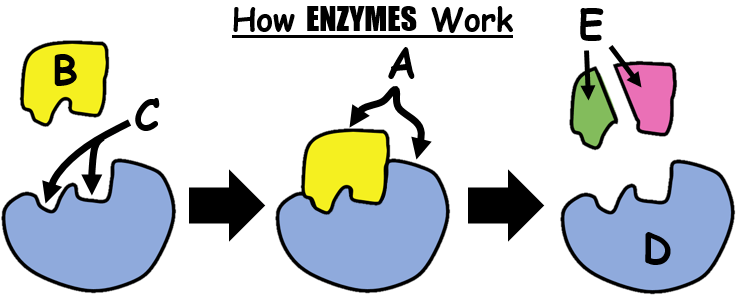
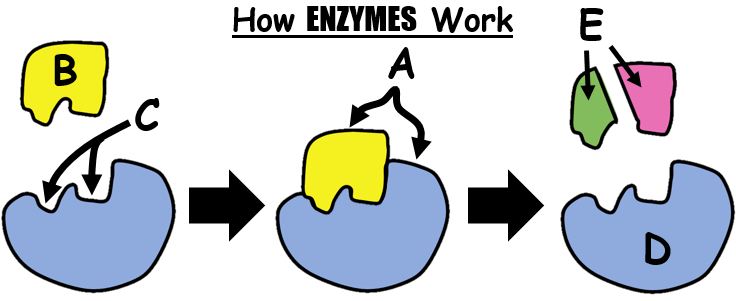
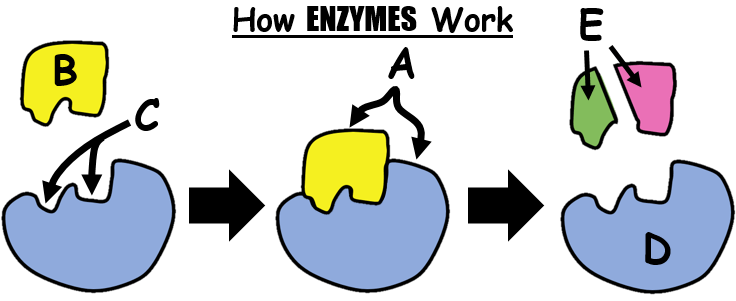
Letter D...
active site
enzyme
substrate
products
26
Multiple Choice
Letter B...
active site
enzyme
substrate
products
27
Multiple Choice
Letter c...
active site
enzyme
substrate
products
28
Multiple Choice
Each enzyme only has 1 substrate that will fit its active site. What is this called?
reusablility
denaturation
specificity
fragility
29
30
31
32
33
Multiple Choice
34
35
Multiple Choice
What happens when enzymes are heated to a high temperature?
The enzymes die.
The shapes of the enzyme are altered denature
The enzymes' amino acid sequence changes.
The enzymes remain the same
36
37
Multiple Choice
Energy needed to get a reaction started
catalytic energy
kinetic energy
covalent energy
activation energy
38
Multiple Choice
How do enzymes affect chemical reactions?
they prevent reactions from occuring
providing energy directly to the reaction
decreasing the amount of energy to get the reaction started
39
Multiple Choice
Enzymes that are denatured. . .
have more energy
have lost their 3-D shape and can no longer function
are inactive until needed
work more efficiently
40
Multiple Choice
What is an "active site"
the substrate
the place on the enzyme that interacts with the substrate
the location, in the organelle, where the reaction occurs
the entire enzyme
41
Multiple Choice
The molecule(s) that the enzymes bind to and change are called
substrates
denatured
hydrolyzed
active site
42
Multiple Choice
Which of the following affect enzyme reactions?
temperature
pH
both temperature and pH
nothing affects enzyme reactions
43
Multiple Choice
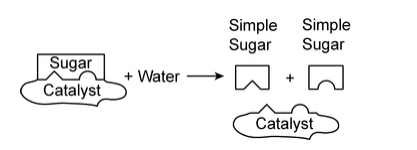
Which reaction is catalyzed by an enzyme?
blue
red
both
neither
44
Multiple Choice
This enzyme works best at a pH of
7
2
8
works the same at any pH
45
Multiple Choice
In this reaction the reactant(s) is/are
H2O2
catalase
H2O + O2
46
Multiple Choice
In this reaction the product(s) is/are
H2O2
catalase
H2O + O2
47
Multiple Choice
In this reaction the enzyme is/are
H2O2
catalase
H2O + O2
48
Multiple Choice
How does temperature affect this enzyme?
the enzyme denatures above 23 degrees C.
the enzyme works more slowly at 20 degrees C
the enzymes works best at a temperature below 15 degrees C
temperature does not affect this enzyme
49
Multiple Choice
What happens when enzymes are heated to a high temperature?
The shape of the enzyme are changed and it denatures
The enzymes die
The enzymes' amino acid sequence changes
The enzymes remain the same
50
Multiple Choice
What happens to an enzyme when it is denatured?
Activation energy is lowered
It becomes stronger
It loses its shape
Activation energy is raised
51
Multiple Choice
Absorbs energy
endothermic reaction
exothermic reaction
52
Multiple Choice
Releases energy
endothermic reaction
exothermic reaction
53
Multiple Choice
Which would be the enzyme that breaks down the starch amylose?
amylase
maltase
lactase
amylose
54
Multiple Choice
What is the optimum pH for the enzyme salivary amylase?
2
5
6.2
9.1
55
Multiple Choice
What is the optimum temperature for this enzyme?
20 degrees Celsius
45 degrees Celsius
52 degrees Celsius
64 degrees Celsius
56
Multiple Choice
How do enzymes speed up chemical reactions? Enzymes
lower the activation energy of chemical reactions.
raise the temperature of the cell, speeding chemical reactions.
store ATP, allowing more energy to be used in chemical reactions.
act as miniature "transfer trucks", gathering materials for chemical reactions, and placing them together.
57
Multiple Choice
Each enzyme produced by the body is
open - meaning it is able to catalyze a reaction with any molecule.
immature - meaning it cannot catalyze a reaction until many years later.
incomplete - meaning it requires other parts before it is able to bind to a molecule.
specific - meaning it is only able to catalyze a rection with a certain molecule.
58
Multiple Choice
What substances are formed as a result of this reaction?
hydrogen peroxide and water
water and oxygen
hydrogen peroxide and oxygen
water and ozone
59
Multiple Choice
Which model describes the active site of the enzyme changing shape slightly to fit the substrate?
'twisted ladder' model
'estimation' model
'induced fit' model
'lock and key' model
60
Multiple Choice
Which of the following describes the role that enzymes play in the process of metabolism?
Enzymes carry the genetic instructions required for a cell to initiate metabolism.
Enzymes increase the rate of the chemical reactions carried out during metabolism.
Enzymes provide the chemical energy that is broken down and released during metabolism.
Enzymes store the chemical energy that is used to construct nucleic acids during metabolism.
61
Multiple Choice
In the lock-and-key model of enzyme action, the __________ fits into the __________ of the enzyme.
product; substrate
active site; product
substrate; active site
active site; substrate
62
Multiple Choice
Where does the substrate bind on an enzyme?
active site
allosteric site
binding site
product site
63
Multiple Choice
catalyst =
enzyme used to break down nucleic acids
substance that speeds up the rate of a chemical reaction
minerals that assist in the normal functioning of enzymes
the part of an enzyme where the substrate binds to the enzyme and where the chemical reaction occurs
Show answer
Auto Play
Slide 1 / 63
SLIDE

Similar Resources on Wayground
61 questions
cells 2022
Lesson
•
9th Grade - University
58 questions
Adaptations and Evolutions
Lesson
•
9th - 12th Grade
56 questions
EES Exam Review: Earth's Motions
Lesson
•
9th - 12th Grade
60 questions
Properties of Sound Waves
Lesson
•
9th - 12th Grade
55 questions
History of Oceanography Lightning Round
Lesson
•
9th - 12th Grade
55 questions
Evolution
Lesson
•
9th - 12th Grade
59 questions
Ecology Intro (Levels, Relationships & Population Data)
Lesson
•
9th - 12th Grade
60 questions
Protein Synthesis
Lesson
•
9th - 12th Grade
Popular Resources on Wayground
10 questions
5.P.1.3 Distance/Time Graphs
Quiz
•
5th Grade
10 questions
Fire Drill
Quiz
•
2nd - 5th Grade
20 questions
Equivalent Fractions
Quiz
•
3rd Grade
15 questions
Hargrett House Quiz: Community & Service
Quiz
•
5th Grade
20 questions
Main Idea and Details
Quiz
•
5th Grade
20 questions
Context Clues
Quiz
•
6th Grade
20 questions
Inferences
Quiz
•
4th Grade
15 questions
Equivalent Fractions
Quiz
•
4th Grade
Discover more resources for Biology
14 questions
Ecological Succession: Primary and Secondary
Quiz
•
9th Grade
20 questions
Cladogram Practice
Quiz
•
10th Grade
20 questions
Evolution and Natural Selection
Quiz
•
9th Grade
21 questions
Cell Cycle and mitosis
Quiz
•
9th - 10th Grade
45 questions
Unit 9 Review: Biosphere
Quiz
•
9th Grade
20 questions
Food Chains and Food Webs
Quiz
•
7th - 12th Grade
20 questions
Sex-Linked Traits
Quiz
•
9th - 12th Grade
22 questions
AP Biology: Unit 7 Review (CED)
Quiz
•
9th - 12th Grade