Search Header Logo
REVIEW DENSITY GRADE 7

REVIEW DENSITY GRADE 7

Assessment

Presentation

Science, Physics

KG

Practice Problem

Hard

Created by

Noble Teacher

Used 1+ times

FREE Resource

12 Slides • 21 Questions

1

media

2

media

3

Multiple Choice

Density is ____

1

the amount of mass in an object

2

the amount of mass in a given space

3

the amount of space an object takes up

4

the weight of an object

4

media

5

media

6

Multiple Choice

Question image
Calculate the density of the cube.
1
2 g/cm3
2
4 g/cm3
3
6 g/cm3
4
8 g/cm3

7

media

8

media

9

media

10

Multiple Choice

Question image

Show all your work on your answer document. D=m/v

1

0.33 g/cm3

2

15 g/cm3

3

3 g/cm3

4

9 g/cm3

11

Multiple Choice

Question image

Show all your work on your answer document. D=m/v

1

0.5 g/cm3

2

6 g/cm3

3

2 g/cm3

4

4 g/cm3

12

Multiple Choice

Question image

Show all your work on your answer document. D=m/v

1

0.5 g/cm3

2

8 g/cm3

3

2 g/cm3

4

4 g/cm3

13

Multiple Choice

Question image
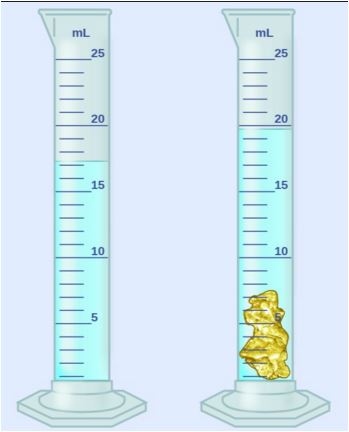
An irregularly shaped piece of gold was lowered into a graduated cylinder holding a volume of water equal to 17 ml. The height of the water rose to 20 ml. If the mass of the gold was 27 g, what was its density?
1
9 g/mL
2
10.5 g/mL
3
6.5 g/mL
4
8 g/mL

14

Multiple Choice

Question image
An irregularly shaped stone was lowered into a graduated cylinder holding a volume of water equal to 200 ml. The height of the water rose to 280 ml. If the mass of the stone was 240 g, what was its density?
1
3 g/mL
2
4 g/mL
3
2 g/mL
4
5 g/mL

15

Multiple Choice

Question image
An irregularly shaped rock was lowered into a graduated cylinder holding a volume of water equal to 50 ml. The height of the water rose to 75 ml. If the mass of the stone was 250 g, what was its density?
1
15 g/mL
2
5 g/mL
3
10 g/mL
4
20 g/mL

16

Multiple Choice

What scientific device would be used to measure the volume of an irregular object?

1

beaker

2

scale

3

graduated cylinder

4

triple beam balance

17

Multiple Choice

If water has a density of 1 g/cm3, what would an object with a density of 1.5 g/cm3 do in water?

1

sink

2

float

3

I don't know

18

media

The different densities of objects determines if it will sink or float in water.

Higher density than water will SINK!

Lower density than water will FLOAT!

The density of water is defined as 1 gram / milliliter3

What makes objects sink or float?

19

Multiple Choice

Calculate the density of a rock with the mass of 108 grams and a volume of 12 cm3.

1

9 g/cm3

2

0.11111 cm3/g

3

I have no idea!

4

19 g/cm3

20

One way would be to put the object in liquid that is inside a graduated cylinder. The liquid in the cylinder will rise the same amount as the volume of the object.

Subtract the final liquid volume reading from the starting volume reading to find the volume of the object.​

Science tool definition: A graduated cylinder is a tall narrow cylinder with markings used to measure volume of liquids!

So, then, how do you measure the volume of an irregular shaped object?

media

21

media

Rectangular objects - calculate volume by using the formula:​

Volume = Length x Width x Height.​

Volume is measured in different ways depending on what shape the object has.

Let's practice using this formula on the next slide.

22

Multiple Choice

Calculate the volume of a block that is 5 m long, 6 m wide, and 2 m high.

1

10 m3

2

30 m2

3

60 m3

4

120 m3

23

media

All matter takes up space. The amount of space an object takes up is called its volume.

Volume can be measured in cubic meters (m3), cubic centimeters (cm3), liters, and milliliters (mL​).

What is volume?

24

media

Mass is defined as the amount of matter an object has. It is not affected by gravity, and doesn't change based on location.

Mass differs from weight because weight is affected by gravity.​ Weight is the force of gravity pulling down on you.

Mass is measured in kilograms.​

​Fun fact! You will weigh less on the moon than you do on Earth! But you will weigh more on Jupiter!

Mass

25

Multiple Choice

Frank has an eraser. It has a mass of 4g, and a volume of 2cm3. What is its density?

1

8 g/cm3

2

2 g/cm3

3

1/2 g/cm3

4

24 g/cm3

26

Multiple Choice

What is the formula for density?

1

density = mass x volume

2

density = mass / volume

3

density = mass + volume

4

density = mass - volume

27

Multiple Choice

Jack has a rock. The rock has a mass of 14g and a volume of 2cm3. What is the density of the rock?

1

7 mL

2

7 g/cm3

3

28 g/cm3

4

1/7 g/cm3

28

Multiple Choice

Question image

What is the volume of the rock?

1

30cm3

2

10cm3

3

40cm3

4

20cm3

29

Multiple Choice

Question image
What is the volume of Object X?
1
10.0 cm3
2
15.0 cm3
3
20.0 cm3
4
25.0 cm3

30

Multiple Choice

If a block of wood has a density of 0.6 g/cm3 and a mass of 120 g, what is its volume?

1

200 cm3

2

0.005 cm3

3

200.0 ml

4

72 ml

31

Multiple Choice

Question image

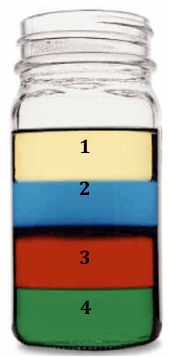
Put the liquids in order from most dense to least dense?

1

4, 3, 2, 1

2

1, 2, 3, 4

3

3, 4, 2, 1,

4

4, 3, 1, 2

32

Multiple Choice

Frank has a paper clip. It has a mass of 9g and a volume of 3cm3. What is its density?

1

3 g/cm3

2

1/3 g/cm3

3

27 g/cm3

4

39 g/cm3

33

Multiple Choice

Which units of measurement are used for volume?

1

grams

2

centimeters

3

grams/milliliter

4

milliliter

media

Show answer

Auto Play

Slide 1 / 33

SLIDE