

Grade 5 EASE 1 Prep

Presentation
•
English
•
5th Grade
•
Practice Problem
•
Easy

Fadia Anugrah
Used 2+ times
FREE Resource
22 Slides • 25 Questions
1

2
3
Smoke
Volcano
Temple
Theater
Statue
Columns
Horse and Cart
Vase
Servant
Fountain
4
Past Progressive, also known as the past continuous, is a verb tense used to describe actions that were ongoing or in progress at a specific point in the past. It is formed by combining the past tense of the verb "to be" (was/were) with the present participle (the -ing form of the main verb).
Examples:
"She was studying when the phone rang."
"They were playing basketball at this time yesterday."
Key Points:
Describes actions that were happening at a specific moment in the past.
Formed by combining "was" or "were" with the present participle (-ing form) of the main verb.
Often used to set the scene or describe two actions happeningsimultaneously in the past.
Past Progressive
5
When describing two actions that were happening simultaneously in the past, we often use the conjunction "while" along with the Past Progressive tense. This construction helps convey the idea that two events were occurring at the same time.
Examples:
"She was studying while he was watching TV."
"They were playing basketball while it was raining."
Key Points:
"While" is used to indicate the simultaneous occurrence of two actions.
Each action is described using the Past Progressive tense (was/were + present participle).
Two Simultaneous Actions with While
6
Multiple Choice

"What is a water feature in the park that sprays water into the air and often looks decorative?"
Tree
Fountain
Rock
Bench
7
Multiple Choice
"In ancient times, where would people gather for religious ceremonies and worship?"
Temple
Theater
Fountain
Pillar
8
Multiple Choice
"Where do people often go to watch live performances, such as plays, musicals, and concerts?"
Temple
School
Theater
Library
9
Multiple Choice
Past Progressive question:
"When we __________ (have) dinner, the phone __________ (ring)."
were having / rang
had / rang
were having / rings
had / rings
10
Multiple Choice
Two Simultaneous Actions with While question:
"John ___________ on his project while Emily ________ a beautiful landscape. What were both John and Emily doing?"
work/paint
was working/was painting
worked/painted
working/painted
11
12
Jaguar
Anteater
Beetle
Pool
Beak
Toucan
Vine
Sloth
Anaconda
Branch
13
Numbers 100-1,000,000
In English, numbers from 100 to 1,000,000 can be expressed using a combination of hundreds, tens, and ones. Here's a breakdown:
Hundreds: The first digit represents the number of hundreds. For example, in 345, the "3" represents 300.
Tens: The second digit represents the number of tens. In 345, the "4" represents 40.
Ones: The last digit represents the number of ones. In 345, the "5" represents 5.
To read the number aloud, you combine these parts. For instance, 345 is read as "three hundred forty-five."
Examples:
512: "five hundred twelve"
1,234: "one thousand two hundred thirty-four"
999,999: "nine hundred ninety-nine thousand nine hundred ninety-nine"
14
Have to / Had to
Have to:
"Have to" is used to express a present obligation or necessity.
Example: "I have to finish my homework before I go out to play."
Had to:
"Had to" is used to talk about a past obligation or something you were required to do.
Example: "Yesterday, I had to clean my room before my friends came over."
Key Points:
"Have to" is for present obligations, things you need to do now.
"Had to" is for past obligations, things you needed to do in the past.
15
Multiple Choice

"What is the name of the bird with a large, colorful beak found in tropical forests?"
Eagle
Sparrow
Toucan
Pigeon
16
Multiple Choice
"What is the name of an animal that eats ants and has a long snout for reaching into ant hills?"
Anteater
Lion
Giraffe
Elephant
17
Multiple Choice
"What slow-moving animal, known for its relaxed pace and often found hanging upside down from trees?"
Sloth
Tiger
Jaguar
Lion
18
Multiple Choice
"What is the word form of the number '678,912'?"
Six hundred seventy-eight thousand nine hundred twelve
Sixty-seven thousand eight hundred ninety-one
Six hundred seventy-eight thousand nine hundred two
Six thousand seven hundred eighty-nine
19
Multiple Choice
"Last month, Lisa __________ finish her book report, and now she __________ complete her science project. What verb forms correctly fill in the blanks?"
has to / had to
had to / has to
has to / has to
had to / had to
20
21
Bodyguards
Stage
Spotlight
Back up Singer
Electric Guitar
Fans
Dancer
Bass guitar
Drum kit
22
Going to …
"Going to" is a way to talk about future plans or intentions. It is often used when you have a specific idea or intention about what you want to do in the future.
Structure:
Subject + am/is/are + going to + base form of the verb
Examples:
"I am going to visit my grandparents next weekend."
"She is going to start a new art project."
"We are going to have a picnic in the park."
23
Telling Time: Past and To the Hour
When telling time, especially on an analog clock, we use phrases like "past" and "to" to indicate the minutes before or after the hour.
Past the Hour:
When the minute hand points past the 12 on the clock, we use the phrase "past."
Example: If the minute hand is on the 6 and the hour hand is on the 2, it is 2:30. We say "half past two."
To the Hour:
When the minute hand points to a number on the right side of the clock, we use the phrase "to."
Example: If the minute hand is on the 3 and the hour hand is on the 2, it is approaching 3 o'clock. We say "two thirty" or "half past two."
24
Multiple Choice

"What is a powerful and focused beam of light used to illuminate and highlight a specific area or person, often in performances or presentations?"
Flashlight
Candle
Lantern
Spotlight
25
Multiple Choice
"Who is a vocalist who supports the main singer or performer by providing harmonies and supporting vocals, especially in live performances or recordings?"
Lead singer
Backup dancer
Backup singer
Choir member
26
Multiple Choice
"What is a set of drums and other percussion instruments arranged for a single drummer, commonly including a bass drum, snare drum, and cymbals?"
Drum Kit
Guitar
Bass
Violin
27
Multiple Choice
"Complete the sentence: 'Next summer, we ____________ build a treehouse in the backyard.'"
are
is
are going to
is going to
28
Multiple Choice
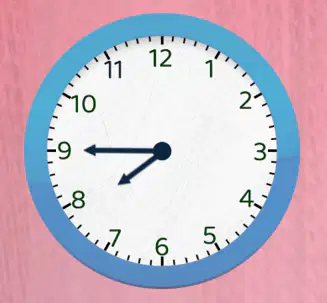
What time is it?
Fifteen past eight
Fifteen to eight
Forty five past eight
Seven past five
29
30
Pepper
Salt
Chopsticks
Waiter
Strawberries
Cookies
Spoon
Napkin
Fork
Knife
31
Ordinal numbers
Ordinal numbers are used to indicate the position or order of items in a sequence. They show the rank or placement of something in relation to others.
Examples:
1st (first)
2nd (second)
3rd (third)
4th (fourth)
5th (fifth)
...
32
Zero Conditionals
Zero Conditionals are used to express general truths, facts, or situations that are always true. This type of conditional sentence is formed with the present simple tense in both the "if" clause and the main clause.
Structure:
If + present simple, present simple
Examples:
"If you heat ice, it melts."
"If it rains, the grass gets wet."
33
Multiple Choice
"What is a piece of cloth or paper used for wiping the mouth or hands while eating?"
Towel
Tablecloth
Napkin
Placemat
34
Multiple Choice
"What eating utensil typically has several prongs or tines and is used to spear and lift food to the mouth?"
Spoon
Knife
Chopsticks
Fork
35
Multiple Choice
"What spice, often ground and used to add flavor and heat to food, comes in both black and white varieties?"
Salt
Cumin
Paprika
Pepper
36
Multiple Choice
"Complete the sentence: 'She finished in __________ place in the race.'"
second
two
twelfth
two-th
37
Multiple Choice
"Complete the sentence: 'If you mix blue and yellow, it __________ green.'"
becomes
become
became
will become
38
39
Handcuffs
Rope
Robbers
Jail
Wagon
Sheriff
Barrel
Saddle
Pistol
40
Be made of.../Be used for
These expressions are used to describe the composition or purpose of an object.
Be made of...:
This phrase indicates the materials or substances from which an object is constructed.
Example: "This table is made of wood."
Be used for:
This phrase indicates the purpose or function of an object.
Example: "This knife is used for cutting."
41
Possessive apostrophes
A possessive apostrophe is used to show ownership or possession. It is placed after the noun, followed by an 's' or just an apostrophe, depending on the form of the noun.
Structure:
For singular nouns: [Noun] + 's
Example: "The cat's tail is fluffy."
For plural nouns: [Plural Noun] + '
Example: "The dogs' toys are scattered around."
42
Multiple Choice
"Choose the correct sentence:
1, The house is made of bricks and stones.
2. The house is used for bricks and stones."
1
2
Both
None of them
43
Multiple Choice
"Who are individuals who unlawfully take property or possessions from others, often using force or threat?"
Police
Robbers
Firefighters
Paramedics
44
Multiple Choice
"What are the metal loops used by police to hold someone's hands together?"
Handcuffs
Keys
Gloves
Rings
45
Multiple Choice
"What flexible and strong material is commonly used for tying, lifting, or securing objects?"
Thread
String
Wire
Rope
46
Multiple Choice
"Select the sentence with the correct use of possessive apostrophe:"
1. The cats dish is empty.
2. The cat's dish is empty.
3. The cats' dish is empty.
4. The cat dish is empty.
1
2
3
4
47
Show answer
Auto Play
Slide 1 / 47
SLIDE
Similar Resources on Wayground

41 questions
6.B Grammar Possessive Nouns
Presentation
•
5th Grade
43 questions
POV
Presentation
•
5th Grade
41 questions
ENGLISH5-Kinds of Adjective
Presentation
•
5th Grade
40 questions
Inca Empire
Presentation
•
5th Grade
44 questions
Simple Present Lesson
Presentation
•
KG
44 questions
Winds and El Nino & El Nina
Presentation
•
5th Grade
42 questions
Vocab lesson: Sport lv2
Presentation
•
5th Grade
41 questions
1st Period Evaluation Review
Presentation
•
5th Grade
Popular Resources on Wayground
10 questions
How much do you know about our Portrait of an Eagle?

Quiz
•
10th Grade
10 questions
Fast Food Slogans
Quiz
•
6th - 8th Grade
21 questions
Continents and Oceans
Quiz
•
6th Grade
20 questions
Parts of Speech
Quiz
•
5th Grade
16 questions
Subject & Predicate
Quiz
•
5th Grade
25 questions
Multiplication Facts
Quiz
•
5th Grade
12 questions
Map Skills
Quiz
•
3rd Grade
22 questions
Continents and Oceans
Quiz
•
5th Grade
Discover more resources for English
20 questions
Parts of Speech
Quiz
•
5th Grade
16 questions
Subject & Predicate
Quiz
•
5th Grade
12 questions
Figurative Language Review

Interactive video
•
5th Grade
15 questions
Common and Proper Nouns
Quiz
•
5th Grade
20 questions
4 Types of Sentences
Quiz
•
4th - 5th Grade
20 questions
Main Idea and Details
Quiz
•
5th Grade
18 questions
Main Idea
Quiz
•
4th - 6th Grade
20 questions
Character traits
Quiz
•
5th Grade