Search Header Logo
Ecological Relationships & Succession Review

Ecological Relationships & Succession Review

Assessment

Presentation

Biology

10th Grade

Medium

NGSS
MS-LS2-4, MS-LS2-2, HS-LS2-2

+2

Standards-aligned

Created by

Alexandra Osler

Used 14+ times

FREE Resource

10 Slides • 25 Questions

1

Ecological Relationships & Succession Review

media
media

2

Symbiotic Relationships

Symbiosis is a close relationship between two species in which at least one species benefits.

  • Mutualism is a symbiotic relationship in which both species benefit.

  • Commensalism is a symbiotic relationship in which one species benefits while the other species is not affected.

  • Parasitism is a symbiotic relationship in which one species benefits (the parasite) while the other species is harmed (the host).

3

media

4

Multiple Choice

Yucca flowers are pollinated by yucca moths. The moths lay their eggs in the flowers where the larvae hatch and eat some of the developing seeds. Both species benefit.

1

commensalism

2

parasitism

3

mutualism

5

Multiple Choice

Question image
A pearlfish spends the day inside the alimentary tract, or intestines, of a sea cucumber. The fish emerges from the sea cucumber at night to feed on small crustaceans. The pearlfish gets a safe place to live. The sea cucumber does not gain anything from the relationship, nor is it harmed. 
1
Mutualism
2
Commensalism
3
Parasitism

6

Multiple Choice

Barnacles create home sites by attaching themselves to whales. This neither harms nor benefits the whales.
1
commensalism
2
parasitism
3
mutualism

7

Multiple Choice

A cymothoid isopod lives inside the mouth of a snapper fish. The isopod severs blood vessels in the fish’s tongue, causing the tongue to atrophy and degenerate.The isopod then hooks its pereopods, or legs, to the base of the fish’s tongue,essentially replacing the tongue. The isopod stays there for the rest of its life, feeding on blood, mucus, and stray pieces of food from the fish.
1
Commensalism
2
Parasitism
3
Mutualism

8

Multiple Choice

Question image
A boxer crab carries a pair of small anemones in its chelipeds, or claws. When approached by a predator, the crab waves the stinging tentacles of the anemones to deter the predator. The anemones benefit from the small particles of food dropped by the crab during feeding. 
1
Commensalism
2
Mutualism
3
Parasitism

9

media
  • Predation is a relationship in which members of one species (the predator) consume members of another species (the prey).

  • A predator-prey relationship tends to keep the populations of both species in balance.

Predation

media

10

media

Competition is a relationship between organisms that strive for the same resources in the same place.
The resources might be food, water, or space.

Competition

Two types of Competition:

  • Intraspecific competition occurs between members of the same species.

    • Ex: 2 males of a species competing for mates

  • Interspecific competition occurs between members of different species.

    • Ex: Predators of different species competing for the same prey.

11

Multiple Choice

Question image
What statement is TRUE about the graph?
1
The prey is the green line because there needs to be more prey than predators.
2
The prey is the red line because there needs to be more predators than prey.
3
The green line is the producers
4
The red line is the producers

12

Multiple Choice

Question image

Predator population lags behind prey population because:

1

Increase in predators leads to decrease in prey

2

Increase in predators leads to increase in prey

3

Increase in predators leads to decrease in producers

13

Multiple Choice

Question image

According to the graph, what is causing the deer population to decrease

1

They got sick

2

The wolf population is decreasing

3

The wolf population increased

4

They ran out of food

14

Multiple Choice

_______ occurs when 1 organisms kills and eats another for food.

1

Symbiosis

2

Competition

3

Predation

4

Collaboration

15

Multiple Choice

Two male deer fight over a female. This is an example of

1

Interspecific Competition

2

Intraspecific Competition

16

Multiple Choice

_______ occurs when two organisms are trying to acquire or get the same resources.

1

Symbiosis

2

Competition

3

Predation

4

Collaboration

17

Multiple Choice

What is intraspecific specific competition?

1

competition among organisms of the same species

2

competition among organisms of different species

18

Multiple Select

What is/are the possible limited resource(s) in interspecific competition?

1

Food

2

Shelter

3

Mating Partner

4

Water

19

Multiple Choice

Question image

Which species outcompete in the competition?

1

P. aurelia

2

P. caudatum

20

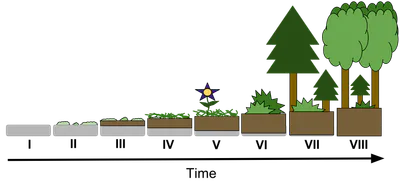
Ecological Succession

  • A community consists of populations of different species that live together and interact with one another.

  • Communities do not usually stay the same; they generally change over time.

  • This is called ecological succession.

21

media
  • Primary succession occurs when new land is formed or bare rock is exposed, doesn't have soil

    1. Pioneer species (like lichen and moss)are the first to colonize

    2. Once soil begins to form, grasses and plants start to grow

    3. Then shrubs and trees can start to grow

Primary Succession

22

media

23

media
  • Secondary succession occurs in a previously occupied area that was disturbed.

    • faster because the soil is already in place.

    • disturbances could be a fire, flood, or human action such as farming

    • the pioneer species are plants such as grasses, birch trees, and fireweed

Secondary Succession

24

media

25

Multiple Choice

___ are the first organisms to colonize an area and begin the process of ecological succession.

1

foundational organisms

2

introductory organisms

3

primary organisms

4

pioneer species

26

Multiple Choice

What is the main difference between primary and secondary ecological succession?

1

Primary begins WITHOUT soil; Secondary begins WITH soil

2

Primary is the first state and secondary is the second stage

3

Primary builds plant community; secondary builds animal community.

4

Primary begins WITH soil; Secondary begins WITHOUT soil

27

Multiple Choice

What is an example of an area that is likely to undergo primary succession?

1

Glaciers melt and leave exposed rock

2

Plants die from drought and decompose

3

Land is bulldozed and soil remains

28

Multiple Choice

Which of the following is the correct order of ecological succession?

1

grass - shrubs - lichens - trees

2

lichens - shrubs - grasses - trees

3

lichens - grasses - shrubs - trees

4

grasses - lichens - shrubs - trees

29

Multiple Choice

All of the following contribute directly to soil formation EXCEPT

1

lichens

2

decomposition of organisms

3

volcanic eruptions

4

erosion of rock by weather

30

Multiple Choice

What is an increase of biodiversity over time, after a natural or man made disturbance?

1

ecological recession

2

climax recession

3

ecological succession

4

climax succession

31

Multiple Choice

What is an example of a disturbance that could bring about secondary succession?

1

Humans cut down many trees in a small region

2

A volcanic eruption covers a village in lava.

32

Multiple Choice

What type of disturbance can be beneficial to ecosystems and communities?

1

Volcanic Eruption

2

Fire

3

Invasive Species

4

Flood

33

Multiple Choice

Which is faster: Primary or Secondary Succession?

1

Primary Succession

2

Secondary Succession

3

Both Take The Same Amount of Time

34

Multiple Choice

Which of the following is NOT a pioneer species?

1

Shrubs

2

Lichen

3

Mosses

4

Fungi

35

Multiple Choice

The Final stage of ecological succession is...

1

Mature Tree Growth

2

Climax Community

3

Pioneer Community

Ecological Relationships & Succession Review

media
media

Show answer

Auto Play

Slide 1 / 35

SLIDE