
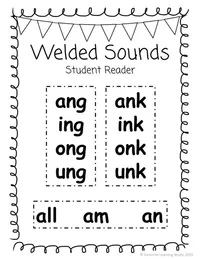
Unleashing the Power of Welded Sounds

Presentation
•
English
•
2nd Grade
•
Practice Problem
•
Hard
+2
Standards-aligned

Patrice Carter
Used 1+ times
FREE Resource
11 Slides • 5 Questions
1
Exploring the transformative potential of combining sounds through welding techniques to create unique and powerful auditory experiences.
2
Unleash the Power
3
Multiple Choice
What are Welded Sounds?
Combinations of two or more vowels that make a single sound
Combinations of two or more consonants that make a single sound
Combinations of a vowel and a consonant that make a single sound
Combinations of three or more consonants that make a single sound
4
Welded Sounds
Trivia: Welded sounds are combinations of a vowel and a consonant that make a single sound. They are important in phonics as they help children learn to read and spell words. Examples of welded sounds include 'sh', 'ch', and 'th'. These sounds can be found in words like 'ship', 'chat', and 'that'.
5
Unleash Welded Sound Power
6
Multiple Choice
What are blends, digraphs, and clusters?
Combination of two or more vowel sounds in a word
Combination of two or more consonant sounds in a word
Combination of a vowel and a consonant sound in a word
Combination of two or more syllables in a word
7
Blends, Digraphs, and Clusters
Trivia: Did you know that blends, digraphs, and clusters are all combinations of a vowel and a consonant sound in a word? They help create unique sounds and make words more interesting. Examples of blends include 'bl' in 'black' and 'st' in 'stop'. Digraphs are two consonants that make a single sound, like 'ch' in 'chair' and 'th' in 'this'. Clusters are two or more consonants together, such as 'spl' in 'splash' and 'str' in 'street'.
8
Unleash the Power
9
Multiple Choice
What is the technique used to smoothly pronounce welded sounds?
Blending Welded Sounds
Breaking Welded Sounds
Identifying Welded Sounds
Practicing Welded Sounds
10
Breaking Welded Sounds
Trivia: Breaking welded sounds is a technique used to smoothly pronounce words with blended sounds. It involves separating the sounds and pronouncing them individually. This helps improve clarity and articulation.
11
Segmenting Welded Sounds
12
Multiple Choice
What is the importance of segmenting welded sounds?
To improve pronunciation and decoding skills
To enhance reading and spelling abilities
To practice multisensory approaches
To identify and blend sounds
13
Enhancing Reading and Spelling
Trivia: Segmenting welded sounds is crucial for improving reading and spelling abilities. It helps learners identify and blend sounds, enhancing their decoding skills. By practicing multisensory approaches, learners can improve their pronunciation and develop better reading and spelling skills.
14
Unleash the Power
15
Multiple Choice
What skill does mastering welded sounds enhance?
Decoding
Fluency
Vocabulary
Spelling
16
Mastering Welded Sounds
Vocabulary is enhanced by mastering welded sounds. Welded sounds are two or three consonants that appear together in a word, but each consonant retains its own sound. Examples include 'bl', 'st', and 'gr'. By mastering these sounds, students can expand their vocabulary and improve their reading and spelling skills.
Exploring the transformative potential of combining sounds through welding techniques to create unique and powerful auditory experiences.
Show answer
Auto Play
Slide 1 / 16
SLIDE
Similar Resources on Wayground

11 questions
Numbers 1-20
Presentation
•
2nd Grade
13 questions
Pronoun-Verb Agreement
Presentation
•
2nd Grade
13 questions
Short and Long Vowels
Presentation
•
2nd Grade
9 questions
Supply and Demand
Presentation
•
2nd Grade
9 questions
Finding theme
Presentation
•
2nd Grade
12 questions
Beginning, Middle, End
Presentation
•
1st - 2nd Grade
11 questions
Reality and Fantasy
Presentation
•
3rd Grade
11 questions
Similes
Presentation
•
3rd Grade
Popular Resources on Wayground
10 questions
Safety Day 2026 – Student Review

Quiz
•
9th Grade
21 questions
Continents and Oceans
Quiz
•
6th Grade
20 questions
Parts of Speech
Quiz
•
5th Grade
16 questions
Subject & Predicate
Quiz
•
5th Grade
25 questions
Multiplication Facts
Quiz
•
5th Grade
12 questions
Map Skills
Quiz
•
3rd Grade
22 questions
Continents and Oceans
Quiz
•
5th Grade
15 questions
Rounding Decimals
Quiz
•
5th Grade
Discover more resources for English
19 questions
Antonyms and Synonyms
Quiz
•
2nd Grade
20 questions
nouns verbs adjectives test
Quiz
•
2nd Grade
27 questions
CKLA Ancient Greece
Quiz
•
2nd Grade
17 questions
Main Idea
Quiz
•
2nd Grade
14 questions
Contractions
Quiz
•
2nd Grade
10 questions
Common and Proper Nouns
Quiz
•
2nd - 3rd Grade
20 questions
Synonyms
Quiz
•
2nd Grade
10 questions
Parts of Speech- Third Grade
Quiz
•
2nd - 4th Grade