
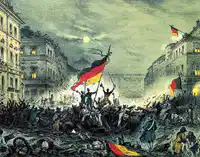
1848 - Springtime of nations

Presentation
•
History
•
10th Grade
•
Practice Problem
•
Medium

Chicken Nugget
Used 2+ times
FREE Resource
8 Slides • 5 Questions
1
G10
2
Springtime of Nations
The historical event referred to as the Springtime of Nations is the Revolutions of 1848. It was a series of political upheavals across Europe, where people demanded political and social reforms. These revolutions were inspired by the ideals of democracy, nationalism, and liberalism. The movement ultimately led to significant changes in the political landscape of Europe.
3
Multiple Choice
What historical event is referred to as the Springtime of Nations?
French Revolution
American Civil War
Glorious Revolution
Revolutions of 1848
4
The Springtime of Nations
Nationalism played a pivotal role in the revolution that swept across Europe during the Springtime of Nations. It fueled the desire for self-determination and independence among various ethnic groups. Nationalist movements emerged, demanding political and cultural autonomy. These movements challenged the existing order and led to significant political and social changes in Europe.
5
Multiple Choice
What role did nationalism play in the revolution during the Springtime of Nations?
Fueled the desire for self-determination and independence
Led to economic changes in Europe
Challenged the existing social order
Promoted international cooperation
6
Nationalism and Revolution
Fueled the desire for self-determination and independence. Nationalism played a crucial role in the revolution during the Springtime of Nations. It challenged the existing social order and led to economic changes in Europe. It promoted international cooperation and inspired people to fight for their own nations' independence. Nationalism was a driving force behind the desire for self-determination and the establishment of independent nations.
7
The Impact of Industrialization
The Industrial Revolution transformed Europe in the 19th century.
It brought significant changes in agriculture, manufacturing, mining, and transportation.
Urbanization, technological advancements, and economic growth were key outcomes.
Factory systems, steam power, and new inventions revolutionized production.
This period laid the foundation for modern industrial societies.
8
Transportation and Urbanization
The Industrial Revolution in Europe in the 19th century brought about a significant expansion of transportation and urbanization. It led to the construction of railways, canals, and roads, facilitating the movement of goods and people. Cities grew rapidly, with the rise of factories and the migration of people from rural areas. This transformation reshaped the landscape and social fabric of Europe.
9
Multiple Choice
What significant changes did the Industrial Revolution bring in Europe in the 19th century?
Advancements in agriculture and manufacturing
Technological innovations and economic growth
Expansion of transportation and urbanization
Development of political systems and social structures
10
The Failure of Revolutions
The Springtime of Nations: A series of revolutions that swept across Europe in 1848
Causes: Economic hardships, political repression, and desire for national independence
Goals: Liberal reforms, constitutional monarchy, and national unity
Challenges: Lack of coordination, internal divisions, and opposition from conservative forces
Outcome: Most revolutions failed to achieve their objectives, leading to restoration of old regimes
11
Lack of coordination
The revolutions during the Springtime of Nations in 1848 faced challenges due to a lack of coordination among the revolutionaries. Internal divisions and opposition from conservative forces further hindered their progress. Despite their efforts, most revolutions failed to achieve their objectives, leading to the restoration of old regimes.
12
Multiple Choice
What were the main causes of the revolutions during the Springtime of Nations in 1848?
Economic hardships, political repression, and desire for national independence
Lack of coordination, internal divisions, and opposition from conservative forces
Liberal reforms, constitutional monarchy, and national unity
Most revolutions failed to achieve their objectives, leading to restoration of old regimes
13
Draw
Draw a day in the life during 1848
G10
Show answer
Auto Play
Slide 1 / 13
SLIDE
Similar Resources on Wayground

11 questions
CFU: Guided Great Schism
Presentation
•
10th Grade
10 questions
The Reformation Continues P2 of 2
Presentation
•
10th Grade
9 questions
CS14 - US Overseas Expansion Pages 4-7
Presentation
•
10th Grade
12 questions
Industrial Revolution Lesson 16
Presentation
•
10th Grade
9 questions
The Father of Faith: YAHUAH's Friend
Presentation
•
KG
8 questions
Australian ANZAC Legacy and Tobruk
Presentation
•
10th Grade
11 questions
Nationalism in India
Presentation
•
10th Grade
8 questions
Semicolons
Presentation
•
10th Grade
Popular Resources on Wayground
10 questions
How much do you know about our Portrait of an Eagle?

Quiz
•
10th Grade
10 questions
Fast Food Slogans
Quiz
•
6th - 8th Grade
21 questions
Continents and Oceans
Quiz
•
6th Grade
20 questions
Parts of Speech
Quiz
•
5th Grade
16 questions
Subject & Predicate
Quiz
•
5th Grade
25 questions
Multiplication Facts
Quiz
•
5th Grade
12 questions
Map Skills
Quiz
•
3rd Grade
22 questions
Continents and Oceans
Quiz
•
5th Grade
Discover more resources for History
10 questions
Exploring the Journey of Early Humans

Interactive video
•
6th - 10th Grade
10 questions
Exploring Jamestown: John Smith and Pocahontas
Interactive video
•
6th - 10th Grade
20 questions
The Early Colonies
Quiz
•
7th - 11th Grade
10 questions
Recap on Mesopotamia: Key Concepts and Facts
Interactive video
•
6th - 10th Grade
16 questions
Government Unit 2
Quiz
•
7th - 11th Grade
10 questions
Exploring Types of Government
Interactive video
•
6th - 10th Grade
16 questions
Students of Civics Unit 2: The Constitution
Quiz
•
7th - 11th Grade
15 questions
Unit 4
Quiz
•
10th Grade