Search Header Logo
Semester Test 1 - Test Day

Semester Test 1 - Test Day

Assessment

Presentation

Science

7th Grade

Easy

NGSS
MS-LS2-3, MS-LS1-6, MS-LS2-4

+9

Standards-aligned

Created by

Gretchen Declue

Used 66+ times

FREE Resource

0 Slides • 50 Questions

1

Multiple Choice

Question image

An organism that can make its own food

1

autobot

2

heterotroph

3

autotroph

4

heterobot

2

Multiple Choice

Question image

Small openings on the underside of a leaf through which oxygen and carbon dioxide can move. Where gas exchange occurs in a plant.

1

nodules

2

stomata

3

chloroplasts

4

chlorophyll

3

Multiple Choice

Question image

Pigment which 'fills' chloroplast. This pigment absorbs sunlight.

1

nodules

2

stomata

3

chlorine

4

chlorophyll

4

Multiple Choice

Question image

A process plants use to turn sunlight into food: Conversion of light energy from the sun into chemical energy (stored in glucose).

1

toxoplasmosis

2

photosynthesis

3

aqua-synthesis

4

homeosynthesis

5

Multiple Choice

Question image

A gas that plants take in through small holes in their leaves for the process of photosynthesis.

1

oxygen

2

methane

3

propane

4

carbon dioxide

6

Multiple Choice

Question image

Taken in by the leaves of the plant to give the chloroplasts energy for food production.

1

chlorophyll

2

oxygen

3

water

4

sunlight

7

Multiple Choice

Question image

In this food web, the dragonfly would be a _________.

1

Producer

2

Primary Consumer

3

Secondary Consumer

4

Tertiary Consumer

5

Fungi

8

Multiple Choice

Question image

In this food web, the berries would be a _________.

1

Producer

2

Primary Consumer

3

Secondary Consumer

4

Tertiary Consumer

5

Secondary Succ ession

9

Multiple Choice

Question image

A rabbit gains energy from eating grass and vegetables. The rabbit is a __________.

1

Producer

2

Primary Consumer

3

Secondary Consumer

4

Tertiary Consumer

10

Multiple Choice

Question image

Organisms that make their own food, often through photosynthesis.

1

Producers

2

Primary Consumers

3

Secondary Consumers

4

Tertiary Consumers

11

Multiple Choice

Question image
The arrows in a food chain or web represents what?
1
They point to the organism that is being eaten.
2
It shows how sunlight flows within an ecosystem.
3
They show what direction the energy is flowing between organisms. 
4
They represent how water is transferred within a habitat.

12

Multiple Choice

Question image

Where does all energy in food web originate from?

1

Earth's Core

2

Water

3

Plants

4

The Sun

13

Multiple Choice

Question image
An organism that gets energy from breaking down dead organisms, non-living material or waste
1
producer
2
consumer
3
decomposer
4
autotroph

14

Multiple Choice

Question image

A connection of producers and consumers with many food energy paths in an ecosystem is a ____________

1

ecosystem

2

food web

3

food chain

4

biome

15

Multiple Choice

Question image
A tree is a ....
1
composer
2
decomposer
3
producer

16

Multiple Choice

Question image
Humans are considered...
1
consumers
2
decomposers
3
producers

17

Multiple Choice

Question image
Example of a decomposer
1
fungus
2
mouse
3
plants
4
frogs

18

Multiple Choice

Question image

Which of the following is an example of a benefit of a flooded river?

1

Burial and uprooting of plants

2

Deposition of nutrients in the surrounding soil

3

Removal of leaves from tall trees

4

Increased formation of habitats for organisms

19

Multiple Choice

Question image
What catastrophic event does this picture depict? 
1
Tsunami
2
Tornado
3
Hurricane
4
Earthquake

20

Multiple Choice

Question image

What catastrophic event could cause contaminated water?

1

Tornado

2

Flood

3

Forest Fire

4

Volcanic Eruption

21

Multiple Choice

A large wave created by an underwater earthquake is called a...
1
Earthquake 
2
Hurricane
3
Tsunami 
4
Flood

22

Multiple Choice

What is a common characteristic among pioneer species?

1

roots that break apart rocks

2

long thick roots

3

exposed surface roots

4

soak up water quickly

23

Multiple Choice

Which of the following best describes primary succession?

1

Volcano wipes out ecosystem that gradually grows back from ash covered soil

2

Volcano creates a new island of rock that must break down to form an ecosystem

3

Forest fire burns down forest that must bounce back over time

4

Tornado destroys a crop that must slowly grow back over time.

24

Multiple Choice

How do pioneer species compare in primary and secondary succession?

1

primary starts with grass and weeds, secondary starts with mosses

2

primary starts with forest fire, secondary starts with volcano

3

primary starts with a volcano, secondary starts with a forest fire

4

Lichens and moss in primary, and grasses/ ferns in secondary

25

Multiple Choice

Primary succession occurs in areas with:

1

very little soil

2

lots of soil

3

no soil

4

soil that has been disturbed

26

Multiple Choice

Question image
What is ecological succession?
1
A slow change in an environment
2
A change that takes days in an environment
3
No change
4
Abiotic change

27

Multiple Choice

Question image

Which progression best explains secondary succession?

1

lichens>grass>shrubs>small trees> big trees

2

mosses>creates soil>grasses>small trees> big trees

3

Volcano destroys ecosystem>grasses>shrubs>small trees>big trees

4

Volcano forms new island> lichens>grasses>shrubs>small trees>big trees

28

Multiple Choice

Question image
What are examples of pioneer species in a primary succession?
1
Bushes and Shrubs
2
Oak trees
3
Mossess and Lichens 
4
A rose Bush

29

Multiple Choice

Question image
A climax community is ….
1
the beginning of a new ecological succession.
2
the rocks in a new environment.
3
the fire that will cause destruction.
4
an area that reaches its greatest growing potential.

30

Multiple Choice

Question image

the BREAKDOWN of rock into smaller pieces of the same rock without any change in its composition

1
mechanical weathering
2
chemical weathering
3
erosion
4
deposition

31

Multiple Choice

Question image

the process in which sediment particles are picked up and MOVED from one place to another

1
mechanical weathering
2
chemical weathering
3
erosion
4
deposition

32

Multiple Choice

Question image
oxidation produces rust on some rocks containing iron
1
chemical weathering
2
mechanical weathering
3
erosion
4
deposition

33

Multiple Choice

Sand dunes are large piles of sand that can be found in the 
desert. What causes these sand dunes to form?
1
Water
2
Wind
3
Ice
4
Volcanoes

34

Multiple Choice

Besides moving water, what other forces cause erosion?

1

Wind, salt and gravity

2

wind, ice and gravity

3

wind, animals and storms

35

Multiple Choice

Question image

Factors within and ecosystem that are NOT living. (Rocks/Water/Air)

1

Biotic

2

Watershed

3

Abiotic

4

Erosion

36

Multiple Choice

Question image

Factors within an ecosystem that are living. (Plants/Animals)

1

Biotic

2

Abiotic

3

Ecosystem

4

Habitat

37

Multiple Choice

Question image
What is a watershed?
1
Water in an area
2
Water that flows into a river or stream
3
Land that water flows over and through
4
Water that is salty

38

Multiple Choice

Question image

Biome with many different species of cacti and reptiles and very little rainfall.

1

Desert

2

Temperate Rainforest

3

Tropical Rainforest

4

Arctic Tundra

39

Multiple Choice

Question image
Type of forest biome near the equator; receives a lot of rain; temperatures are warm all year.
1
desert
2
tropical rain forest
3
arctic
4
temperate rain forest

40

Multiple Choice

Question image

Which biome is represented by the rainfall amounts in letter C?

1

desert

2

prairie

3

deciduous forest

4

tropical rain forest

41

Multiple Choice

Question image
The earth's coldest biome is the....
1
Antartica
2
Grasslands
3
Tundra
4
Freshwater

42

Multiple Choice

Question image
The climate in a tropical rain forest can be described as
1
cold and wet 
2
warm and dry 
3
cold and dry 
4
warm and wet 

43

Multiple Choice

Question image
This is the most important thing that makes each biome different from each other.
1
Animals
2
Location
3
Climate
4
People

44

Multiple Choice

bears hibernate
1
behavioral adaptations
2
structural adaptations

45

Multiple Choice

polar bears have thick white fur to blend in
1
behavioral
2
structural

46

Multiple Choice

Plants grow towards sunlight to help them acquire as much sunlight as possible.
1
behavioral
2
structural

47

Multiple Choice

When using a dichotomous key to identify organisms, what do we look at?
1
physical features
2
weather patterns
3
environment
4
diet

48

Multiple Choice

What step do we always start with when using dichotomous keys?
1
1
2
2
3
3
4
4

49

Multiple Choice

Question image
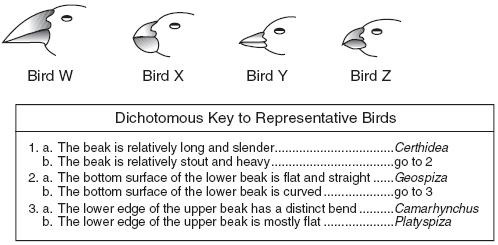
What is the name of bird W?
1
Certhidea
2
Geospiza
3
Camarhynchus
4
Platyspiza

50

Multiple Choice

Question image
What is a dichotomous key used for in science?
1
To organize biomes
2
Classify organisms
3
Identify bacteria only
4
None of these
Question image

An organism that can make its own food

1

autobot

2

heterotroph

3

autotroph

4

heterobot

Show answer

Auto Play

Slide 1 / 50

MULTIPLE CHOICE