

Untitled Lesson

Presentation
•
Mathematics
•
5th Grade
•
Practice Problem
•
Hard

Teacher Super
FREE Resource
27 Slides • 0 Questions
1


Where opportunity creates success
VMC002 Foundation Evidenced
Based Bioveterinary Sciences
Chemistry 4
2


Learning Outcomes
• Catalysts and Enzymes
– Describe the basic structure of enzymes and how they work
– Define the role enzymes play in homeostasis
– Describe how different factors affect the rate of reactions
• Diffusion and Osmosis
– Define diffusion and osmosis. Describe the differences between them
– Define tonicity and explain how it is used to describe different relative
concentrations
• Acid Base balance
– Define pH and the difference between acids and bases
– Explain the difference between strong and weak acids and bases
– Describe why acid base balance is important for homeostasis
3
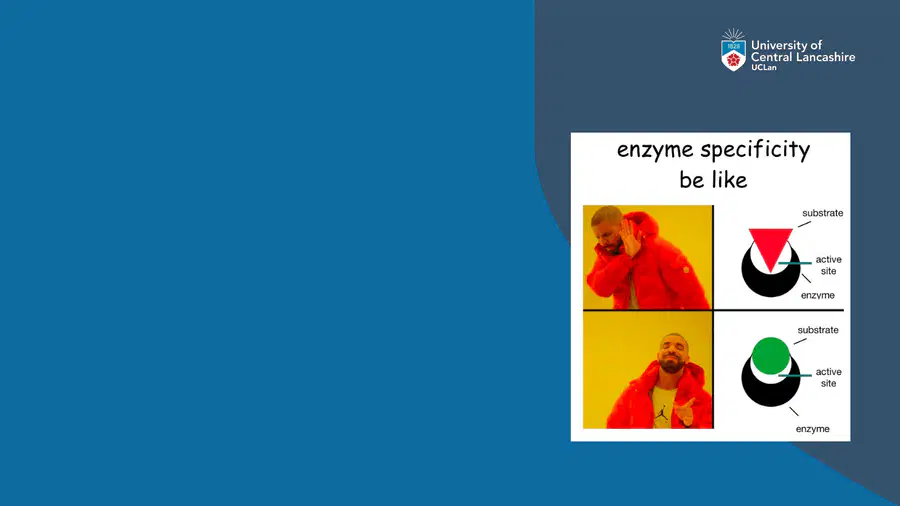
Catalysts and
enzymes
4


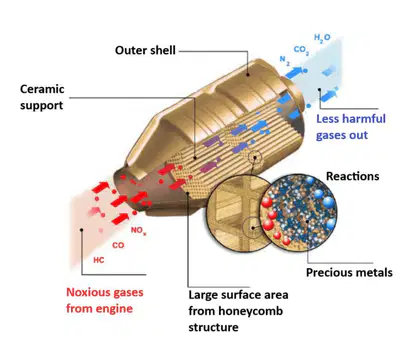
Catalysts
A substance that increases the rate
of a chemical reaction without
itself undergoing any permanent
chemical change
E.g. Catalytic converter uses
Platinum, Rhodium and Palladium
to reduce toxin gases in car
exhaust fumes
5


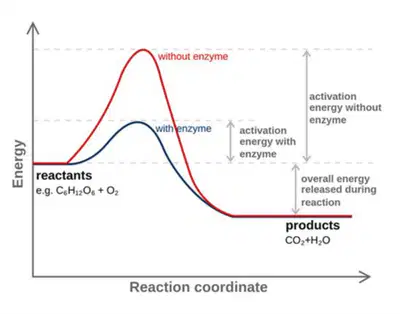
Enzymes
• Biological catalysts - Not used up in
the reaction or changed
• Reduce activation energy of a
reaction and make the transition state
more stable
• Increase reaction rate
• Can be anabolic (e.g. DNA
polymerase) or catabolic
(e.g.amylase)
6


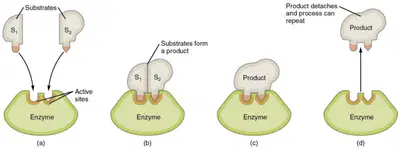
What enzymes do
Globular proteins – specific
shape (tertiary structure) and
active site
Regulatory regions
(allosteric binding) , co-
factors and/or co-enzymes
Hold molecules together or
stress bonds to lower
Activation Energy
7


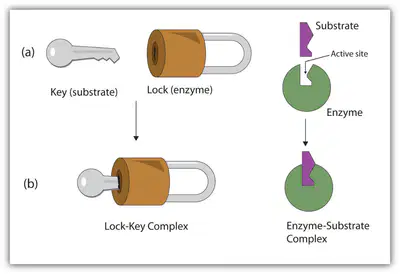
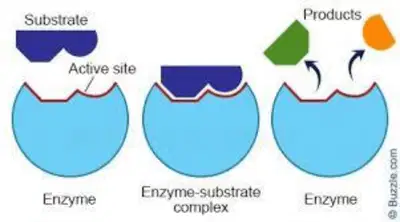
Models of enzyme action: Lock and Key
Recommend
watching Enzymes
(Bozeman
science) 12 mins
8


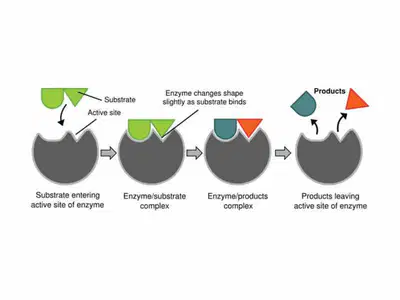
Models of enzyme action: Induced fit hypothesis
Induced-fit hypothesis
9


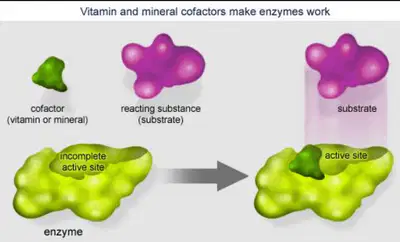
What are enzyme activators?
Some enzymes require the addition of a
non-protein substance called a Co-enzymes
or cofactors before they can catalyse a
reaction. There are two main types of
cofactor:
• cofactors – inorganic groups that are
permanently bound to the enzyme and so
are a type of prosthetic group. Common
examples include iron, zinc and copper.
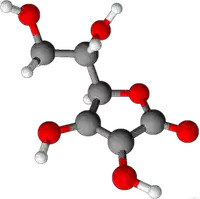
• coenzymes – organic molecules that bind
only temporarily to the enzyme,
transferring a chemical group necessary
required for the reaction. Examples include
vitamin C and ATP.
vitamin C
10


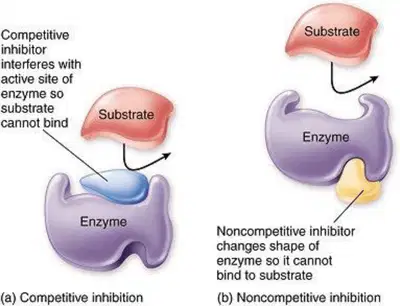
What are enzyme inhibitors?
Substances that interfere with
enzyme activity
Can be reversible or irreversible
(e.g. many poisons and toxins)
Can be competitive (blocking the
active site) or non-competitive
(allosteric) if change the shape of
the active site by binding at a
different location
11


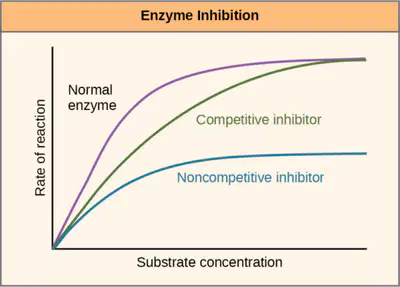
Reaction rate inhibition
Increasing substrate concentration will
only increase rate in competitive
inhibition, not allosteric.
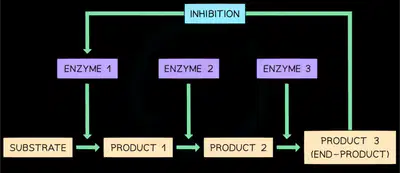
Enzyme inhibition is important in
regulating metabolic pathways. The
final (end) product often acts as a
regulator of the pathway in a process
called end-product inhibition.
When the amount of end product is
high, it binds non-competitively to an
enzyme in the pathway, blocking
further production of itself.
12


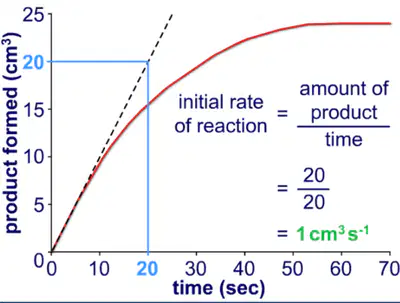
Kinematics of enzyme-catalysed reactions
• During an enzyme-catalysed
reaction, substrate is converted to
product.
• The reaction rate is highest
initially, then plateaus off as it
reaches equilibrium.
• Reaction rate is how fast a reaction
occurs; a change in concentration
per unit time.
13


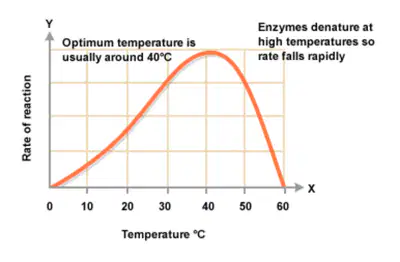
Rate of enzymatic-catalysed reactions
Factors affecting rate of reaction include
•
Enzyme concentration
•
Substrate concentration
•
Temperature
•
pH
Different enzymes function best at
different pH
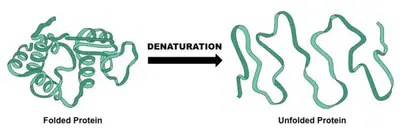
Most function best around body
temperature, 38C and are denatured at
higher temperatures
14

Diffusion and
osmosis
15


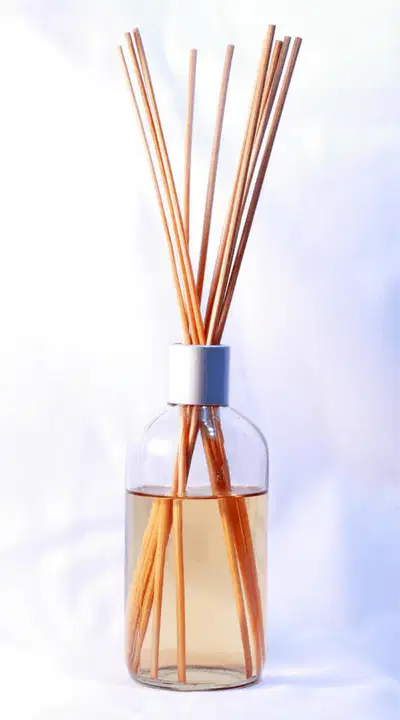
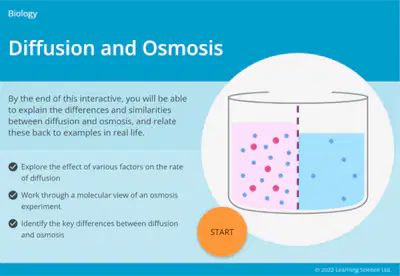
Diffusion
The passive movement of particles from a region of
higher concentration to one of lower concentration
i.e. down a concentration gradient.
Multiple factors can affect its rate
concentration gradient
size of the molecules
temperature
16


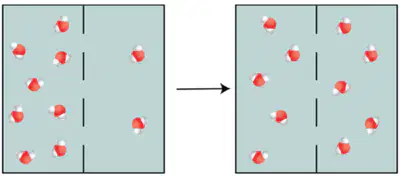
Osmosis
Diffusion of water molecules
down the gradient of ‘water potential’.
Occurs when solutions with different
solute concentration are separated by a
semi-permeable membrane.
Only smaller water molecules can
diffuse across and equalize the solute
concentration.
17


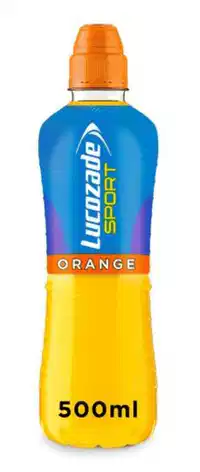
Concentration and tonicity
Solution – mixture of a solute dissolved into a solvent.
Solute concentration is a measure of the amount of solute to volume
of solvent.
Tonicity - its solute concentration relative to that of another solution
Hypertonic - the solute concentration is greater
Hypotonic – the solute concentration is less
Animal cells have a salt concentration of 0.9 %,described as isotonic.
18

Acid base balance
Quick recap: Acids and Bases (2 mins)
19


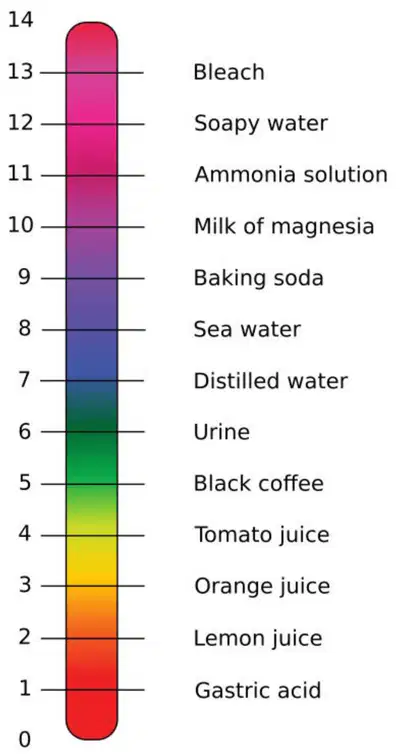
Acid base balance - pH scale
pH is a measure on a logarithmic scale of the
acidity or alkalinity of a substance
Acids dissolve to give pH <7
•They are proton donors and will release
hydrogen ions (protons) in water
Alkalis dissolve to give a pH >7
•They are proton acceptors and form hydroxide
ions in solution
pH is defined as the concentration of hydrogen
ions in solution
20


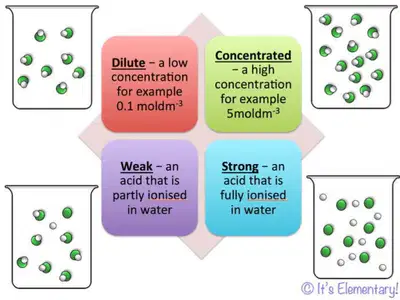
Dissociation
Molecules split to become ionised in
solution.
– Complete
– Incomplete – equilibrium exists between
states
Strong acids e.g. Nitric, Sulphuric and
Hydrochloric acid are usually fully
dissociated
Weak acids exist in equilibrium that favours
their undissociated state
Strong bases e.g. Sodium hydroxide, are
usually fully dissociated
Weak bases exist in equilibrium that favours
their undissociated state
21

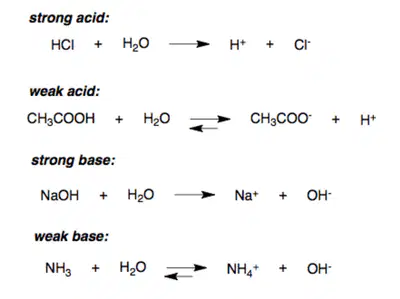
Examples of acids and bases:
22




Water
Water exists in a slightly dissociated state
equilibrium of dissociation is relatively constant. We describe
this as Kw, the dissociation constant of water
Hence an acid is more protonated than water, and a base is
less protonated than water
23


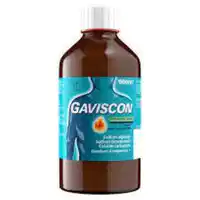
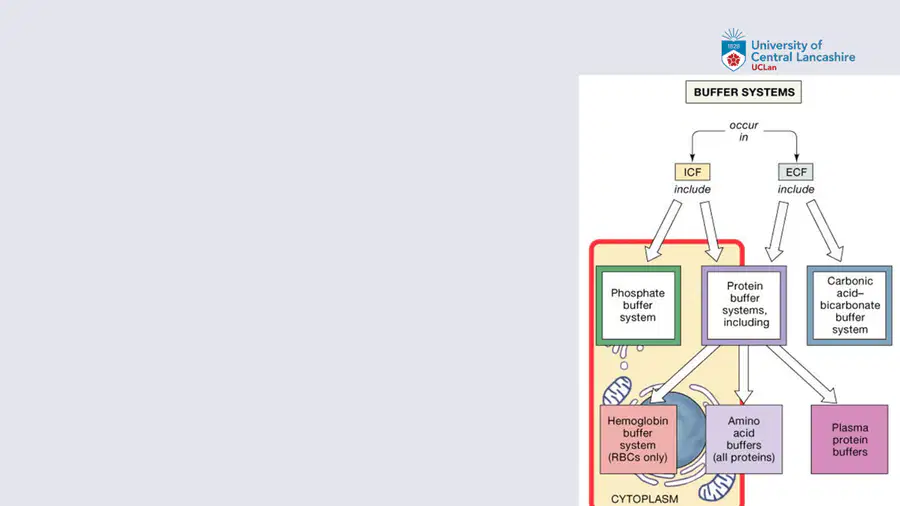
Buffers
• Maintain an approximate pH
• Acidic buffers are made from a weak acid (that dissociates poorly) and a salt
of the weak acid (that dissociates fully)
• Similarly basic buffers are made from a weak base
and a salt of the weak base
• Because there are two equilibriums in play, this results
in ‘mopping up’ of the Hydrogen or Hydroxide ions
and helps resist pH changes in.
• ‘Buffering capacity’ - important role in homeostasis
24
Acid-base homeostasis
• Minor changes in pH can have a devastating effect
• Animal bodies normal pH is 7.35-7.45
• Dealing with disturbance in acid-base balance
– Blood buffering capacity HCO−
3
– CO2 can be eliminated through the lungs. Fast but
not a long term option
– Kidneys secrete acid (H+) using buffers such as
ammonia, and reabsorb bicarbonate. Tight
physiological control, takes days.
• This is why respiratory and renal disease will cause
upsets in the body’s acid base balance, e.g. acidosis
or alkalosis in plasma pH
25


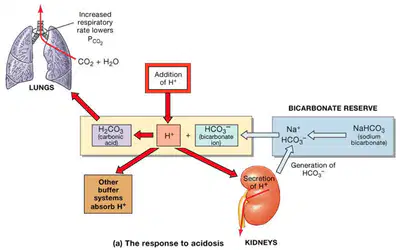
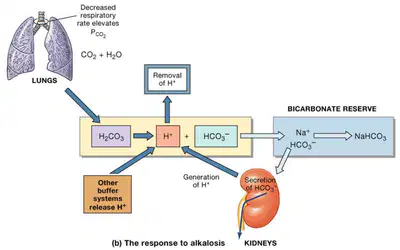
Acidosis and Alkalosis
26


Summary
Enzymes allow biochemical processes to take place in the
most energy efficient way.
Osmosis of water across a semi-permeable membrane is
essential for cell function
Homeostatic control is achieved by active management of
acid-base balance in the body, through buffers and
physiological mechanisms
27


Next steps
• Review the LabSci practical simulation
– Access through Blackboard
Where opportunity creates success
VMC002 Foundation Evidenced
Based Bioveterinary Sciences
Chemistry 4
Show answer
Auto Play
Slide 1 / 27
SLIDE
Similar Resources on Wayground

21 questions
5.3D - Multiply Decimal by Decimal with Area Models
Presentation
•
5th Grade
21 questions
Identify Parts of a Circle
Presentation
•
5th Grade
21 questions
Converting Customary Units of Length
Presentation
•
5th Grade
21 questions
NF.5 Lesson
Presentation
•
5th Grade
21 questions
OA.1 Lesson
Presentation
•
5th Grade
20 questions
Volume
Presentation
•
5th Grade
19 questions
Understand Place Value--Decimals
Presentation
•
5th Grade
20 questions
Area and Perimeter
Presentation
•
5th Grade
Popular Resources on Wayground
10 questions
How much do you know about our Portrait of an Eagle?

Quiz
•
10th Grade
10 questions
Fast Food Slogans
Quiz
•
6th - 8th Grade
21 questions
Continents and Oceans
Quiz
•
6th Grade
20 questions
Parts of Speech
Quiz
•
5th Grade
16 questions
Subject & Predicate
Quiz
•
5th Grade
25 questions
Multiplication Facts
Quiz
•
5th Grade
12 questions
Map Skills
Quiz
•
3rd Grade
22 questions
Continents and Oceans
Quiz
•
5th Grade
Discover more resources for Mathematics
25 questions
Multiplication Facts
Quiz
•
5th Grade
15 questions
Rounding Decimals
Quiz
•
5th Grade
20 questions
Decimal Place Value
Quiz
•
4th - 6th Grade
10 questions
2 digit by 2 digit Multiplication
Quiz
•
5th Grade
10 questions
3 Digit by 2 Digit Multiplication
Quiz
•
5th Grade
20 questions
Prime Factorization #2
Quiz
•
5th Grade
70 questions
Multiplication Facts
Quiz
•
3rd - 6th Grade
10 questions
Adding and Subtracting Decimals
Quiz
•
5th Grade