Kinetics Review
Presentation
•
Chemistry
•
12th Grade
•
Practice Problem
•
Medium
Nancy Flory
Used 1+ times
FREE Resource
7 Slides • 8 Questions
1
There are many factors that influence the reaction rates of chemical reactions including the concentration of reactants, temperature, the physical state of reactants and their dispersion, the solvent, and the presence of a catalyst.
How well do you remember how reaction rates are affected.
Next>
2
Multiple Choice
Stove burners are connected to nozzles that regulate the steady flow and supply of gas. When the nozzle is clogged, there is an interference in the flow of gas which affects the performance of the burner. Which of the following best describes this scenario and the effect on the kinetics?
Clogged nozzle restricts the flow of gas, leading to a reduced gas volume available for combustion, slowing down the rate of combustion and producing a smaller or nonexistent flame.
Clogged nozzle increases the flow of gas, leading to an excess gas volume available for combustion, increasing the rate of combustion and producing an oversized flame.
Clogged nozzle ensures even distribution of gas, resulting in efficient combustion and a consistent flame.
Clogged nozzle allows for rapid bursts of gas intermittently, causing an unpredictable and fluctuating flame.
3
Multiple Choice
A chemist is trying to observe the decomposition of H2O2 into H2 and O2. One reaction set-up involved 5.00 g H2O2 being placed in a 500-mL flask at 30 °C. Another set-up involved 5.00 g H2O2 being placed in a 1.0-L flask at 30 °C. Which explains why the second set-up would have a slower reaction?
The second set-up has a higher concentration, hence a slower reaction.
There is insufficient information to make a conclusion.
The second set-up has a lower concentration, hence a slower reaction.
4
Next, you demonstrated how a reaction rate is quantitatively determined. Reaction rates can be determined over particular time intervals or at a given point in time.
A rate law describes the relationship between reactant rates and reactant concentrations. Reaction rates are reported as either the average rate over a period of time or as the instantaneous rate at a single time. Reaction rates can be determined over particular time intervals or at a given point in time.
5
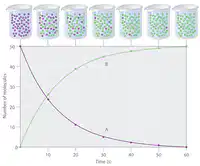
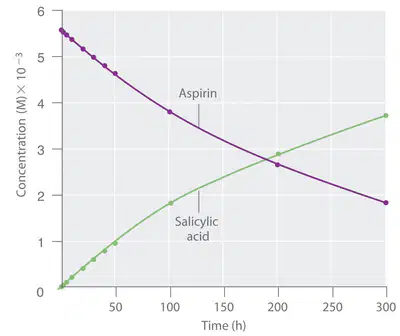
Reaction rates are usually expressed as the concentration of reactant consumed or the concentration of product formed per unit time. The units are thus moles per liter per unit time, written as M/s, M/min, or M/h. To measure reaction rates, chemists initiate the reaction, measure the concentration of the reactant or product at different times as the reaction progresses, perhaps plot the concentration as a function of time on a graph, and then calculate the change in the concentration per unit time.
rate = Δ[B]/Δt = −Δ[A]/Δt
6
7
8
The instantaneous rate of a reaction is the reaction rate at any given point in time. As the period of time used to calculate an average rate of a reaction becomes shorter and shorter, the average rate approaches the instantaneous rate. Comparing this to calculus, the instantaneous rate of a reaction at a given time corresponds to the slope of a line tangent to the concentration-versus-time curve at that point—that is, the derivative of concentration with respect to time.
9
10
Multiple Choice
How does the instantaneous rate of a reaction change with time?
Instantaneous rate decreases as the reaction progresses.
Instantaneous rate increases as the reaction progresses.
Instantaneous rate remains constant over the course of the chemical reaction.
11
Multiple Choice
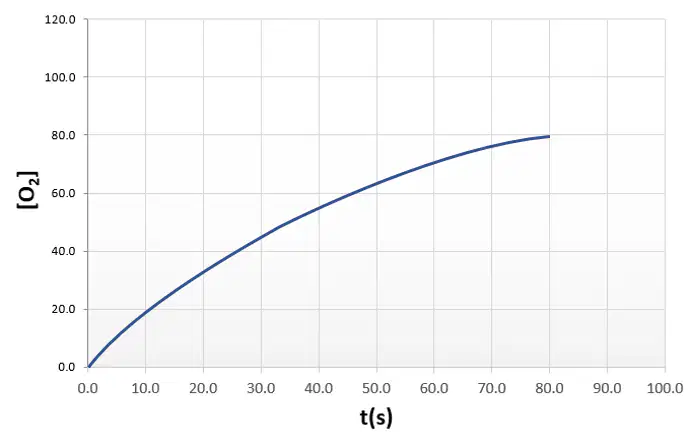
Estimate the instantaneous rate of formation of O2 at 70 s for the reaction based on the given graph.
2 N2O5 → 4 NO2 + O2
1.0x10³ M/s
5.0x10⁻² M/s
3.0x10⁻³ M/s
7.0x10⁻³ M/s
12
Multiple Choice
Using the given kinetic data below for the reaction B → C + D, approximate the instantaneous rate at t = 40 s.
0.012 M/s
0.0105 M/s
8.5 × 10⁻³ M/s
9.0 × 10⁻³ M/sK
13
Multiple Choice
Give the relationship between the rate of disappearance of the reactants and the rate of appearance of the products in the gas-phase reaction below:
4 NO2 (g) + O2 (g) → 2 N2O5 (g)
2 Δ[NO2]/Δt = Δ[O2]/Δt = - 1/2 Δ[N2O5]/Δt
-1/2 Δ[NO2]/Δt = - Δ[O2]/Δt = Δ[N2O5]/Δt
-1/4 Δ[NO2]/Δt = - Δ[O2]/Δt = 1/2 Δ[N2O5]/Δt
- 2 Δ[NO2]/Δt = - Δ[O2]/Δt = 4 Δ[N2O5]/Δt
14
Multiple Choice
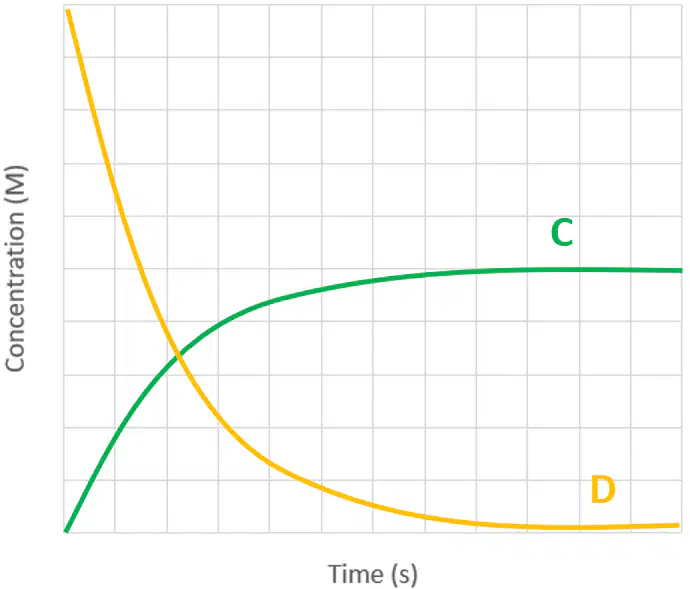
Determine the chemical equation describing the data shown in the graph made by measuring the concentration of the reactant and product as a function of time
C → D
2D → C
D → 2C
C → 4D
15
Multiple Choice
A 0.078 mol C sample was allowed to react in a flask to produce D according to the hypothetical gas-phase reaction C → D
Select the attributes needed to determine the rate in terms of concentration per time for the reaction taking place.
temperature of the solution
molecular mass of the solute
volume of the container
mass of the solution
There are many factors that influence the reaction rates of chemical reactions including the concentration of reactants, temperature, the physical state of reactants and their dispersion, the solvent, and the presence of a catalyst.
How well do you remember how reaction rates are affected.
Next>
Show answer
Auto Play
Slide 1 / 15
SLIDE

Similar Resources on Wayground
11 questions
SIMPLE PAST: READING
Presentation
•
12th Grade
11 questions
Bohr Model
Presentation
•
11th - 12th Grade
11 questions
RELATIVE CLAUSES
Presentation
•
12th Grade
11 questions
Pre-Lab Experiment 2: Determination of Heat of Reaction
Presentation
•
12th Grade
10 questions
Molar Mass Learning Check
Presentation
•
12th Grade
10 questions
Poetic Structure
Presentation
•
11th - 12th Grade
11 questions
Equilibrium-Shortage-Surplus
Presentation
•
11th - 12th Grade
10 questions
Thermochemistry
Presentation
•
11th - 12th Grade
Popular Resources on Wayground
10 questions
HCS SCI 03 Summer School Review 4
Quiz
•
3rd Grade
11 questions
HSMS - Standard Response Protocol
Quiz
•
6th - 8th Grade
16 questions
1.1-1.2 Quiz Review
Quiz
•
9th - 12th Grade
12 questions
Exponent Expressions
Quiz
•
6th Grade
20 questions
Adding and Subtracting Integers
Quiz
•
6th - 7th Grade
11 questions
Northeast States
Quiz
•
3rd - 4th Grade
10 questions
Characterization
Quiz
•
3rd - 7th Grade
10 questions
Common Denominators
Quiz
•
5th Grade