2 8th review
Presentation
•
Science
•
8th Grade
•
Easy
Rebecca Smith
Used 1+ times
FREE Resource
21 Slides • 39 Questions
1
Poll
Would you rather...
Take a 1 week trip around the foreign country of your choice
Take a 4 week trip around the U.S.
2
Poll
Would you rather...
Have a piggy bank that doubles any money you put in it
Find ten dollars under your pillow every time you wake up
3
Poll
Would you rather...
Be able to talk to animals and have them understand you but you can't understand them
Be able to understand animals but they can't understand you
4
Poll
Would you rather...
Sneeze uncontrollably for 15 minutes once every day
Sneeze once every 3 minutes of the day while you are awake
5
Poll
Would you rather...
Visit every country in the world
Be able to play any musical instrument
6
Poll
Would you rather...
Every vegetable you eat tastes like candy and still be healthy
All the water you drink tastes like a different beverage every time you drink it
7
Poll
Would you rather...
Have a robot do your chores
Have a robot do your homework
8
Poll
Would you rather...
Have octopus arms
Have caterpillar legs
9
Poll
Would you rather...
Only be able to walk on all fours
Only be able to walk sideways like a crab
10
Poll
Would you rather...
Have a tail that can't grab things
Have wings that can't fly
11
Poll
Would you rather...
Eat a bowl of spaghetti without sauce
Eat a bowl of sauce without spaghetti
12
Poll
Would you rather...
Have an elephant-sized dog
Have a dog-sized elephant
13

14
15
Multiple Choice
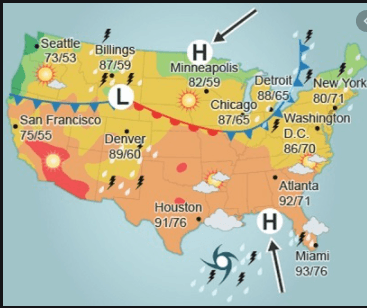
Look at the image. Which city is about to have a cold front?
El Paso
Los Angeles
Tampa
Chicago
16
Multiple Choice
Cold fronts usually travel from...
South to North
North to South
17
Multiple Choice
When a cold front passes through, the temperature gets warmer!
True
False
18
Multiple Choice
What happens when a cold front comes through?
Temperature gets cooler and heavy rain, thunderstorms, or snow occur
Temperature gets warmer and it produces a nice gentle rain
19
20
Multiple Choice
Which city is about to have a warm front?
St. Louis
Denver
Atlanta
21
Multiple Choice
Warm fronts usually travel from...
North to South
South to North
22
Multiple Choice
When a warm front passes through, what usually happens?
The temperature increases (gets warmer) and brings gentle, steady rain over a few days
The temperature decreases (gets cooler) and brings storms (heavy rain or snow)
23
Multiple Choice
Which of the following is a cold front?
24
Air molecules are squeezed closely together
Temperature is cool and dry
Areas with high pressure have clear, sunny skies
25
Air molecules are spaced out
Temperature is warm and moist
Areas with low pressure will be warm and rainy
26
Multiple Choice
Based on the weather map, which city will most likely experience decreasing temperatures during the next 24 hours?
Denver, because it is raining there
Minneapolis, because a cold front is approaching
Atlanta, because a warm front is approaching
Houston, because it is in a high temperature area
27
Multiple Choice
Which city is going to experience cool weather with sunny, clear skies?
Minneapolis
Billings
Denver
Washington D.C.
28
29
The lithosphere is made from the crust and the uppermost part of the mantle
The lithosphere is rigid, brittle rock
These plates float on the asthenosphere
30
31
The super continent that Alfred Wegener described in his theory of Continental Drift
32
Convection currents in the asthenosphere drive the movement of lithospheric plates
33
34
Hot magma in the asthenosphere begins to rise, similar to the way hot air rises.
As it rises to the top of the asthenosphere, it cools and becomes more dense.
This cooler, dense magma then sinks again. As it sinks, it gets warmer, until the process begins again
This movement of magma is what drives the plates to move.
35
Multiple Choice
Tectonic plates consist of
continental crust
mesospheric crust
both continental and oceanic crust
oceanic crust
36
Multiple Choice
The idea that the continents were once part of a single landmass that broke apart and
moved is
Continental Drift
Tectonic Plates
Transform
37
Multiple Choice
The region where two lithospheric plates meet
Continental Drift
Plate tectonics
Plate Boundaries
38
Multiple Choice
The scientist who developed the big idea called "sea-floor spreading"
Alfred Wedgener
Harry Hess
Edward Dutton
Ortelius
39
Multiple Choice
Pangaea was an ancient supercontinent made up of...
America, Greenland, and Europe
Antarctica, India, and America
all of Earth’s continents
South Africa, India, Australia, and South America
40
Multiple Choice
Why did no one believe Wegener's thoery that the continents were once together?
He could not explain HOW the continents moved
He didn't have evidence
His data was wrong
He didn't use the right technology to gather data
41
Multiple Choice
The movement of the tectonic plates is caused by
the rotation of the Earth
convection currents in the Asthenosphere
the gravity of the iron-nickel core
the Moho discontinuity
42
Multiple Choice
Which layer of the Earth consists of tectonic plates?
asthenosphere
mantle
mesosphere
lithosphere
43
Multiple Choice
Tectonic plates “float” on
the lithosphere
the mantle
the ocean
the asthenosphere
44
Multiple Choice
The fact that similar fossils are found on both sides of the ocean is evidence of
magnetic reversal
global positioning
continental drift
oceanic drift
45
By Edge
46
HR Diagrams show temperature/color in relation to relative brightness.
Some text here about the topic of discussion.
HR Diagrams
47
Most stars live in the main sequence for the majority of their lives. Our star is a yellow star within this main sequence.
Some text here about the topic of discussion.
Main Sequence
48
Blue Giants are massive, fast burning stars that are the hottest and brightest in our universe. They use up their fuel quickly (relative to other stars).
Some text here about the topic of discussion.
Blue Giants
49
Red Giants are massive, relatively cool stars. our star will become a red giant after the hydrogen is gone. Blue giants turn into red SUPERgiants at the end of their hydrogen.
Some text here about the topic of discussion.
Red Giants
50
White dwarfs are small, white, very hot stars. Our star will become a white dwarf after the reg diant phase.
Some text here about the topic of discussion.
White Dwarfs
51
The closer to the Y axis, the hotter the star. Thus, white dwarfs and blue giants are the hottest stars.
The further from the Y axis, the cooler the star. Red giants are large, but very cool.
Some text here about the topic of discussion.
Temperature
52
Brightness on the HR diagram increases the further you get from the X axis. Blue and red giants are the brightest stars mainly due to their size; not temperature!
Some text here about the topic of discussion.
Brightness
53
Multiple Choice
Which quadrant has the hottest, dimmest stars?
Quadrant 1
Quadrant 2
Quadrant 3
Quadrant 4
54
Multiple Choice
What is the name of the stars located in quadrant 2?
Main Sequence
White Dwarfs
Red Giants
Blue Giants
55
Multiple Choice
Where would our sun be located?
Quadrant 1
Quadrant 2
Quadrant 3
Quadrant 4
56
Multiple Choice
Where would blue giants be found?
Quadrant 1
Quadrant 2
Quadrant 3
Quadrant 4
57
Multiple Choice
What section is considered the main sequence?
Area M
Area P
Area X
Area Z
58
Multiple Choice
Where are red giants?
Area M
Area P
Area X
Area Z
59
Multiple Choice
Where are white dwarfs?
Area M
Area P
Area X
Area Z
60
Some text here about the topic of discussion
Would you rather...
Take a 1 week trip around the foreign country of your choice
Take a 4 week trip around the U.S.
Show answer
Auto Play
Slide 1 / 60
POLL

Similar Resources on Wayground
52 questions
Coriolis Effect & Wind Patters (with student notes)
Presentation
•
8th Grade
55 questions
Review Earth & Space
Presentation
•
8th Grade
53 questions
Ecosystem Unit EOG 2022
Presentation
•
8th Grade
55 questions
Lesson 11 The Constitution Review
Presentation
•
8th Grade
54 questions
Electricity & Magnetism Review
Presentation
•
8th Grade
56 questions
HR Diagram
Presentation
•
8th Grade
56 questions
5.2 Larutan dan Kadar Keterlarutan
Presentation
•
8th Grade
53 questions
Reporting Category 3
Presentation
•
8th Grade
Popular Resources on Wayground
10 questions
Safety Day 2026 – Student Review
Quiz
•
9th Grade
21 questions
Continents and Oceans
Quiz
•
6th Grade
20 questions
Parts of Speech
Quiz
•
5th Grade
16 questions
Subject & Predicate
Quiz
•
5th Grade
25 questions
Multiplication Facts
Quiz
•
5th Grade
12 questions
Map Skills
Quiz
•
3rd Grade
22 questions
Continents and Oceans
Quiz
•
5th Grade
15 questions
Rounding Decimals
Quiz
•
5th Grade
Discover more resources for Science
20 questions
Newton's Laws of Motion
Quiz
•
8th Grade
15 questions
potential and kinetic energy
Quiz
•
8th Grade
21 questions
Newton's Laws of Motion
Quiz
•
8th Grade
20 questions
Elements, Compounds and Mixtures
Quiz
•
8th Grade
10 questions
Exploring Chemical and Physical Changes
Interactive video
•
6th - 10th Grade
20 questions
Physical vs Chemical Changes
Quiz
•
8th Grade
20 questions
Conduction, convection, and Radiation Practice
Quiz
•
8th Grade
21 questions
Waves and Wave Properties
Quiz
•
6th - 8th Grade