

ESS Volcanoes Case Study

Presentation
•
Science
•
9th Grade
•
Practice Problem
•
Easy
+15
Standards-aligned

Megan Howard
Used 2+ times
FREE Resource
12 Slides • 25 Questions
1
2
Objectives
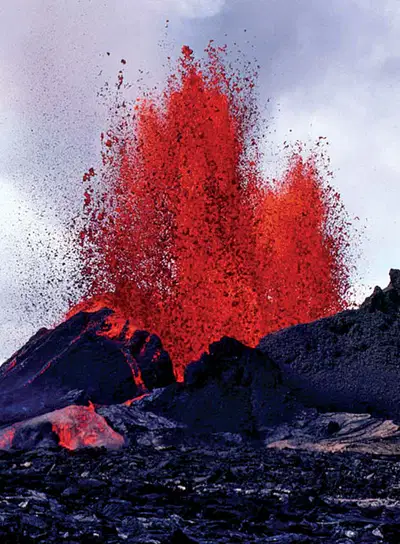
Understand what volcanoes are, how they form, and the rocks they create
List volcano characteristics
Use acquired knowledge to identify several types of modern volcanic eruptions around the world
3
Draw
Mark the locations on this map of famous volcanoes you already know about.
4
Open Ended
Thinking about the locations you drew, are there any patterns in where volcanoes are found around the world?
5
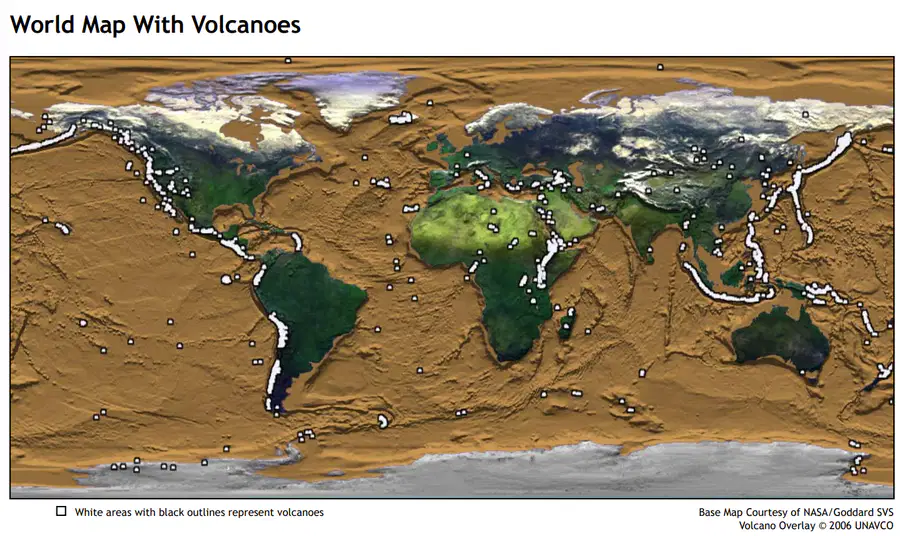
Study this map carefully-- there are questions about it!
6
Open Ended
Think about the distribution (where they are at on the map) of volcanoes:
1. Why do you think they are where they are?
2. Why do you think certain areas are more active than others?
7
On the next slide is an interactive. Click all of the tabs and read the information. Following the interactive there are question slides-- you should be able to move back and forth from the questions to the interactive in order to answer everything.
8
9
Open Ended
1. How do volcanoes form?
10
Open Ended
2. What are the four primary types of volcanoes?
11
Open Ended
3. Where do volcanoes form?
12
Open Ended
CONNECTIONS FROM PAST MATERIAL: Rocks are classified by what they are made of and how they form. Igneous rocks always begin as magma. 4. What are the two main types of igneous rocks, and what is the main difference between them?
13
14
Open Ended
5. Will an effusive eruption have more gas and be more dense (viscous) than an explosive flow, or will it be less gaseous and less viscous?
15
Open Ended
6. Which type of eruption appears to be the more hazardous to humans? Explain your answer.
16
Open Ended
7. Of the numerous hazards caused by volcanic eruptions, list and describe ONE that cause damage on a local level, and at ONE that has global implications.
17
18
Open Ended
Explore the interactive for each of these volcanic features:
lava, tephra, lava lake, vent, fissure, dike, magma, caldera, crater, geyser, spring, `a`a flow, pahoehoe flow, and lava tubes.
8. Choose FOUR (4) of the fourteen volcanic features listed above and describe what they are like:
19
Lava Sampling on Kilauea
Watch the video at this link: https://sdpb.pbslearningmedia.org/asset/ess05_vid_sample/
Answer questions about it on the next slide.
20
Open Ended
8. Why does scientist Michael Garcia refer to the basalt he is walking on as "the youngest real estate on Earth"?
21
Open Ended
9. What does viscous mean?
22
Open Ended
10. For what scientific reason does Dr. Garcia quickly quench the hot lava with water?
23
Open Ended
11. What has careful study of the composition of the lavas from Kilauea and Mauna Loa revealed about their origins and relationship?
24
Case Study 1: Mount Pinatubo
Watch these TWO videos. Answer the questions about them on the next slide.
https://sdpb.pbslearningmedia.org/asset/ess05_vid_pinatubo/
https://sdpb.pbslearningmedia.org/asset/ess05_vid_lahar/
25
Open Ended
12. Was the Mount Pinatubo eruption an effusive or explosive eruption?
26
Open Ended
13. Based on your observations, what type of volcano is Mount Pinatubo? On what evidence do you base your answer?
27
Open Ended
14. Over what type of plate boundary is this volcano located?
28
Open Ended
15. Because vulcanologists were able to accurately predict the timing of this eruption, the lives of hundreds of people who evacuated the nearby area were probably saved. What evidence did the scientists observe that prompted them to call for an evacuation?
29
Case Study 2: Tungurahua
On the next slide is a web page. Read the information, then answer the questions on the following slides.
30
31
Open Ended
16. What problems did the inaccurate eruption forecast of the Tungurahua volcano cause for the people of Ecuador AND what difficulties might this cause for community officials in the future?
32
Open Ended
17. What three variables do scientists monitor when attempting to forecast volcanic eruptions?
33
Open Ended
18. What are some of the hurdles that vulcanologists face when trying to make accurate eruption forecasts?
34
Case Study 3: Kilauea
Go to the link below and watch the video about Kilauea. Use the video to answer the questions on the following slides.
https://sdpb.pbslearningmedia.org/resource/ess05.sci.ess.earthsys.hawaii/plate-tectonics-the-hawaiian-archipelago/
35
Open Ended
19. Based on your observations of this video and previous videos you have seen, what type of volcanoes are Kilauea and the other Hawaiian volcanoes? On what evidence do you base your answer?
36
Open Ended
20. Does Hawai'i experience effusive or explosive eruptions?
37
Open Ended
21. Explain Hawai'i's setting in terms of plate boundaries. What makes it so unusual?
Show answer
Auto Play
Slide 1 / 37
SLIDE
Similar Resources on Wayground

31 questions
Separating Mixtures
Presentation
•
9th Grade
28 questions
Wave Interactions
Presentation
•
8th - 9th Grade
36 questions
Periodic Table Groups
Presentation
•
9th Grade
33 questions
6.2 Intro to Quadratics
Presentation
•
9th Grade
31 questions
Forces: Inertia and Gravity
Presentation
•
8th Grade
30 questions
Lesson2 Nonmetal
Presentation
•
9th Grade
29 questions
Into to DNA Replication
Presentation
•
9th Grade
33 questions
Science Fun Facts
Presentation
•
9th Grade
Popular Resources on Wayground
10 questions
Safety Day 2026 – Student Review

Quiz
•
9th Grade
21 questions
Continents and Oceans
Quiz
•
6th Grade
20 questions
Parts of Speech
Quiz
•
5th Grade
16 questions
Subject & Predicate
Quiz
•
5th Grade
25 questions
Multiplication Facts
Quiz
•
5th Grade
12 questions
Map Skills
Quiz
•
3rd Grade
22 questions
Continents and Oceans
Quiz
•
5th Grade
15 questions
Rounding Decimals
Quiz
•
5th Grade
Discover more resources for Science
10 questions
Exploring Chemical and Physical Changes

Interactive video
•
6th - 10th Grade
20 questions
Atomic Structure
Quiz
•
9th Grade
10 questions
Exploring the Electromagnetic Spectrum for Middle School Science
Interactive video
•
6th - 10th Grade
10 questions
Exploring Force and Motion Concepts
Interactive video
•
6th - 10th Grade
10 questions
Exploring Air Masses and Weather Fronts
Interactive video
•
6th - 10th Grade
10 questions
Exploring the States of Matter
Interactive video
•
6th - 10th Grade
10 questions
Exploring Forces: Net Force, Normal Force, Gravity, and Friction
Interactive video
•
6th - 10th Grade
10 questions
Differentiating Thermal Energy and Temperature
Interactive video
•
6th - 10th Grade