
Search Header Logo
Rural Fieldwork

Rural Fieldwork

Assessment

Presentation

Geography

7th Grade

Practice Problem

Easy

Created by

Aimee Cooper

Used 1+ times

FREE Resource

24 Slides • 11 Questions

1

media

​Lesson Objectives

​To identify a rural fieldwork enquiry

To understand how we collect rural fieldwork data.

To evaluate our data collection

media

2

media

​Coming up with a question?

​Coming up with a question about rural areas is the first stage of our fieldwork.

What have we learned about and how can we measure that in real life?

Think about who lives in rural areas, the environment, tourism, farming, sustainability, decline and growth

media

3

Open Ended

Question image

What investigation could we do on this area?

4

media

​Aims and hypothesis

​The aim of your fieldwork is what you are trying to find out. E.g

  • What impact on the rural environment does the building of a new housing estate estate have?

  • An investigation into the environmental impact of the new housing estate.

media

5

media

​Hypothesis

​The hypothesis is what you think you are going to find.

E.g The building of the new housing estate has had a negative impact on the environment.

media

6

media

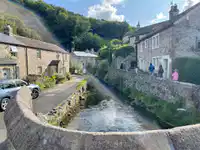
Our rural area: Castleton (Peak District)

​Watch this short clip and note why people might want to visit the Peak District.

7

media

​Castleton

Castleton is a small village in the High Peak district of Derbyshire, England. As of the 2011 census, the population was around 649 people.

Castleton is a popular tourist destination, known for its picturesque surroundings and historical attractions. Some notable points of interest include Peveril Castle.
Tourism is a significant part of the local economy, with shops, cafes, and other businesses catering to the needs of visitors.

media

8

Open Ended

Question image

What hypothesis would you set for the following investigation.

"An investigation into the impact of tourism in a rural village in the Peak District"

(Think about what you expect to find...will it impact the environment, the shops, the people, the economy)

9

media

​Our investigation: Castleton

​Aims:
An Investigation into the impacts of tourism in rural Castleton.

Hypothesis:
1: Tourism has a negative impact on the environment in Castleton.

2: Tourism has a negative impact on the economy in Castleton

media

10

Open Ended

Question image

What risks might we face if we all went to Castleton?

11

media

Risk Assessment

  • Any fieldwork will involve consideration of health and safety using a risk assessment

  • Risks specifically associated with rural environment fieldwork may include:

    • Weather conditions

    • Uneven ground

    • Working in an unfamiliar place

    • Traffic

    • Livestock

media

12

media

​How can we measure this?

Fieldwork involves the collection of information or data. Quantitative data usually consists of factual information that can be counted and used in fieldwork. Qualitative data is more opinion-based, but is still useful for geographical investigations.

13

Open Ended

Question image

What quantitative data could we collect to measure the impact of tourism on Castleton

14

media

Environmental Quality Survey

An environmental quality survey uses an observer’s judgements to assess environmental quality against a range of indicators. Often they work on a sliding scale of quality (like 1 to 5) to represent less good to good. Alternatively you can use a Bi-polar scale (like -5 to +5) to indicate a negative assessment through to a positive assessment, with 0 representing neither good or bad.

media

15

media
media
media
media
media

16

Open Ended

Do you think Environmental Quality Survey is a good measure? What are some of its limitations?

17

media

​Environmental Quality Survey

As it is based on personal judgements the data collected using environmental quality surveys is subjective.

media

18

Open Ended

How could the Environmental Quality Survey be improved?

19

media

​Pedestrian and Traffic counts

Pedestrian survey to consider the type of person, where they are, what they are doing within different parts of the rural settlement. This could be conducted at differing times of the day or year.

media

20

media
media
media

21

media

​Traffic Count

 This might include determining the noise level, measuring the speed of the traffic, as well as count different types of transport and the numbers of people using it. This count could also be conducted at differing times of the day.


media

22

media
media

23

Open Ended

Question image

What does this traffic co

24

Open Ended

Question image

What could some limitations of pedestrian counts and traffic counts be?

25

media

​Qualitative Data Collection

Data does not have to be in numeric form - it can also be in words and descriptions

media

26

Open Ended

Question image

What qualitative data could we collect in Castleton?

27

media

Field sketches and photographs

- this is when a snapshot of a landscape is taken, either with a camera or by drawing. Field sketches and photographs provide a good reminder of what a place is like.

media

28

media
media
media
media

29

media

​Limitations

​The sketch may be inaccurate or not to the correct scale.
Important details may be missed.

The sketch may contain inaccuracies which affect the analysis for example more litter than there actually was at the site


media

30

media

these can be either hand-drawn or sourced from somewhere like the internet. Maps give spatial information about places. Satellite images and GIS maps are types of map that can be used for fieldwork.

​Maps

media

31

media

​Questionnaires

This is when people are asked what they think. Questionnaires are good at finding out opinions, but they may be less accurate when looking for facts.

media

32

Open Ended

Question image

What problems are there with this questionnaire?

33

Multiple Choice

Identify one type of quantitative data used in a rural environment land use change enquiry

1

Population count

2

traffic count

3

environmental quality survey

4

field sketch

34

media

​Lesson Objectives

​To identify a rural fieldwork enquiry

To understand how we collect rural fieldwork data.

To evaluate our data collection

media

35

media

​Homework

​ In this case, you are aiming to investigate consumer awareness of, and people’s opinions of sustainable shopping. In other words, you want to know what customers know and think about things like packaging, recycling, eco-friendly and Fairtrade products etc., and whether it affects where / how they shop.

media
media

​Lesson Objectives

​To identify a rural fieldwork enquiry

To understand how we collect rural fieldwork data.

To evaluate our data collection

media

Show answer

Auto Play

Slide 1 / 35

SLIDE
