Review of Evolution
Presentation
•
Mathematics
•
8th Grade
•
Medium
+11
Standards-aligned
A. Bleecher
Used 1+ times
FREE Resource
34 Slides • 43 Questions
1
2
3
Multiple Choice
Scientists have collected millions of fossils of different organisms, and have developed a timeline of life on Earth. What do we call this?
Mutation
Natural Selection
The theory of evolution
Fossil Record
4
Multiple Choice
A remains or traces left over of an organism from the past is called a _______.
Ancestor
Skeleton
Fossil
Imprints
5
6
7
The Law of Superposition
The Law of Superposition gives us information about the relative age of different fossils.
Relative age does not tell the exact age of something, but it tells us which object is oldest and which is youngest.
8
Multiple Choice
9
Multiple Choice
10
Multiple Choice
11
12
Multiple Choice
use or disuse
Karl Weissman
13
Multiple Choice
acquired characteristics are inherited
Karl Weissman
14
Multiple Choice
This scientist that disproved the theory of 'Use and disuse" and inheritance of acquired characteristics by cutting off tails of mice for 24 generations and showing the offspring still had full tails.
Lamarck
Darwin
Weismann
Einstein
15
16
Multiple Choice
A study of the body structures of animals to know how they evolved from the likes of their common ancestors for the purpose of adapting to their environment.
Evidence of Evolution
Comparative Anatomy
Fossils
Embryonic Development
17
Multiple Choice
Used as evidence to show that organisms had a common ancestor. It compares embryo development across species.
cladogram
common ancestor
comparative embryology
evolution
18
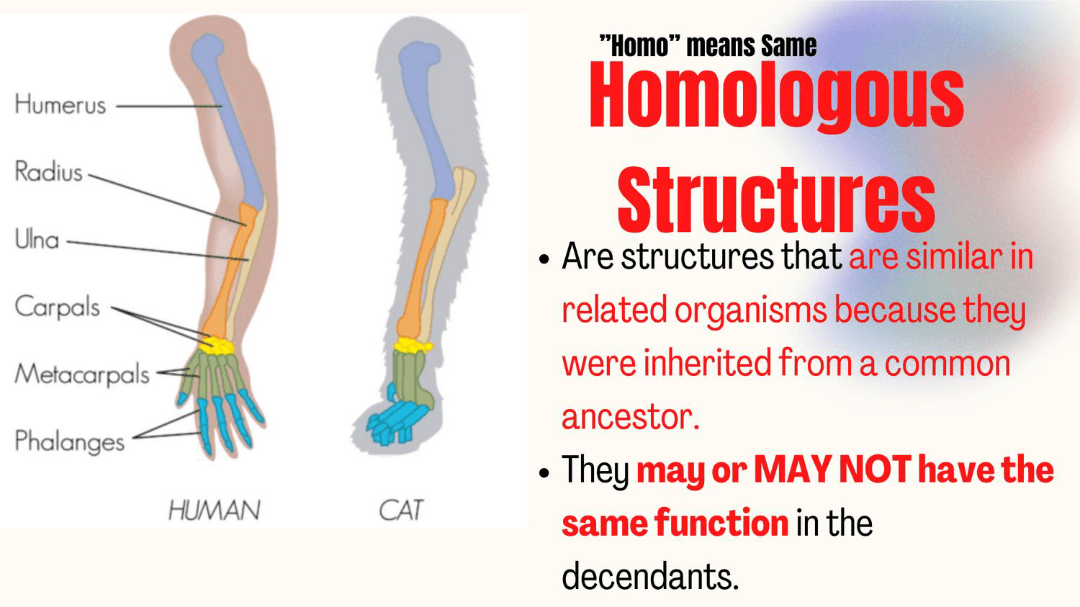
​Las estructuras homólogas son estructuras que son similares en organismos relacionados porque fueron heredadas de un ancestro común.
19
20
21
22
Multiple Choice
Scientist that contributed the most to our understanding of evolution
Darwin
Lamarck
Karl Weissman
23
Multiple Choice
Which scientist visited the Galapagos Islands and came up with the theory of natural selection?
Theodor Schwann
Gregor Mendel
Charles Darwin
Rudolf Virchow
24
25
26
27
Multiple Choice
When organisms are better adapted to their environment they will survive and reproduce more successfully than organisms less adapted. This process is called what?
Selective breeding
Natural Selection
Cloning
Evolution of all species
28
29
Multiple Choice
What most likely caused the finches on the Galapagos Islands to have beaks that were different from the finches on the mainland?
There were different types of predators on the island.
There were different types of food available on the island.
The finches had no water to drink.
The finches on the mainland could not fly high enough.
30
Multiple Choice
What interested Charles Darwin when looking at the different finches?
Each bird has a different size and shaped beak.
Each bird had a different wing span.
Each bird had a different life expectancy.
Each bird was colored differently.
31
Multiple Choice
What led Darwin to his idea of natural selection?
Individuals had certain traits that made them more successful.
The Galápagos finches had a unique method of adaptation.
Ecosystems with limited resources fostered great biodiversity.
All of the above
32
Multiple Choice
Charles Darwin’s theory to explain evolution, is called his
theory of __________ _____________ .
natural development.
national eviction
natural selection.
33
34
Multiple Choice
When looking at two birds of the same species, you notice that one has darker feathers than the other one. You also notice that one has a beak that is just a little longer. These slight differences within members of the same species are called.....
Fossils
Extinction
Meiosis
Variations
35
Multiple Choice
What do we call a change in a species over time?
Adaptation
Evolution
Extinction
Environmental influences
36
Multiple Choice
37
Multiple Choice
Which of the following are factors that affect the survival of species?
Overproduction
Variation
Competition
All of the above
38
Multiple Choice
In Survival of the Fittest Darwin believed
The organism with adaptations that allow it to fit into its environment better is the one that will survive and reproduce.
The organisms without the adaptations to fit into its environment is the one that will survive.
39
Multiple Choice
Why is competition important for natural selection?
The organisms that hare the best adapted have the best chance for survival as they struggle and compete for food, water, mates, territory and shelter.
It causes organisms, regardless of which traits they have, to die out, reducing the population size.
It causes organisms to get stronger due to having to outcompete other species.
Competition is not important for natural selection.
40
Multiple Choice
Which best describes the role of mutations in natural selection?
Mutations help an organism to better survive in their environment
An organism may acquire a helpful mutation by interacting with the environment
A mutation may result in a beneficial trait that makes an organism more likely to survive and reproduce
Organisms with certain traits are more likely to win competitions for mutations
41
Multiple Choice
Mutations are important because they bring about
death of the organism in which they develop
genetic variation needed for a population to evolve
benefits for the individual, not for the population
changes in genotype, but not phenotype
42
Multiple Choice
43
44
45
46
Multiple Choice
A physical or behavioral trait that helps an organism survive and reproduce in its environment is called a what?
An adaptation
A response to a stimulus
A mutation
Evolution
47
Multiple Choice
48
Multiple Choice
49
Multiple Choice
Which of the following are factors that affect the survival of species?
Overproduction
Variation
Competition
All of the above
50
51
52
53
54
55
56
57
Multiple Choice
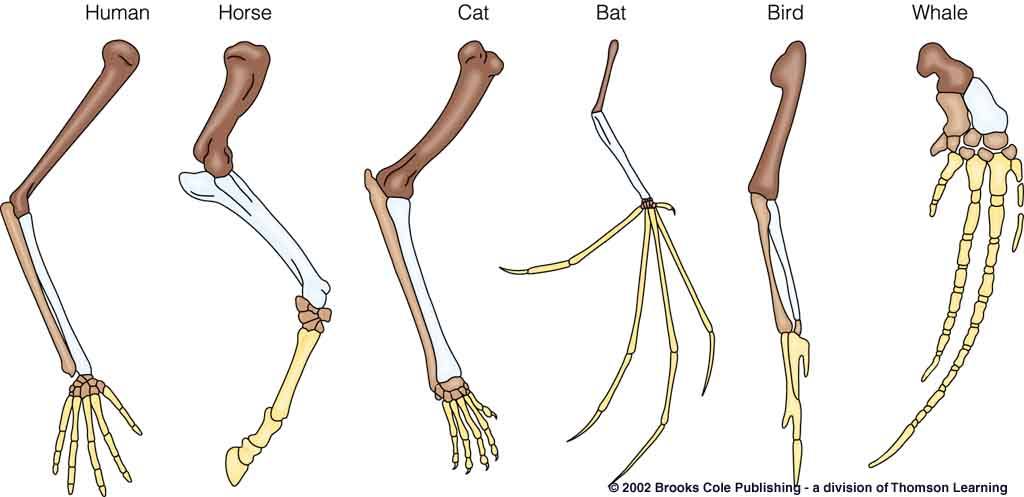
Sometimes bones in the front limbs of animals are very similar in structure. What do we call similar bone structures that indicate a link to a common ancestor?
Adaptations
Gradualism
Homologous Structures
Extinction
58
Multiple Choice
59
60
61
62
63
64
65
Multiple Choice
Some organisms of a population of birds are born with extra-long beaks instead of a normal sized beak.
Gene Flow
Natural Selection
Genetic Drift
Mutation
66
Multiple Choice
Recent fossils can be found in upper rock layers. What two scientific ideas does this support?
The law of superposition and the periodic nature of the elements
Cell theory and the theory of evolution
the theory of evolution and the law of superposition
the periodic nature of the elements and cell theory
67
68
Multiple Choice
69
Multiple Choice
Penguin flipper and fish fin
Homologous
Vestigial
Analogous
None of the above
70
Multiple Choice
Evolved from different ancestors, but due to living in similar environments have a similar function.
Homologous structures
Analogous structures
Vestigial structures
All of the above
71
Multiple Choice
Evolved from the same ancestor, but have different functions
Homologous structures
Analogous structures
Vestigial structures
All of the above
72
Multiple Choice
73
Multiple Choice
74
Multiple Choice
75
Multiple Choice
Which is the best evidence for evolution?
old rock layers contain fossils unlike existing organisms
old rock layers contain fossils of complex organisms
new rock layers contain fossils of simple organims
new rock layers contain fossils unlike existing organisms
76
Multiple Choice
When a population sees constant and slow change over time
convergent evolution
gradualism
coevolution
punctuated equilibrium
77
Show answer
Auto Play
Slide 1 / 77
SLIDE

Similar Resources on Wayground
75 questions
Egalitarianism & Solidarity in the Paleolithic Age
Lesson
•
8th Grade
71 questions
HHE 2.2 Energy Transfers
Lesson
•
8th Grade
70 questions
Principal Roots and Irrational Numbers
Lesson
•
7th Grade
74 questions
8.ch2.1-4
Lesson
•
8th Grade
70 questions
Stem and Leaf Plots and Dot Plots
Lesson
•
8th Grade
75 questions
Exponent Properties
Lesson
•
8th - 9th Grade
74 questions
GEM Class: Measurement
Lesson
•
7th - 8th Grade
72 questions
Unit 5: Civil War/ Recon
Lesson
•
8th Grade
Popular Resources on Wayground
15 questions
Fractions on a Number Line
Quiz
•
3rd Grade
14 questions
Boundaries & Healthy Relationships
Lesson
•
6th - 8th Grade
13 questions
SMS Cafeteria Expectations Quiz
Quiz
•
6th - 8th Grade
20 questions
Equivalent Fractions
Quiz
•
3rd Grade
25 questions
Multiplication Facts
Quiz
•
5th Grade
12 questions
SMS Restroom Expectations Quiz
Quiz
•
6th - 8th Grade
20 questions
Main Idea and Details
Quiz
•
5th Grade
10 questions
Pi Day Trivia!
Quiz
•
6th - 9th Grade
Discover more resources for Mathematics
10 questions
Pi Day Trivia!
Quiz
•
6th - 9th Grade
10 questions
Mind the pi : Pi Day Trivia
Lesson
•
6th - 8th Grade
20 questions
Scatter Plots and Line of Best Fit
Quiz
•
8th Grade
20 questions
Graphing Inequalities on a Number Line
Quiz
•
6th - 9th Grade
10 questions
Exploring Basic Probability Concepts
Interactive video
•
6th - 10th Grade
9 questions
U6L7 Quiz Review
Quiz
•
8th Grade
22 questions
Classifying Triangles by Sides and Angles
Quiz
•
6th - 8th Grade
20 questions
Pythagorean Theorem Review
Quiz
•
8th Grade