Transformations Review A2 Edition
Presentation
•
Mathematics
•
7th - 8th Grade
•
Medium
+2
Standards-aligned
Mr. Simpson
Used 4+ times
FREE Resource
5 Slides • 23 Questions
1
2
Multiple Choice
Triangle JVA is dilated with the origin as the center of dilation to create triangle J'V'A'. Which rule best represents the dilation that has been applied to triangle JVA to create triangle J'V'A'?
(x, y) → (x - 3, y - 3)
(x, y) → (x - 4, y - 4)
(x, y) → (1/4x, 1/4y)
(x, y) → (4x, 4y)
3
Multiple Choice
Pentagon PENTA is shown on a coordinate grid. Pentagon PENTA is dilated with the origin as the center of dilation using the rule (x, y) → (5/4x, 5/4y) to create pentagon P'E'N'T'A'. Which statement is true?
Pentagon P'E'N'T'A' is larger than pentagon PENTA, because the scale factor is greater than 1.
Pentagon P'E'N'T'A' is smaller than pentagon PENTA, because the scale factor is less than 1.
Pentagon P'E'N'T'A' is smaller than pentagon PENTA, because the scale factor is greater than 1.
Pentagon P'E'N'T'A' is larger than pentagon PENTA, because the scale factor is less than 1.
4
Multiple Choice
Quadrilateral PQRS is dilated with the origin as the center of dilation to create triangle P'Q'R'S'. Which rule best represents the dilation that has been applied to triangle PQRS to create triangle P'Q'R'S'?
(x, y) → (x + 2, y + 1)
(x, y) → (x − 2, y + 4)
(x, y) → (0.5x, 0.5y)
(x, y) → (2x, 2y)
5
Other Transformations
Translations - moving a shape left, right, up, or down.
Reflections - Flipping a shape over a line of reflection like the x or y axis.
Rotations - Turning a shape either clockwise or counterclockwise.
6
Important
Congruenence and Orientation
Congruence - The shape stays the same size. Only dilations doesn't preserve congruence.
Orientation - The angles of the shapes change directions. Only reflections change orientation.
Remember Dilations change congruence. Orientation changes Reflections.
7
Multiple Choice
Trapezoid DEFG is rotated 180° about the origin to form trapezoid D'E'F'G'. Which statement is true?
The sum of the angle measures of trapezoid DEFG is 180° less than the sum of the angle measures of trapezoid D'E'F'G'.
Trapezoid DEFG is not congruent to trapezoid D'E'F'G'.
The area of trapezoid DEFG is less than the area of trapezoid D'E'F'G'.
The angle measures of trapezoid DEFG are equal to the corresponding angle measures of trapezoid D'E'F'G'.
8
Multiple Choice
Rectangle ABCD is transformed according to the rule (x, y) → (x + 3, y - 6). Which statement is true?
The angle measures of rectangle A'B'C'D' are greater than the corresponding angle measures of rectangle ABCD.
The angle measures of rectangle A'B'C'D' are equal to the corresponding angle measures of rectangle ABCD.
The side lengths of rectangle A'B'C'D' are 3 units longer than the corresponding side lengths of rectangle ABCD.
The side lengths of rectangle A'B'C'D' are 6 units shorter than the side lengths of rectangle ABCD.
9
Multiple Choice
Which representation of a transformation on a coordinate grid does not preserve congruence?
(x, y) → (x + 5, y + 5)
(x, y) → (−x, −y)
(x, y) → (−y, x)
(x, y) → (0.2x, 0.2y)
10
Multiple Choice
A transformation was applied to a figure to create a new figure. Which transformation does not preserve congruence?
A rotation of 180°
A dilation by a scale factor of 3
A translation 4 units up
A reflection across the y-axis
11
Multiple Choice
Quadrilateral DEFG is shown on the coordinate grid. A student reflected the quadrilateral DEFG across the y-axis to create quadrilateral DE'F'G'. Which rule describes this transformation? [diagram]
(x, y) → (−x, −y)
(x, y) → (−x, y)
(x, y) → (−y, x)
(x, y) → (x + 3, y − 3)
12
Multiple Choice
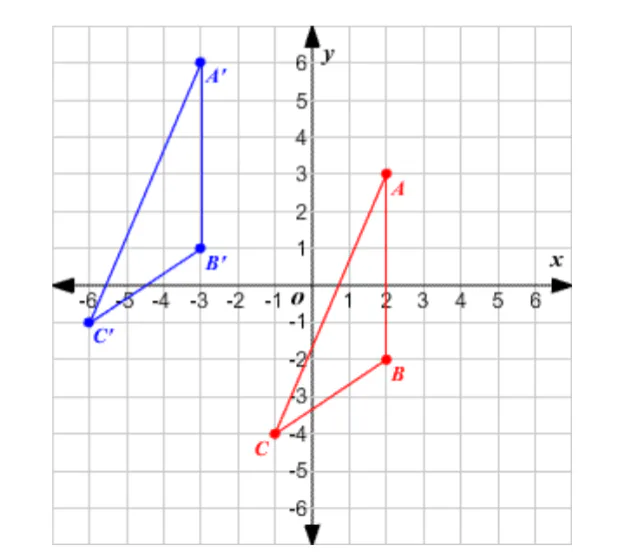
Triangle ABC was translated 5 units to the left and 3 units up to create triangle A'B'C'. Which rule best describes this transformation?
(x,y) → (5x, −3y)
(x,y) → (−5x, 3y)
(x,y) → (x − 5, y + 3)
(x,y) → (x + 5, y + 3)
13
Multiple Choice
Triangle ABC was translated 5 units down and 2 units to the right to create triangle A'B'C'. Which rule best describes this transformation?
(x, y) → (x − 5, y + 2)
(x, y) → (x + 2, y − 5)
(x, y) → (x + 5, x − 2)
(x, y) → (x − 2, y + 5)
14
Multiple Choice
A figure is graphed on a coordinate grid and then rotated 90° counterclockwise. If the center of the original figure was located at (x, y), which ordered pair represents the center of the new figure after the transformation?
(x, y)
(−x, y)
(−y, x)
(y, −x)
15
Multiple Choice
The coordinate grid shows pentagon PENTA. Pentagon PENTA is reflected over the x-axis to create pentagon P'E'N'T'A'. Which rule describes this transformation?
(x, y) → (−x, −y)
(x, y) → (−y, x)
(x, y) → (−x, y)
(x, y) → (x, −y)
16
Multiple Choice
The coordinates of the vertices of a triangle are A(2, 1), B(3, 5), C(7, 0). Triangle ABC is reflected across the x-axis to create triangle A'B'C'. Which rule describes this transformation?
(x, y) → (−x, y)
(x, y) → (x, −y)
(x, y) → (−y, x)
(x, y) → (y, −x)
17
Multiple Choice
Quadrilateral RSTU was translated 5 units to the left. Which rule describes the translation that was applied to triangle RSTU to create R'S'T'U'?
(x, y) → (−5x, y)
(x, y) → (x − 5, y)
(x, y) → (x, −5y)
(x, y) → (x, y − 5)
18
Multiple Choice
A square with a perimeter of 10 units is graphed on a coordinate grid. The square is dilated by a scale factor of 3 with the origin as the center of dilation. If (x, y) represents the location of any point on the original square, which ordered pair represents the coordinates of the corresponding point on the resulting square?
(x + 10, y + 10)
(10x, 10y)
(3x, 3y)
(x + 3, y + 3)
19
Multiple Choice
Quadrilateral DEFG is shown on the coordinate grid. A student rotated the quadrilateral DEFG 180° to create quadrilateral DEFG. Which rule describes this transformation?
A. (x, y) → (−x, −y)
B. (x, y) → (−x, y)
C. (x, y) → (−y, x)
D. (x, y) → (x + 3, y − 3)
20
Multiple Choice
Triangle ABC was reflected over the y-axis to create triangle A'B'C'. Which rule best describes this transformation?
(x, y) → (x, y)
(x, y) → (−x, −y)
(x, y) → (−y, x)
(x, y) → (−x, y)
21
Multiple Choice
Quadrilateral RSTU was translated 3 units to the right and 2 units down. Which rule describes the translation that was applied to triangle RSTU to create R'S'T'U'?
(x, y) → (3x, -2y)
(x, y) → (-2x, 3y)
(x, y) → (x + 3, y - 2)
(x, y) → (x - 2, y + 3)
22
23
Got that?
The perimeter of the shape will increase or decrease by a factor that is the SAME of the scale factor.
Area will increase or decrease by a factor of scale factor squared.
24
Multiple Choice
25
Multiple Choice
26
Multiple Choice
27
Multiple Choice
A scale factor of 2 is used to enlarge the dimensions of a square. What is the effect of this change on the area of the square?
The area will be half as big.
The area will be twice as large.
The area will be 4 times larger.
The area will be 8 times larger.
The area will not change.
28
Multiple Choice
A figure is dilated by a scale factor of 41 . How will the perimeter of the figure be effected?
It will be 41 as larger as the original.
It will be 4 times larger as the original.
It will be 8 times larger as the original.
It will be 161 as larger as the original.
Show answer
Auto Play
Slide 1 / 28
SLIDE

Similar Resources on Wayground
21 questions
Two Step-Equations
Presentation
•
7th Grade
21 questions
Adding & Subtracting LIKE Fractions
Presentation
•
7th Grade
19 questions
Real Numbers
Presentation
•
7th - 8th Grade
21 questions
Using Measures of Center to Draw Inferences
Presentation
•
7th Grade
21 questions
Polygons
Presentation
•
7th Grade
21 questions
Area and Circumference of Circles
Presentation
•
8th Grade
21 questions
8th Grade
Presentation
•
8th Grade
21 questions
One Step Equations
Presentation
•
7th Grade
Popular Resources on Wayground
20 questions
"What is the question asking??" Grades 3-5
Quiz
•
1st - 5th Grade
20 questions
“What is the question asking??” Grades 6-8
Quiz
•
6th - 8th Grade
10 questions
Fire Safety Quiz
Quiz
•
12th Grade
20 questions
Equivalent Fractions
Quiz
•
3rd Grade
34 questions
STAAR Review 6th - 8th grade Reading Part 1
Quiz
•
6th - 8th Grade
20 questions
“What is the question asking??” English I-II
Quiz
•
9th - 12th Grade
20 questions
Main Idea and Details
Quiz
•
5th Grade
47 questions
8th Grade Reading STAAR Ultimate Review!
Quiz
•
8th Grade
Discover more resources for Mathematics
14 questions
Volume of rectangular prisms
Quiz
•
7th Grade
15 questions
Pythagorean Theorem Word Problems Quizizz
Quiz
•
8th Grade
22 questions
Simple Probability
Quiz
•
7th Grade
20 questions
Graphing Inequalities on a Number Line
Quiz
•
6th - 9th Grade
20 questions
Scatter Plots and Line of Best Fit
Quiz
•
8th Grade
20 questions
Pythagorean Theorem Review
Quiz
•
8th Grade
24 questions
7th Grade Math STAAR REVIEW
Quiz
•
7th Grade
12 questions
Simple Probability
Quiz
•
7th Grade