Search Header Logo
Q3W1 KINETIC MOLECULAR MODEL

Q3W1 KINETIC MOLECULAR MODEL

Assessment

Presentation

Chemistry

12th Grade

Practice Problem

Medium

Created by

MERLIE WASAWAS

Used 5+ times

FREE Resource

54 Slides • 26 Questions

1

media

2

Match

Match the ΔEN and the type of bond.

< 0.5

0.5 to 1.9

> 1.9

Nonpolar covalent

Polar covalent

Ionic

3

Categorize

Options (12)

N2

Br

Li

HF

H2O

NH3

CH3COOH

CH3OH

CH3NH2

I2

O2

F2

Categorize the following molecules as polar or non-polar.

Polar
Non-polar

4

Categorize

Options (15)

has dipole

partially positive and negative

CH4

assymetrical geometry

symmetrical geometry

HF

O2

Helium

central atom has lone pairs

central atom has no lone pairs

Cl

Electronegativity difference is >0.5

Electronegativity difference is <0.5

unequal sharing of electrons

equal sharing of electrons

Organize these options into the right categories. Electronegativity difference is <0.5

Polar
Non-polar

5

media

6

media

7

media
media

8

Multiple Choice

What form of energy does an object possesses due to its motion?

1

Chemical energy

2

Electrical energy

3

Kinetic energy

4

Potential energy

9

media

10

media
media

11

media
media

12

media
media

13

media
media

14

media
media

15

media
media

16

media
media

17

media
media
media

18

Multiple Choice

Particle can be atom, molecule or ions.

1

True

2

False

19

Multiple Choice

Particles move in random curve motion.

1

True

2

False

20

Multiple Choice

Gas molecules exert attractive or repulsive forces on each other or the container walls

1

True

2

False

21

Multiple Choice

Collisions between gas particles or collisions with the walls of the container involve loss of energy.

1

True

2

False

22

Multiple Choice

None of the energy of a gas particle is lost when it collides with another particle or with the walls of the container.

1

True

2

False

23

Multiple Choice

The average kinetic energy of a collection of gas particles depends on the temperature of the gas and nothing else.

1

True

2

False

24

Multiple Choice

There is no force of attraction between gas particles or between the particles and the walls of the container.

1

True

2

False

25

media

26

media

27

media

28

media

29

media

30

media

31

media

32

media
media

33

media

34

media

35

media

36

media

37

media

38

media

39

media

40

Match

Match the following IMF.

present in all condensed phases (solid & liquid)

approach of an ion induces a dipole

a polar molecule induces a dipole

between polar molecules

between an ion and a polar molecule

London Dispersion Force

Ion-induced dipole

Dipole-induced dipole

Dipole-dipole

Ion-dipole

41

media

42

media

43

Reorder

Re-order the following intermolecular forces from strongest (1) to weakest (5).

Ion-dipole

Hydrogen bonding

Dipole-dipole

Dipole-induced dipole

London-dispersion forces

1
2
3
4
5

44

media

45

Multiple Select

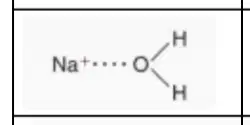
Question image

Select all applicable IMF involved.

1

Ion-dipole

2

London dispersion

3

Dipole-dipole

4

Hydrogen bond

46

Multiple Select

Question image

Select all applicable IMF involved.

1

Ion-dipole

2

London dispersion

3

Dipole-dipole

4

Hydrogen bond

47

Multiple Select

Question image

Select all applicable IMF involved.

1

Ion-dipole

2

London dispersion

3

Dipole-dipole

4

Hydrogen bond

48

Multiple Select

Question image

Select all applicable IMF involved.

1

Ion-dipole

2

London dispersion

3

Dipole-dipole

4

Hydrogen bond

49

media

50

media

51

Multiple Choice

Which of the following has the strongest IMFA?

1

HCl

2

N2

3

NH3

4

NaCl

52

Multiple Choice

Which of the following has the weakest IMFA?

1

HCl

2

N2

3

NH3

4

NaCl

53

media

54

media

55

media

56

media

57

media

58

Multiple Choice

Which of the following defines surface tension?

1

The measure of a fluid’s resistance to flow.

2

The measure of the elastic force in the surface of a liquid.

3

The temperature at which the vapor pressure of a liquid is equal to the external pressure.

4

The pressure exerted by the gas in equilibrium with a liquid in a closed container at a given temperature.

59

media

60

Multiple Choice

How will you characterize the viscosity of a liquid with a strong IMFA?

1

Average

2

High

3

Low

4

None

61

media

62

Multiple Choice

How will you characterize the viscosity of a liquid with a weak IMFA?

1

Average

2

High

3

Low

4

None

63

media
media

64

media
media

65

media
media

66

media

67

Multiple Choice

Which of the following defines vapor pressure?

1

The measure of a fluid’s resistance to flow.

2

The measure of the elastic force in the surface of a liquid.

3

The temperature at which the vapor pressure of a liquid is equal to the external pressure.

4

The pressure exerted by the gas in equilibrium with a liquid in a closed container at a given temperature.

68

media

69

media
media
media

70

media

71

Multiple Choice

Why does oil have a higher boiling point (>200°C) than water (100°C) even though it is non-polar?

1

It has ionic bonding.

2

It has more atoms involved than water.

3

It has a relatively large size of molecules compared to water.

4

All of the above.

72

media
media

73

media

74

media

75

media

76

media

77

media

78

media

79

Multiple Choice

Which of the following is an amorphous solid?

1

Salt

2

Iron

3

Glass

4

Sugar

80

Multiple Choice

The following are examples of amorphous solids EXCEPT

1

Rubber

2

Iron

3

Glass

4

Cotton candy

media

Show answer

Auto Play

Slide 1 / 80

SLIDE