8.11.4-Galaxies & the Universe
Presentation
•
Science
•
8th Grade
•
Easy
+14
Standards-aligned
Jessica Freeman
Used 2+ times
FREE Resource
68 Slides • 72 Questions
1
2
3
4
5
6
7
8
9
This fuzzy band of light in the night skys is the Milky Way, our Galaxy
Galileo discovered that the light in it is actually stars.
10
11
​
​
12
Multiple Choice
If you were to look up at the night sky on a clear night outside of the city you may see this moving across the sky....
The Northern Lights
The Milky Way Galaxy
The Asteroid Belt
13
14
15
16
17
18
19
3 Main Types (based on shape)
- Spiral
- Elliptical
- Irregular
20
21
22
​
23
Multiple Choice
What do scientists believe is at the center of our Milky Way Galaxy?
A wormhole
The Sun
A supermassive black hole
24
Multiple Choice
What is the name of the galaxy we live in?
M38
Milky Way Galaxy
Andromeda Galaxy
25
26
​
27
How does our Solar System move within the Milky Way Galaxy?​
28
​
​
29
Multiple Choice
How are galaxies held together?
Electromagnetism
Love
Gravity
Inertia
30
Multiple Choice
solar systems
universes
galaxies
31
Multiple Choice
Spiral
Elliptical
Irregular
Samsung
32
Multiple Choice
Spiral
Elliptical
Irregular
33
34
Multiple Choice
Spiral
Elliptical
Irregular
35
Multiple Choice
Spiral
Elliptical
Irregular
36
Multiple Choice
Spiral
Elliptical
Irregular
37
Multiple Choice
What type of galaxy is the Milky Way?
Spiral
Elliptical
Irregular
38
Multiple Choice
Spiral
Elliptical
Irregular
39
Multiple Choice
Spiral, Gibbous, and Crescent Galaxies
Spiral Galaxies, Irregular Galaxies, and Elliptical Galaxies
Milky Way, Elliptical Galaxies, and Spiral Galaxies
Milky Way, Samsung Galaxies, and Irregular Galaxies
40
Multiple Choice
The type of galaxy that is composed of the older, low mass, and dwarf stars.
Spiral
Elliptical
Irregular
Constellation
41
Multiple Choice
millions or billions
thousands
hundreds
dozens
42
Match
Match the galaxies.
Irregular
Spiral
Elliptical
A galaxy with no set shape
A galaxy with arms protruding out of the center
A galaxy shaped like a ball
A galaxy with no set shape
A galaxy with arms protruding out of the center
A galaxy shaped like a ball
43
Multiple Choice
Irregular galaxies have a distinct shape
True
False
44
Multiple Choice
What galaxy is the Milky Way?
Irregular
Elliptical
Spiral
45
Multiple Choice
What galaxy is this?
Irregular
Spiral
Elliptical
46
Multiple Choice
What galaxy is this?
Spiral
Irregular
Elliptical
47
Multiple Choice
What galaxy is this?
Elliptical
Irregular
Spiral
48
Multiple Choice
The distance light travels through space in one year is a
space-year
light-year
distance-year
solar-year
49
Multiple Choice
From the choices presented - which is the largest object or structure in space?
Earth
The Sun
The Solar System
The asteroid belt
50
Multiple Choice
The largest single object in the solar system is ______.
Saturn
Jupiter
Earth
The Sun
51
Multiple Choice
It would take a single beam of light about ______ years to travel across the Milky Way.
1 million
10
100,000
1 billion
52
Explanation Slide...
In space, there is no air, so sound has nothing to travel through. If someone were to scream in space, the sound wouldn't even leave their mouths.
53
Explanation Slide...
In space, there is no air, so sound has nothing to travel through. If someone were to scream in space, the sound wouldn't even leave their mouths.
54
Multiple Choice
Why can't anyone hear if you scream in space?
There's no gravity in space
There are no rules in space
There's no air in space
There's no vacuum in space
55
Match
Match the following
Spiral Galaxy
Elliptical Galaxy
Irregular Galaxy
Spiral Galaxy
Elliptical Galaxy
Irregular Galaxy
56
Galaxy Clusters
A group of close together galaxies is known as a galaxy cluster.
There are many of these clusters throughout space.
They seem to occur randomly, sometimes there are lots of clusters in one area, then almost none in others.
57
Irregular Galaxies
As their name suggests, irregular galaxies have no distinct or orderly shape. Many new stars are born in irregular galaxies. This is because these galaxies contain far more gas and dust than elliptical or spiral galaxies.
58
Spinning Galaxies
Since the big bang, galaxies have been moving away from each other. Galaxies move in other ways, too. For example, spiral galaxies spin fast in the center, while their arms spin slower. Many scientists think that several, or perhaps most, galaxies rotate around the enormous gravitational pull of a massive black hole at their center.
59
Black Hole
a region in space where it is theorized that no mass or light can escape
60
The speed of a galaxy
The sun circles the center of the Milky Way at a speed of about a half a million miles an hour. Even at that rate, it takes the sun more than 200 million years to make one complete orbit Opens in modal popup windowaround the center of the galaxy!
61
Holding it all together
How do each of these gigantic galaxies stay clumped together? What keeps everything in the universe from spinning out into space? The law of universal gravitation holds each galaxy together. This same force causes you to return to the ground after you jump into the air. In the next lesson, you will learn more about the force of gravity
62
​Big Bang Theory
63
The Big Bang Theory says that everything in the universe once fit into an incredibly small area. Because this area was very hot, a powerful expansion of energy was created. Everything that was densely packed in the small area went flying out in all directions. In a blink of an eye, this microscopic area expanded into something larger than the Milky Way galaxy.
​
​Within seconds, everything began to cool down. Still expanding, the building blocks of the universe began to form. After millions of years, the universe’s temperature was cool enough to allow galaxies and stars to form. To this very day, the universe is still cooling and expanding.
64
Multiple Choice
The Big Bang Theory suggests that our universe formed as the result of a huge explosion that sent all existing matter flying outward from a single point. The Big Bang Theory is supported by which of these observations?
All matter in the universe is composed of the same atoms.
All galaxies appear to be moving away from all other galaxies.
All stars in the universe are approximately the same age.
The universe is relatively the same temperature in all locations.
65
Multiple Choice
What is happening to the Universe to this day?
The universe is getting smaller and hotter.
The universe is staying the same.
The universe is getting cooler and bigger.
66
​The Big Bang Theory is not the only theory that tries to explain the creation of the universe. However, it the most popular current theory. Scientists have discovered that galaxies are traveling away from Earth. Scientists know this by studying the color of light that the galaxies give off. Light from each galaxy appears to be shifted toward the red end of the electromagnetic spectrum. This means they are traveling away from Earth. This supports the idea of a
great expansion from the Big Bang.
67
Multiple Choice
What does it mean if a galaxy gives off light which has been shifted toward the red end of the electromagnetic spectrum?
The galaxy is much older than Earth.
The galaxy is moving away from Earth.
The galaxy is very hot and has not cooled down yet.
The remnants of an explosion are between the galaxy and Earth.
68
Multiple Choice
True or False:
The Big Bang Theory is the ONLY explanation for the origin of the universe.
True.
False.
69
Another piece of evidence that supports the Big Bang was found when scientists had
launched the Cosmic Background Explorer satellite. It precisely measured the temperature of the Cosmic Microwave Background radiation. Scientists had made temperature predictions based on starting with a hot Big Bang. The satellite found temperatures which matched with the predictions. Scientists believe this radiation is from the energy released during the first year of the Big Bang.
70
​Scientists have estimated that the universe was formed over 13 billion years ago. In 1995,
scientists pointed the Hubble Space Telescope into an area of space that seemed empty.
The telescope collected light for 240 hours. The images that were sent back to Earth were
amazing. Many thousands of galaxies appeared in a space as small as a grain of sand.
​If there are this many galaxies spread evenly through space, there could be over 50 billion galaxies in the universe. The farthest galaxies are over 13 billion light years away. This supports the Big Bang Theory by telling scientists how old our universe is.
71
Multiple Choice
The Big Bang Theory suggests that our universe originated hot long ago?
10 - 20 billion years ago
10 - 20 million years ago
10 - 20 thousand years ago
10 - 20 centuries ago
72
The universe’s creation is still a mystery to scientists. The Big Bang is just one theory that tries to explain the origins of the universe. Exactly how big is the universe? Where is it expanding to? These questions continue to fascinate scientists and non-scientists alike.
STEMSCOPES - 2013 Rice University.
73
Multiple Choice
As part of The Big Bang Theory of the formation of the Universe, scientists believe that over time, the universe is continually changing in what characteristic?
From more dense to less dense.
From rotating to stationary.
From cooler to hotter.
From very large to very small.
74
Multiple Choice
Cosmic Microwave Background Radiation (CMBR) is the term used to describe the residual microwave radiation observed everywhere in the universe that seems to have no single source. The observation of CMBR is used as evidence of The Big Bang Theory because it is believed to be -
The result of collisions between neighboring galaxies.
Particles of dust that have absorbed radioactivity.
Radiation left over from the rapid expansion of matter.
Light energy emitted from the source of The Big Bang.
75
76
77
Multiple Choice
What makes up a planetary system?
Moons & Asteroids
Galaxies & Nebulae
Stars & Planets
Comets & Meteors
78
Multiple Choice
What makes up a Galaxy?
Nebulae; Asteroids & Comets
Planetary System; Stars & Planets
Dark Matter; Supermassive Black Holes
Interstellar Gas & Dust
79
Multiple Choice
What makes up a Universe?
Galaxies; Planetary Systems; & Stars & Planets
Nebulae; Quasars; & Dark Matter
Supernovas; Asteroids; & Comets
Black Holes; Galaxies; & Nebulae
80
81
Multiple Choice
What is the size of a Galaxy based on?
The amount of dust and gas it contains.
The number of stars it contains.
The age of the galaxy.
The distance from other galaxies.
82
83
Multiple Choice
What is the name of the star in our Planetary System?
Moon
Jupiter
Saturn
The Sun.
84
85
86
Multiple Choice
How old is the universe?
13.7 million years old
13.7 billion years old
9.5 million years old
93 billion years old
87
88
89
90
91
Open Ended
How does red-shift support the Big Bang theory?
92
Open Ended
According to the Big Bang Theory, how has the universe changed since the beginning?
93
Doppler Shift!
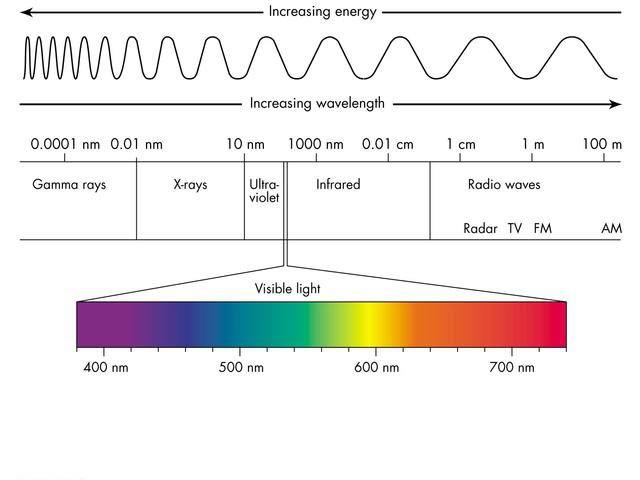
When light from distant objects in the universe shifts (moves) to the red end of the visible specturm, the object is moving away from us
94
Multiple Choice
95
Multiple Choice
As galaxies move away from our galaxy
a shift in the electromagnetic spectrum is noticed. This phenomena is
called _____________.
redshift
blueshift
96
Multiple Choice
What is the correct order of the visible light spectrum starting with the longer wavelength?
Red, yellow, orange, blue, violet, indigo
Violet, indigo, blue, green, yellow, orange, red
Green, yellow, blue, indigo, red, orange
Red, orange, yellow, green, blue, indigo, violet
97
Multiple Choice
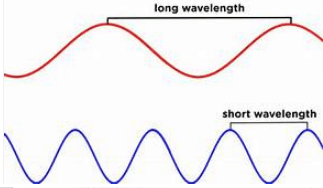
What happens to the wavelengths of energy if they are moving AWAY from a source?
The waves stretch out and get longer.
The waves compress and get shorter.
98
Dark Matter - a Brief Intro
- Something is strange about the spin of many galaxies, going against the laws of Kepler.
- Based on this, it was proposed that a large % of matter within galaxies, including our own, is invisible.
- This matter helps hold galaxies together and effects the movement objects within the galaxy
99
Red Shift!!
Scientists believe the universe is still expanding because distant objects shift in frequency toward RED on the electromagnetic spectrum.
100
Multiple Choice
Word 2:
The farther away a galaxy is from Earth, the faster it is moving
Newton's Law
John's Law
Hubble's Law
Speed Law
101
Hubble's Law!!
If a galaxy is farther away from us, then it is moving at a greater speed.
102
Multiple Choice
Word 3:
A very young star with a core that is not hot enough for fusion to yet take place
Young star
Protostar
Prestar
Old star
103
104
105
Open Ended
What elements are part of this star?
106
The Doppler Effect
Explains how wavelengths of light and sound change when the source is in motion
107
Sound and Light Moving Towards an object
As an object gets closer to another the waves of light or sound shorten
On a spectograph shorter light "shifts" bluer
108
Sound and Light Moving Away From An Object
As an object moves away from another the waves of light or sound lenghthen
On a spectograph longer light "shifts" redder
109
Spectograph
An tool that breaks apart light into it's parts, then records the results.
Our curriculum also calls it the photographic record of light waves.
110
Multiple Choice
As a star moves away the light appears blue
True
False
111
Multiple Choice
The doppler effect causes the pitch of a sound to change as it moves closer
True
False
112
Multiple Select
The doppler effect uses the wavelength of sound or light.
True
False
113
Multiple Select
Scientists can tell how fast a star is moving by the size of the star.
True
False
114
Multiple Choice
A spectograph measures the doppler effect of stars.
true
false
115
Multiple Choice
The doppler effect only uses light.
True
False
116
Galaxies are Moving Away
Using the doppler effect, scientists have seen that most stars are showing a red shift, or moving away . Though there may be some objects in space moving towards our solar system, that is because we are in a space in the universe.
117
118
119
Multiple Choice
When an ambulance move TOWARD you it sounds ________ pitched.
high
low
120
Multiple Choice
When an ambulance move TOWARD you it sounds ________ pitched.
high
low
121
Multiple Choice
The pitch of a sound wave relates to the wave's _________________.
Wavelength
Frequency
122
Multiple Choice
the doppler effect causes a shift in...
pitch
wavelength
frequency
All of the above
123
Multiple Choice
You are standing on the side of the road when a police car races past you with its siren on. After the police car passes you, what happens to the pitch of the siren?
It increases
It decreases
It turns red
124
Multiple Choice
What best describes the doppler effect?
An apparent change in frequency of a wave due to the relative motion between a wave source and an observer
When sound changes pitch
When light changes color
An apparent change in the amplitude of a wave due to the relative motion between a wave source and an observer.
125
Multiple Choice
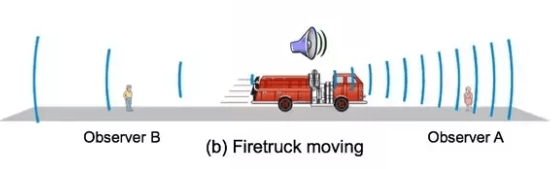
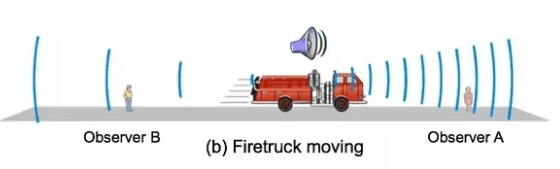
Look at the picture. Who is experiencing a lower pitched sound?
Observer A
Observer B
There is no difference
126
Multiple Choice
Look at the picture. Who is experiencing a higher pitched sound?
Observer A
Observer B
There's no difference
127
128
129
130
131
132
Multiple Choice
When blueshift occurs, the perceived frequency of the wave would...
Increase
Decrease
Stay the same
Make duck sounds
133
Multiple Choice
When redshift occurs, the perceived frequency of the wave would...
Increase
Decrease
Stay the same
Make bird sounds
134
Multiple Choice
The vast majority of galaxies in our universe are moving away from us. We know this because we observe __________ in the galaxies absorption spectra.
Redshift
Blueshift
135
Multiple Choice
If a star is being observed from Earth and it's light has shifted towards the red side of the spectrum it would be...
Moving towards the Earth
Moving away from the Earth
This is a trick question that cannot be answered
It isn't a star, it is a very large blueberry.
136
Multiple Choice
If a star is being observed from Earth and it's light has shifted towards the blue side of the spectrum it would be...
Moving towards the Earth
Moving away from the Earth
This is a trick question that cannot be answered
It isn't a star, it is a very large blueberry.
137
Multiple Choice
Which discovery(ies) came from our understanding redshift/ blueshift?
The universe is expanding
Most galaxies are moving away from us
All of the above
none of the above
138
Multiple Choice
139
Multiple Choice
Use the image to identify the motion of the object relative to Earth. Compare the absorption spectra of the star to what the star would look like if it were not moving at all relative to Earth.
It is not moving relative to Earth
It is moving away from Earth (Redshift)
It is moving towards Earth (Blueshift)
140
Multiple Choice
Light can change color due to the Doppler Effect.
True
False
Show answer
Auto Play
Slide 1 / 140
SLIDE

Similar Resources on Wayground
126 questions
Unit 3 REVIEW Ratios, Proportions, Percent, Interest With Help
Lesson
•
7th Grade
132 questions
Buen Viaje Ch 8
Lesson
•
6th - 8th Grade
131 questions
Spanish: Subject pronouns
Lesson
•
6th - 8th Grade
137 questions
Topic 2.2-Electromagnetic Force-TN Standard: 8.PS2-2-Master
Lesson
•
8th Grade
127 questions
Sight Words
Lesson
•
KG
129 questions
The Rise and Fall of Imperial Japan
Lesson
•
6th - 9th Grade
143 questions
F5 Revision Module Set 1 L27
Lesson
•
9th Grade
133 questions
Untitled Presentation
Lesson
•
7th Grade
Popular Resources on Wayground
15 questions
Fractions on a Number Line
Quiz
•
3rd Grade
14 questions
Boundaries & Healthy Relationships
Lesson
•
6th - 8th Grade
13 questions
SMS Cafeteria Expectations Quiz
Quiz
•
6th - 8th Grade
20 questions
Equivalent Fractions
Quiz
•
3rd Grade
25 questions
Multiplication Facts
Quiz
•
5th Grade
12 questions
SMS Restroom Expectations Quiz
Quiz
•
6th - 8th Grade
20 questions
Main Idea and Details
Quiz
•
5th Grade
10 questions
Pi Day Trivia!
Quiz
•
6th - 9th Grade
Discover more resources for Science
20 questions
Cell Organelles and Functions
Quiz
•
6th - 8th Grade
10 questions
Exploring the Layers of the Earth
Interactive video
•
6th - 10th Grade
21 questions
Waves and Wave Properties
Quiz
•
6th - 8th Grade
20 questions
Newton's Laws of Motion
Quiz
•
8th Grade
20 questions
Heredity Punnett square review
Quiz
•
8th Grade
13 questions
Plate Tectonics and Earth's Structure
Lesson
•
6th - 8th Grade
16 questions
Pedigree
Quiz
•
8th Grade
10 questions
Exploring Heat Transfer: Conduction, Convection, and Radiation
Interactive video
•
6th - 8th Grade