

Space 5th grade

Presentation
•
Science
•
5th Grade
•
Practice Problem
•
Hard
+4
Standards-aligned

Leigha Stone
Used 7+ times
FREE Resource
7 Slides • 0 Questions
1
What is a universe made of ?
The universe is filled with billions of galaxies and trillions of stars, along with nearly uncountable numbers of planets, moons, asteroids, comets and clouds of dust and gas – all swirling in the vastness of space.
But if we zoom in, what are the building blocks of these celestial bodies, and where did they come from?
Hydrogen is the most common element found in the universe, followed by helium; together, they make up nearly all ordinary matter.
2


All of space and time, and everything in it. It’s everything ever!
Universe
A collection of thousands to billions of stars held together by gravity. The galaxy we live in is called the Milky Way.
galaxy
The constant stream of particles and energy emitted by the sun.
solar system
A large body in outer space that circles around the sun or another star.
planet
3
We live on a planet called Earth that is part of our solar system. But where is our solar system? It’s a small part of the Milky Way Galaxy.
A galaxy is a huge collection of gas, dust, and billions of stars and their solar systems. A galaxy is held together by gravity. Our galaxy, the Milky Way, also has a supermassive black hole in the middle.
Create your own black hole!
https://spaceplace.nasa.gov/pinwheel-galaxy/en/
What is a galaxy?

4

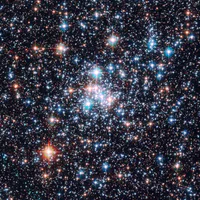


the building blocks of the universe.
Gas is a loose collection of atoms that gather around each other. They gather until they have enough mass to form a star.
gas and dust
Replace this with your body text. Have a nice day. Happy teaching!
stars
A large body in outer space that circles around the sun or another star.
planets
Replace this with your body text. Have a nice day. Happy teaching!A natural object that travels around a bigger natural object. Planets can have moons. Dwarf planets can have moons. Even some asteroids have moons! Astronomers usually call them satellites or natural satellites.
moons
5


-Looks like giant pinwheels. The arms of the pinwheel are made up of stars and lots of gas and dust.
-Young stars burn much hotter than older stars, so spiral galaxies are often some of the brightest in the universe.
-Our home galaxy, the Milky Way, is a very good example of one.
Spiral Galaxy
-Shaped like stretched-out circles, or ellipses
-Contain mostly older stars. That means they often aren't as bright as spiral galaxies
-Largest and most common galaxies observed
Elliptical Galaxy
-Don't have a single common shape.
-Smallest galaxies scientists have observed.
-Very bright.
-Filled with gas, dust, and lots of bright young stars
Irregular Galaxy
6
Telescopes and satellites
https://nasaeclips.arc.nasa.gov/video/launchpad/launchpad-atmosphere-and-optical-telescopes
7
Laser Relay
Can you complete all 5 missions? satellites
https://spaceplace.nasa.gov/relay-laser-communications-game/en/
What is a universe made of ?
The universe is filled with billions of galaxies and trillions of stars, along with nearly uncountable numbers of planets, moons, asteroids, comets and clouds of dust and gas – all swirling in the vastness of space.
But if we zoom in, what are the building blocks of these celestial bodies, and where did they come from?
Hydrogen is the most common element found in the universe, followed by helium; together, they make up nearly all ordinary matter.
Show answer
Auto Play
Slide 1 / 7
SLIDE
Similar Resources on Wayground

6 questions
Types of computers
Presentation
•
4th - 5th Grade
7 questions
9/15 Heat Transfer
Presentation
•
5th Grade
1 questions
Pahlawan Nasional
Presentation
•
5th Grade
7 questions
5TH Grade Science Cat. 1 2021
Presentation
•
5th Grade
6 questions
Matter and Energy Day 5
Presentation
•
5th Grade
6 questions
Weather reports
Presentation
•
5th Grade
6 questions
WALA: BOILING
Presentation
•
5th Grade
8 questions
Asexual Reproduction in Animals
Presentation
•
6th Grade
Popular Resources on Wayground
10 questions
Safety Day 2026 – Student Review

Quiz
•
9th Grade
21 questions
Continents and Oceans
Quiz
•
6th Grade
20 questions
Parts of Speech
Quiz
•
5th Grade
16 questions
Subject & Predicate
Quiz
•
5th Grade
25 questions
Multiplication Facts
Quiz
•
5th Grade
12 questions
Map Skills
Quiz
•
3rd Grade
22 questions
Continents and Oceans
Quiz
•
5th Grade
15 questions
Rounding Decimals
Quiz
•
5th Grade
Discover more resources for Science
20 questions
Mixtures and Solutions Practice
Quiz
•
5th Grade
20 questions
Food Chains and Food Webs Review
Quiz
•
5th Grade
20 questions
GC Interim #1 Review 2026
Quiz
•
5th Grade
20 questions
5.3 Force and Motion Study Guide Review
Quiz
•
5th Grade
15 questions
Force and Motion
Presentation
•
5th Grade
25 questions
Chemical and Physical Changes in Matter
Quiz
•
5th Grade
10 questions
Exploring the Periodic Table Structure

Interactive video
•
5th Grade
14 questions
Land Breeze and Sea Breeze
Quiz
•
5th Grade