
Cell membrane introduction

Presentation
•
Science
•
9th - 12th Grade
•
Practice Problem
•
Hard
+4
Standards-aligned

Heather Glazebrook
Used 6+ times
FREE Resource
16 Slides • 0 Questions
1
Please get the handout labeled:
CELL MEMBRANE OVERVIEW

2

Directions: Follow along and fill out your notes. Answer the questions on your own :)
Please start on this page
3

Balanced internal condition of cells
Also called equilibrium
Maintained by plasma or cell
membrane controlling what enters
& leaves the cell
2
4

Plasma Membrane
The plasma membrane is
the flexible outer layer of
cells.
(inside of cell wall if present)
Has three main jobs:
1.
Separate cells from the
outside
2.
Protect cells from the
environment
3.
Decides what can enter
(or exit) the cell
5

Selective permeability: the ability that
allows some molecules to pass into the
cell while keeping others out
6

>> Check for Understanding
How does a window screen
show selective
permeability?
7

Directions: Use the following slides to help you complete this page. Ask for help if you need it :)
Please flip to this page
8

What are membranes made of?
Membranes are made up of molecules called
phospholipids.
Phosphate
and glycerol
9

What are membranes made of?
Hydrophillic:
Mixes with water
“HATES”
water →
Hydrophobic:
10

What are membranes made of?
To keep their non-
polar tails away
from water,
phospholipids
form a two-sided
layer called a
bilayer.
Water
Water
No Water
11

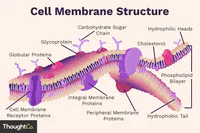
Other Membrane Components
Turns out that the cell membrane is NOT
this simple:
12

Other Membrane Components
There are other parts to the membrane,
including cholesterol, proteins, and
carbohydrates
13

Cholesterol: Holding it Together
Cholesterol is mixed in with the phospholipids
to keep the tails from sticking together.
This gives the cells more stability
14

Transport Proteins: The Doors to
the Cell
Some molecules have trouble crossing the
membrane… Why???
Transport proteins help molecules enter or exit
the cell.
15

Other Parts: Sending Signals
Other proteins and carbohydrates stick out from
the cell; they act as signals for other cells to
read.
16

The Fluid Mosaic Model
The parts of the cell membrane are not held
in place; they flow around the cell like boats
in water. This is called the fluid mosaic
model.
Please get the handout labeled:
CELL MEMBRANE OVERVIEW
Show answer
Auto Play
Slide 1 / 16
SLIDE
Similar Resources on Wayground

14 questions
Balancing Chemical Equations Review
Presentation
•
9th - 12th Grade
13 questions
Energy Pyramid
Presentation
•
9th - 11th Grade
11 questions
Unit 9 - Complex Circuits
Presentation
•
9th - 12th Grade
11 questions
Long & Short Term Goals
Presentation
•
9th - 12th Grade
12 questions
Eutrophication TedED & Doodle Notes Lesson
Presentation
•
9th - 12th Grade
12 questions
Earth Sciences: Weather vs. Climate
Presentation
•
9th - 12th Grade
16 questions
Bioaccumulation vs. Biomagnification
Presentation
•
9th - 12th Grade
11 questions
Origin of Life - Scientific Contributions
Presentation
•
9th - 12th Grade
Popular Resources on Wayground
10 questions
Safety Day 2026 – Student Review

Quiz
•
9th Grade
21 questions
Continents and Oceans
Quiz
•
6th Grade
20 questions
Parts of Speech
Quiz
•
5th Grade
16 questions
Subject & Predicate
Quiz
•
5th Grade
25 questions
Multiplication Facts
Quiz
•
5th Grade
12 questions
Map Skills
Quiz
•
3rd Grade
22 questions
Continents and Oceans
Quiz
•
5th Grade
15 questions
Rounding Decimals
Quiz
•
5th Grade
Discover more resources for Science
10 questions
Exploring Chemical and Physical Changes

Interactive video
•
6th - 10th Grade
20 questions
Atomic Structure
Quiz
•
9th Grade
10 questions
Exploring the Electromagnetic Spectrum for Middle School Science
Interactive video
•
6th - 10th Grade
10 questions
Exploring Force and Motion Concepts
Interactive video
•
6th - 10th Grade
10 questions
Exploring Air Masses and Weather Fronts
Interactive video
•
6th - 10th Grade
14 questions
Periodic Trends
Interactive video
•
11th Grade
10 questions
Exploring the States of Matter
Interactive video
•
6th - 10th Grade
10 questions
Exploring Forces: Net Force, Normal Force, Gravity, and Friction
Interactive video
•
6th - 10th Grade