Search Header Logo
Powers Microscope Lesson

Powers Microscope Lesson

Assessment

Presentation

Biology, Science

9th - 12th Grade

Medium

Created by

Christopher Powers

Used 6+ times

FREE Resource

11 Slides • 10 Questions

1

Microscope Intro

by Lesley Patterson

2

Microscope Lesson/Lab

media

3

Parts of the cell theory

​1. All organisms are made of cells (plants, animals, fungus...)

​2. All cells come from preexisting cells.

​3. Cells are the basic structure of life.

media

4

​People to know...

​-Zaccharias Jensenn

​-Robert Hooke

-Matthias Schleiden

-Anton van Leeuwenhoek

​- Theodor Schwann

​-Rudolph Virchow

5

media

6

7

​The microscope

​Looking at cells and discovering the three parts of the cell theory wouldn't have been possible without the microscope. Cells are too small to see without a microscope.

media

8

Multiple Choice

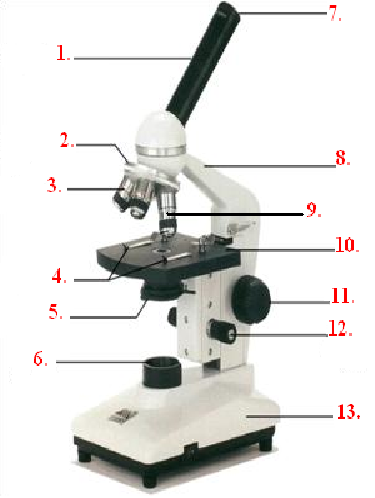
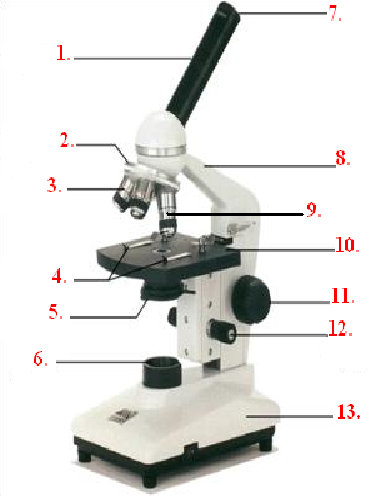
Question image
Number 10
1
Stage
2
Stage Clips
3
Diaphragm
4
Base

9

Multiple Choice

Question image
Number 3
1
Ocular Lens
2
Objective Lens
3
Diaphragm
4
Base

10

Multiple Choice

Question image
Number 5
1
Knob
2
Ocular Lens
3
Diaphragm
4
Objective Lens

11

Multiple Choice

Question image
Number 12
1
Course Adjustment
2
Fine Adjustment
3
Small Adjuster
4
Large Adjuster

12

Multiple Choice

You must carry a microscope with...

1

your nose in the air like you just don't care

2

your hand and your chin

3

two hands, one under the base and one on the top

13

Multiple Choice

To focus a specimen, it is best to start with which objective:

1

high power

2

low power

3

scanning

4

ocular

14

Multiple Choice

When moving to the next higher power objective,

Focus using only the_________ adjustment knob; the object quickly comes into focus with very light adjustment

1

coarse

2

fishy

3

fine

4

crunchy

15

Multiple Choice

Question image
If you move the slide left while viewing, in which direction will it appear to move?
1
right 
2
left
3
up 
4
down

16

media

17

Multiple Choice

Question image
Electron microscopes use a beam of _________________ to produce an image magnified up to 100,000 or more
1
Sunlight
2
Lasers
3
Electrons

18

scanning electron microscope (SEM) is a type of electron microscope that produces images of a sample by scanning the surface with a focused beam of electrons

media

19

The transmission electron microscope is used to view thin specimens (tissue sections, molecules, etc) through which electrons can pass generating a projection image.

media

20

Multiple Choice

Question image

Type of microscope that commonly uses visible light and a system of lenses to magnify images of small objects

1

Electron Microscope

2

Scanning Electron Microscope

3

Transmission Electron Microscope

4

Light Microscope

21

dissecting microscope is used to view three-dimensional objects and larger specimens, with a maximum magnification of 100x

media

Microscope Intro

by Lesley Patterson

Show answer

Auto Play

Slide 1 / 21

SLIDE